

Twenty-eight years ago, a group of neighbors in downtown Tucson, Arizona, led by permaculture designer Brad Lancaster, cut curbs in their neighborhood to let rainwater into the verge, where they guerrilla-planted indigenous flora. These and other crimes made their once-barren neighborhood an urban refuge. Then they put on their lobbying hats; today, Tucson’s government gives financial incentives to do what the scofflaws once did illegally.
When I first moved back to Tucson part-time to find good care for my mother, I met David Walker, a friend of Brad’s with another ambitious vision: Use a huge, extremely destructive weed called buffelgrass — imported from Africa by the USDA and Big Cattle, for feed — to make beautiful adobe housing for the unhoused, while paying them to help build it. He imagined a network of brickyards, sponsored by the city and providing not only money but food, music, community and new skills to people in need, and to anyone.
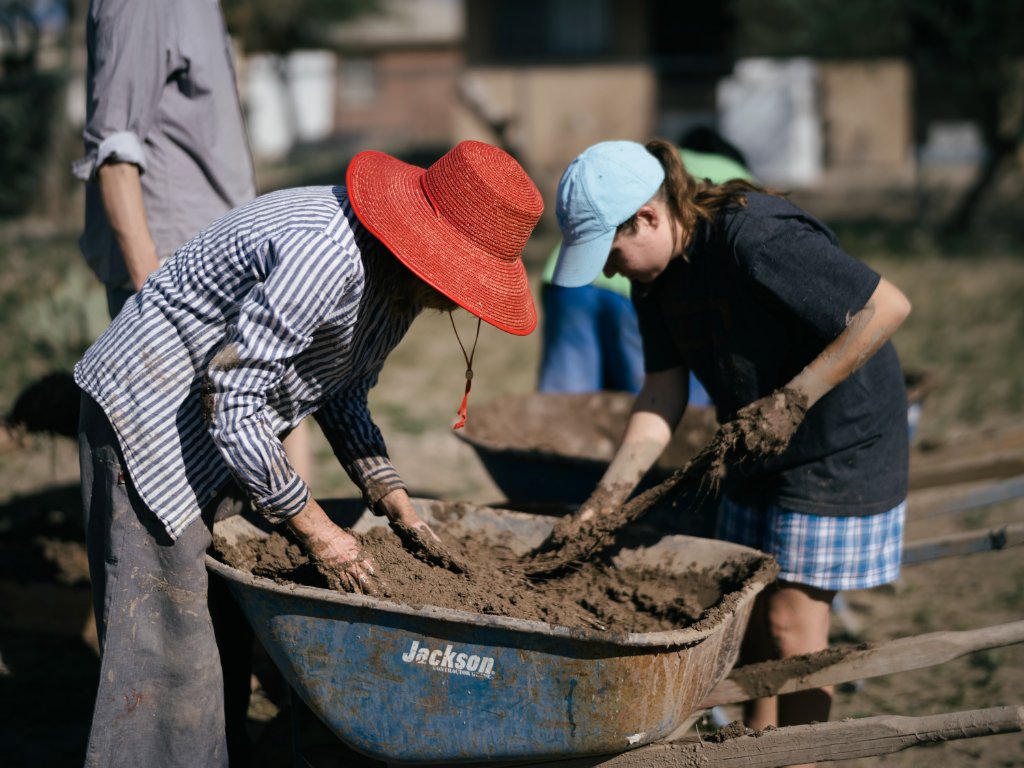
This felt like the best idea I’d ever heard, and once my mother was finally in good hands I helped gather a group of university students and others to start making it a reality. Long story short, today we have a functioning prototype brickyard where volunteers — and, soon, a number of unhoused people paid by a local non-profit — pull buffelgrass, mold it with dirt and water into 4-foot-long bricks, eat freshly cooked food and make friends. We’re working towards five buffelgrass-adobe structures, including a low-income row house and two low-income accessory dwelling units, or ADUs, in backyards volunteered by their owners. This isn’t mutual aid, or not only: Once these pilot projects prove viable, we’ll lobby the city to sponsor this kind of low-income housing at scale, for a fraction of the cost of commercial construction and a whole lot more social, ecological and aesthetic benefit. Never having lobbied before, I don’t know all that’s involved, but several city officials have been very supportive, and Brad has given us a good roadmap.
Escaping the corporate maze
In Tucson, regular people — especially the less privileged — once built their own houses from dirt and plants and water, and could repair them when needed. Then, in the 1960s, the city razed most of downtown, uprooting hundreds of families to make way for a brutalist convention center meant to attract business dollars. Today, what remains of that old adobe neighborhood is one of the most prized parts of the city to live in and homes there command the highest prices. Building adobe structures citywide to serve the unhoused could be a way for the city to make amends for those 1960s-era crimes against people, community and aesthetics.
Buffelgrass-adobe housing would also be an improvement over commercially built shelters, and not only because they’d be cheaper to build and run and a whole lot nicer to live in: The ways corporations make buildings, even “green” ones, ruin natural landscapes, emit massive carbon and fuel a race to the bottom among providers of raw materials.
In other forms of housing for vulnerable populations, it’s the corporate structure itself that’s the source of the problem — but that, too, could be fairly straightforward to fix, at the municipal level at least.
When my mother was diagnosed with dementia and keeping her in her home proved untenable, I found a nearby facility that was part of a statewide chain called The Villas. The place was as stately and manicured as its name suggests, but a host of dysfunctions appeared soon enough: neglect of some residents, conflict between staff and management, and so much turnover that I sometimes couldn’t keep track of who the director was, let alone staff. For want of activities, the TV often served as a caregiver. I visited other facilities that looked just as good, but all clearly had the same problems, or worse: one large branch of Atria Senior Living, with more than a billion dollars of revenues yearly, informed me that they didn’t even have a staff nurse for residents and so couldn’t administer medicines on an as-needed basis, for anxiety or anything else. (Atria did not respond by deadline for a comment request for this piece.)
I finally stumbled onto a large independent facility and was able to settle my mother there. This place is owned by a local couple who built it and now help to run it. They don’t advertise, and the building is unimpressive, but the high-ceilinged inside is airy and bright, with big windows everywhere onto a courtyard that — in contrast to the perfunctory runs of some corporate places — is lush and green, with a path that weaves through three distinct zones. It also has chickens and rabbits, plus one gregarious tortoise named Penelope; the owners know animals are good for those with dementia, and to hell with the small extra cost. Besides the full-time medical staff there is also a full-time activities director and a music director, and the TV stays off except for occasional movie nights. The staff changed little in my mother’s last years, and we both formed valuable bonds with several of them.
Local ownership may not guarantee this kind of quality, but I’ve come to believe that corporate ownership guarantees quite the opposite. The hierarchy required to run a chain of facilities manufactures a kind of psychopathy: People at the top, making decisions for profit, are shielded by layers of management from what their decisions might mean. Local owners, by contrast, must face the results of their decisions; to be as cutthroat as chains they’d need to be actual psychopaths — and luckily that’s pretty rare.
To make eldercare less psychopathic at local levels, we could disincentivize ownership of more than one care facility. Getting good-enough city governments to do this would take lots of legwork, but it would be possible. Just as corporate lobbyists work hard to accomplish their aims — like building water-guzzling data centers in the desert near Tucson, against the city’s wishes — regular people can also lobby and win, as Brad and his cohort proved.
Local change can be deeper change
Back when the Yes Men began in early 2000, we thought the world just needed a few giant tweaks. The final action of our first movie was a fictional mega-tweak: a reform of the World Trade Organization to serve human people instead of big corporate ones. Over the next two decades we never let go of the feeling that change at the top could occur through public pressure, and we communicated that through dozens of actions.
Today, of course, positive change at the federal level is unimaginable in the U.S. At that level, and in some cities and states, progress can only occur through changes in leadership — as has happened in New York City. But in most cities, and many states, the government’s good enough as it is: We just have to use it to fix what’s been broken in better, creative ways. That can also change worlds: Many movements, like women’s suffrage and marriage equality, spread city to city and state to state before changing national policy.
And who knows? The takeover of farming and manufacturing by big corporations destroyed rural economies, creating deep hardship that a tin-pot wannabe dictator turned into false grievances. Maybe building the muscles we need to declare independence from big corporations could not only help us to solve big problems now, but even help prevent future slides into fascism. That’s just theory; what’s certain is that it’s great fun to get our hands dirty.
This story was produced in partnership with The Yes Men substack.
ZNetwork is funded solely through the generosity of its readers.
Donate




