


As the climate crisis escalates, the spotlight is on a potent but often overlooked greenhouse gas: methane. With approximately 1.3 billion tonnes of food wasted annually and 2.6 million tonnes of organic waste per day globally, organic waste contributes to methane emissions. This issue is particularly urgent for Asia and the Pacific, where more than 50% of municipal solid waste is organic, and where proven solutions exist in Asia which need to be scaled up.
Methane is 82.5 times more potent than carbon dioxide over a 20-year period, making it the second largest component of greenhouse gasses and responsible for 30% of global emissions. The Intergovernmental Panel on Climate Change (IPCC) underscores the necessity of reducing greenhouse gas emissions by 45% by 2030 to limit global warming to 1.5°C. Immediate and substantial reductions in methane emissions could achieve a significant impact, reducing expected global warming by nearly 20% by 2045.
The Global Alliance for Incinerator Alternatives (GAIA) Asia Pacific is leading a campaign to mobilize local governments in the region, aiming for at least 70% recovery of organic waste from municipal waste streams by 2030. The campaign has already secured commitments from 50 local governments, all dedicated to developing the necessary policies, infrastructure, and institutional mechanisms.
Composting and organic waste management are crucial strategies for mitigating methane emissions. The Organic Waste Working Group of the India Zero Waste Alliance highlights the potential of decentralized systems to capture organic waste and achieve significant greenhouse gas savings.
Shibu Nair, GAIA Asia Pacific’s Regional Organics Campaigner, emphasized the urgent need to scale up the many proven solutions existing in Asia, “Asia-Pacific has a unique opportunity to lead in organic waste management as a climate solution. By implementing decentralized management systems, and forward linking it with farming, we not only reduce methane emissions but also create enduring, community-based solutions that benefit both the environment and the economy.”
Recognizing the critical role of waste pickers, the Indian Alliance of Waste Pickers has been working to ensure their integration into waste solutions and systems. Nalini Shekar, co-founder and Executive Director of Hasiru Dala, points out, “For a solution to be truly effective and just, it must be sustainable in every way – ecologically, financially, and socially. Decentralized waste management is a powerful tool that meets all of these requirements. By being cost-effective and acknowledging and supporting the vital work of waste pickers, we can improve organic waste recovery and significantly cut methane emissions.”
India’s innovative approaches to organic waste management further illustrate the potential for effective waste strategies. The history of evolution of municipal waste composting in India begins from the Indore composting model in the 1920s to the Bangalore methods of the 1930s and the Coimbatore model in the late 60s, India has led in utilizing organic discards productively. The Nirmal Bharat Abhiyaan and Swachh Bharat Mission has integrated solid waste management with the total sanitation movement and accelerated these efforts with policy, standards, guidelines, and financing for scientific solid waste management across the country.

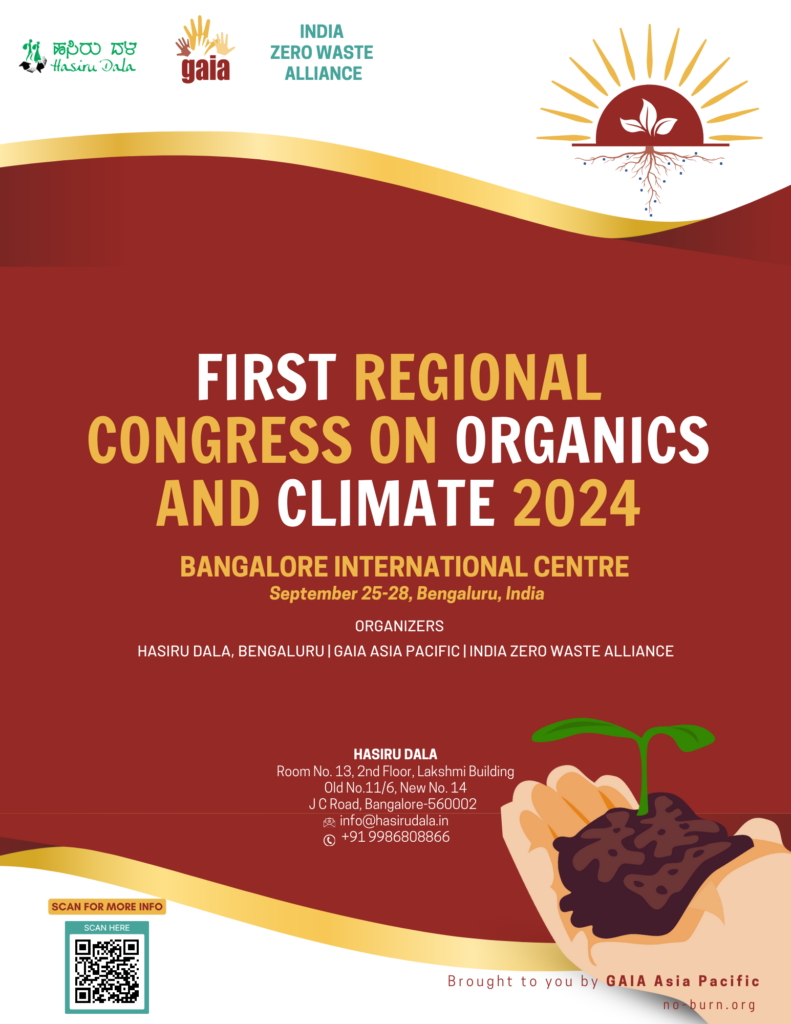
The upcoming Organics Congress, scheduled for September 25-28 at Bengaluru, India, will bring together zero waste practitioners from governments and civil society across the Asia-Pacific region. The event aims to develop a shared strategy and action plan for reducing food waste and enhancing organic waste recovery. Key topics will include the connection between organics, methane, and climate change; policies and legal frameworks; just transition principles; and innovative technologies.
Additionally, the Organics Congress will feature an exhibition of successful organic waste management models and a trade fair showcasing technology vendors and service providers. A guided study tour of organic waste management models in Bengaluru and Mysuru will also be conducted for city officials and delegates.
Join us in tackling climate change with innovative waste management solutions. Register now to be part of the change at the Organics Congress: REGISTER HERE.
Hosted by Hasiru Dala and in collaboration with GAIA Asia Pacific and the India Zero Waste Alliance.
ZNetwork is funded solely through the generosity of its readers.
Donate
