


When Palestinian politicians talk to journalists, a longing for Leon Trotsky suddenly takes hold of me.
If my memory does not fail me, history textbooks recount how, as foreign minister in the first Bolshevik government, Trotsky ordered all the Czarist government's diplomatic correspondence published. How do you fight empires? You reveal what they want to conceal.
True, the Bolsheviks very soon abandoned this subversive approach and became experts at concealment. But there is no gag order on nostalgia, and certainly not against mentioning how wearisome is the talent of Palestinian representatives to be generous with declarations and stingy with information, especially in real time.
In 1994 I still held onto the romantic, yet clearly unrealistic hope that the Palestinians would provide precise details about the process of negotiations with Israeli representatives. I correctly surmised that Israeli military supremacy would be translated into arrogance and extortion and artificial friendliness at the negotiating table. And in my great naivete I hoped that the Palestinians would take the subversive approach by telling the world what was happening, this being one of very few means they have had for undermining the unfair balance of power.
Twenty years have passed, and with a few exceptions the Palestinian approach to reporting on meetings with Israelis and Americans has been characterized by three stages: The first is maintaining secrecy. The second, denying the juicy and detailed Israeli version of events (regardless of how true or untrue those details are).
And the third is releasing the Palestinian version, but only a few months or even years later, by which time, even if the information is accurate and reliable, nobody can remember what it's about (or, if they do, they don't believe it because the Israeli version has so settled into their consciousness).
And so, last Tuesday, at a meeting of journalists and diplomats with Saeb Erekat, the Palestine Liberation Organization's chief negotiator, I once again found myself longing for Trotsky. Erekat spoke at length about how much he wanted the U.S. secretary of state to succeed in his efforts to renew negotiations. But anyone there who had hoped for information about whether and how the Americans are pressuring Palestinian Authority President Mahmoud Abbas to surrender to Western dictates was ultimately disappointed.
Erekat showered us with declarations: "The Israelis suffer from political blindness when they ignore the Palestinians." "The cessation of construction in the settlements is an Israeli commitment in signed agreements, not a Palestinian precondition." "If negotiations are renewed, we have a right to know the Israeli agenda. Is that a precondition?"
These declarations are fine for Radio Palestine and the Palestinian daily Al-Ayyam, not for frenetic and information-hungry media like ours.
And yet that discussion, which by the way took place outdoors, revealed something hidden.
'Canada Park'
Commemorating the 46th anniversary of the June 1967 war, the PLO's negotiations department offered a tour for diplomats and journalists of a piece of Jewish National Fund land – a swathe of young forest and hills with a 2,000-year history. Self-loving Canadian Jews donated money to the institution that redeems land so it could convert a rural Palestinian landscape into a forest, a site for Israelis who like landscapes and hiking. And in honor of the donors, the site was christened "Canada Park."
If you've read this far and feel cheated because you thought we were going to mock the Palestinians – you're right. It's all a trick to write about yet another war crime perpetrated by the Israel Defense Forces in 1967, a war crime which Canada Park-JNF was designed to conceal and bury. The tour was of the Latrun enclave, midway between Jerusalem and Jaffa, on land belonging to three villages that the IDF was unable to conquer and destroy in 1948: Imwas (Emmaus), Beit Nuba and Yalu.
Approximately 5,200 people lived in those three villages on the eve of the war's outbreak, on June 5, 1967. Lacking bomb shelters, some of them hid in nearby caves, others wandered in the direction of Ramallah, and still others remained in their homes – where rifles showed up, with soldiers behind them, ordering them to wander eastward.
Schools, mosques, an ancient church, olive presses, paths to fields and orchards, bubbling streams, mountain air, sabra bushes, carob and olive and deciduous trees, harvested fields, graves, water cisterns.
All this our soldiers saw. And probably the rifles thought to themselves, and the soldiers behind them repeated: How infuriating this rootedness is, how annoying the way the beauty of nature combines with the human touch of non-Jews, how exasperating that this isn't ours.
The magic word "security" was pulled out and before you knew it they brought in the bulldozers and destroyed and detonated and trampled. Not for the first time, not for the last. And the owners of all that beauty – the elderly, the children, the infants – heard and watched the explosions from a kilometer or two away.
When they asked to return after the war, to rebuild their homes, Maj. Gen. Uzi Narkis issued a military order declaring the areas closed. The settlement of Mevo Horon was built on the land of Beit Nuba. Highways were constructed, signs were conveniently posted for hikers, checkpoints were established, a separation fence went up. And the locals are not only unable to return to their land – they aren't even allowed back to see the ruins and to roam among olive trees planted by their grandparents.
The PLO negotiations department wanted to convey a message to the Israelis and the diplomats: The 50 square kilometers of the Latrun enclave are part of the occupied Palestinian state, like East Jerusalem and the Jordan Valley. Do you want a two-state solution? Then these villages will be rehabilitated and their inhabitants will live in them once again.
And incidentally, if you're curious – the Canadian representative in the Palestinian Authority was not invited to the tour.

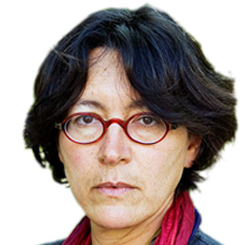
Amira Hass (Hebrew: עמירה הס; born 28 June 1956) is a prominent left-wing Israeli journalist and author, mostly known for her columns in the daily newspaper Ha'aretz. She is particularly recognized for her reporting on Palestinian affairs in the West Bank and Gaza, where she has also lived for a number of years.
ZNetwork is funded solely through the generosity of its readers.
Donate




