


The images of floods and mudslides in Kerala, known as “God’s own country”, should be a wake-up call — we should ask ourselves if we are on a sustainable development path.
In the 1970s deforestation was leading to landslides and floods in what is now Uttarakhand. The women of the mountains banded together as “Chipko” to stop the logging. I became a volunteer in the Chipko movement. After 1978’s devastating floods, the government realised that the small revenues it collected from extractive forestry in the fragile hills were insignificant in the context of the costs of flood destruction.
The Gadgil report on the Western Ghats established that deforestation of fragile catchments, building of too many dams, and construction in flood plains was a recipe for ecological disaster. Add to it climate extremes driven by climate change, and we have the disaster we are now seeing in Kerala.
Every ecological warning was ignored as governments of different parties share the religion of “development” and “growth”. These two words dominate the economic, political, social, cultural discourse. They are amoeba words that can be given whatever shape/meaning the speaker and listener assign to them.
Development is originally a biological, not an economic term. It refers to the auto-poetic evolution of a seed into a plant, an embryo into a person. It refers to self-organised, self-directed, self-evolutionary development. The structure of future forms of development is enfolded in the complex potential of living systems.
“Development” was genetically engineered into an economic/political concept on January 20, 1949 when US President Harry Truman, in his inaugural speech, declared the former Southern Hemisphere colonies drained of their wealth through colonisation as “underdeveloped areas” needed development, which became another term for recolonisation.
From its meaning as self-organised evolution, it became externally imposed economic systems to keep former colonies dependent on the empire, trapped in debt, sources of rents from interest repayments. In a meeting at Bretton Woods in 1944, two years after Mahatma Gandhi gave the “Quit India” call, new institutions like the World Bank and IMF were created to continue the colonial extraction and economic drain. “Development” became the new colonisation to legitimise displacement of tribals from their forests, and farmers from their land.
“Growth” too has its origins in the world of biology and life. Plants grow, children grow. Growth, like development, earlier referred to growth and flourishing of life. “Growth” as GDP was invented to mobilise resources for the war. The definition of growth was based on “if you produce what you consume, you don’t produce”. This was a global assault on local self-provisioning, self-reliant economies, like those for women’s sustenance.
Nature’s amazing cycles of renewal of water and nutrients are defined thus as non-production. The world’s peasants, providing 72 per cent of its food, are defined as unproductive. Women who do most of the work are defined as not working in this paradigm of “growth”.
GDP, or gross domestic product, emerged both as the most powerful number and dominant concept of our times. It is supposed to measure the wealth of nations. Limitless growth is the fantasy of economists, businesses and politicians. It’s seen as a measure of wealth and progress.
It is repeatedly said that to remove poverty, we must have growth. The rich must become super-rich, millionaires become billionaires, so that “growth” can end poverty.
The increase of money flow via GDP is totally disassociated from real value, but those who accumulate financial resources can stake claim on people’s real resources: land and water, forests and seeds. “Hungry” money is predating on the last drop of water, and the last inch of land on the planet. This isn’t an end to poverty, but an end to human rights, justice and ecological security. People are made disposable in a world where money rules and the value of money had replaced human values that lead to sustainability, justice and human dignity.
What growth measures is the super-profits of the one per cent. What it fails to measure is destruction of life in nature and society. The poverty and exclusion of the 99 per cent from the economy of one per cent is linked to the growth paradigm. It’s said the cake must grow bigger so that it can be shared among a larger number. That’s how poverty will be removed in the fundamentalist religion of growth.
But the illusions substituting real wealth and real people are actually making the ecological/material cake shrink. Further, the shrinking cake is being poisoned by processes that create “growth”: another word for profits of the one per cent. A shrinking poisoned cake becomes a cause for increasing poverty, inequality, disease. It’s not an answer to poverty, it’s the cause of both poverty and ecological destruction.
The processes that allow the one per cent to accumulate limitless wealth are those through which they grab resources and livelihoods of people, creating poverty. The creation of extreme poverty and accumulation of extreme wealth is a single interconnected process. England’s increase in wealth during colonialism was linked to the creation of poverty and famines in India. The concentration of wealth in the hands of the one per cent is linked to the planetary crisis, and the crisis of deepening hunger and poverty.
Economic growth hides the poverty it creates, both through destruction of nature, and nature’s ability to provide goods and services, as well as through destroying self-provisioning capacities of societies which Gandhi called “swadeshi”. The manipulation of the economy through GDP needs to be replaced by a development model for the well-being of all life and all people.
That’s why nations like Bhutan have adopted Gross National Happiness instead of Gross National Product to measure well-being. Economists like Joseph Stiglitz and Amartya Sen have admitted GDP doesn’t capture the human condition. Navdanya is working with Bhutan to make a transition to a 100 per cent organic Bhutan, as well as transition from GDP to Gross National Happiness as a measure of socio-economic well-being. Growing organic is growing happiness and well-being for the planet — for farmers as well as for everyone who eats.

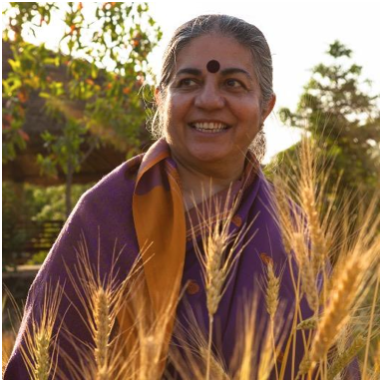
Vandana Shiva (born 5 November 1952) is an Indian scholar, environmental activist, food sovereignty advocate, ecofeminist, and anti-globalisation author. Based in Delhi, she has written more than 20 books. Shiva is one of the leaders and board members of the International Forum on Globalization, and a figure of the anti-globalisation movement. She has argued in favor of many traditional practices, as in her interview in the book Vedic Ecology (Ranchor Prime). She is a member of the scientific committee of the Fundacion IDEAS, Spain's Socialist Party's think tank, a member of the International Organization for a Participatory Society, and the founder of Navdanya, a movement for biodiversity conservation and farmers’ rights. She is also the founder and director of the Research Foundation for Science, Technology and Natural Resource Policy. Shiva fights for changes in the practice and paradigms of agriculture and food. She received the Right Livelihood Award in 1993, an award established by Swedish-German philanthropist Jakob von Uexkull, and regarded as an "Alternative Nobel Prize”.
ZNetwork is funded solely through the generosity of its readers.
Donate




