


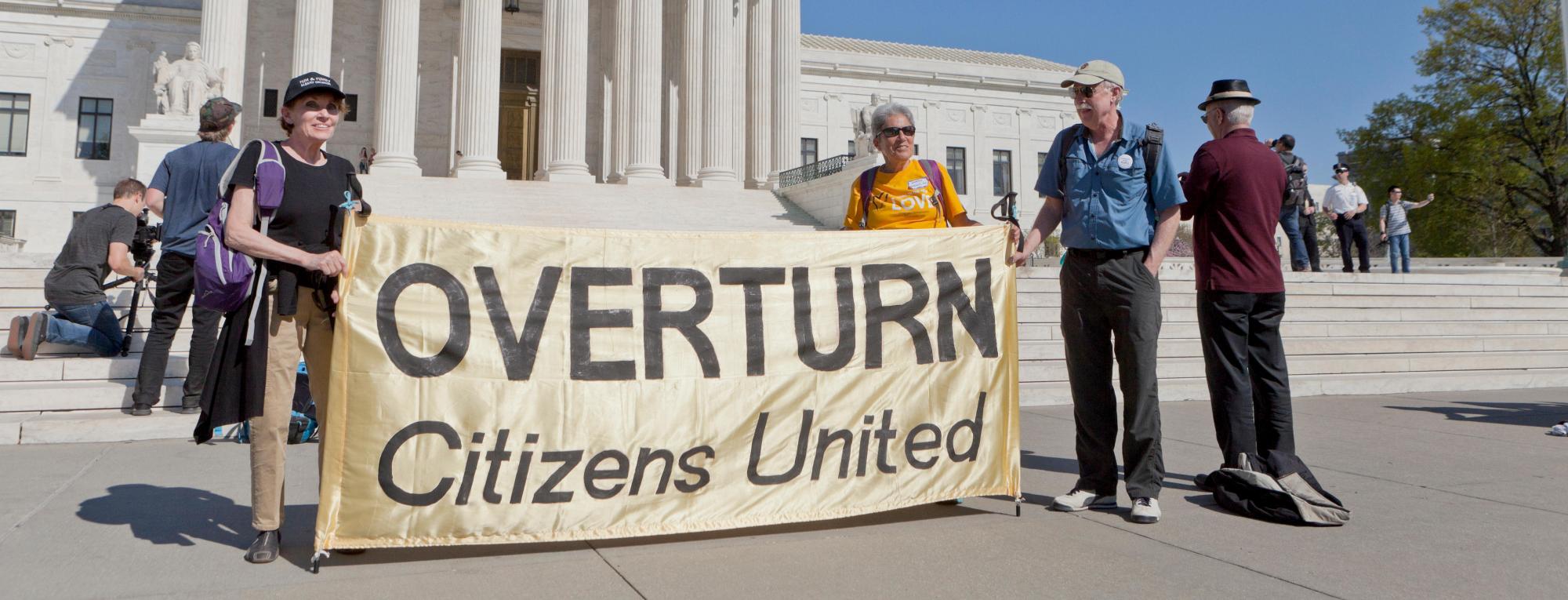
More than 15 years ago, the Supreme Court removed limits on corporate political spending in its notorious Citizens United decision, ushering in an era of unprecedented influence by moneyed interests.
As a result, a small group of ultrawealthy donors have skewed the political system to their advantage — and today, social scientists link the growing gap between rich and poor to that seminal 2010 decision.
Federal attempts to overturn the ruling by amending the U.S. Constitution or legislating against corporate spending have repeatedly failed. But now several states are experimenting with new ways to get this flood of corporate money out of politics.
The state of Hawaii just passed a first-of-its-kind law redefining corporations as entities that aren’t allowed to spend money in elections anywhere within the state. The effort could kick off a powerful state-by-state pushback that succeeds where federal efforts failed.
This simple idea is the brainchild of Tom Moore, senior fellow for democracy policy at the Center for American Progress. “It’s not regulation; it’s redefinition,” Moore told me. “States create corporations, and they give powers to all the corporations that operate within their states.”
So if the federal government and the Supreme Court enable corporations to influence elections, states can counter that merely by changing the definition of a corporation. And that’s precisely what Hawaii did. Effective starting July 2027, corporations doing business in the state are redefined to “not include the power to spend money or contribute anything of value to influence elections or ballot measures.”
The novel approach is well-protected against legal challenges. Moore explained that, “the Supreme Court has said consistently for 200 years that [the power to define corporations] is a matter of state law, that the federal courts don’t have anything to do with that.”
The impact of this on Hawaii’s politics are likely to be monumental. “Basically, in Hawaii politics, local, state, and federal, every dollar that’s spent will be from an individual human being,” said Moore. “It’ll be disclosed, it’ll be voluntary. And that is a gigantic difference from what we have right now.”
Hawaii’s law doesn’t overturn Citizens United — it makes the 2010 ruling meaningless within its borders.
Residents of Montana are pushing a similar effort. Activists there are gathering signatures to place a measure on the November ballot to similarly redefine corporations so they can’t spend money in elections. If the measure passes, it will go into effect in January 2027, six months before Hawaii’s law takes effect.
In fact, according to Moore, Hawaii’s legislators borrowed the language for their bill from Montana’s ballot measure and sped it through their legislative process, pleasantly surprising advocates. Moore is confident the Montana effort will succeed. “They’re in very, very good shape, they’re incredibly well-organized,” he said.
At least 14 states, including New York and California, are currently considering similar bills, and Hawaii’s new law prompted interested lawmakers from two other states to contact Moore. “We’ve had outreach from folks in almost every state,” he said. Given the fact that it’s been less than a year since Moore first published his idea, the speed at which it’s caught on has been remarkable.
Curtailing corporate influence on the political system is essential at a time when corporations are thriving while ordinary Americans struggle to make ends meet. “At the end of the day, corporations don’t actually work for their shareholders, they work for us because we create them through our legislatures, through our laws,” said Moore.
“And if corporations are doing something in our state that we don’t like, we have the power as citizens and working through our legislators to do something about that.”


Sonali Kolhatkar is an award-winning multimedia journalist. She is the founder, host, and executive producer of “Rising Up With Sonali,” a weekly television and radio show that airs on Free Speech TV and Pacifica stations. Her most recent book is Rising Up: The Power of Narrative in Pursuing Racial Justice (City Lights Books, 2023). She is a writing fellow for the Economy for All project at the Independent Media Institute and the racial justice and civil liberties editor at Yes! Magazine. She serves as the co-director of the nonprofit solidarity organization the Afghan Women’s Mission and is a co-author of Bleeding Afghanistan. She also sits on the board of directors of Justice Action Center, an immigrant rights organization.
ZNetwork is funded solely through the generosity of its readers.
Donate




