

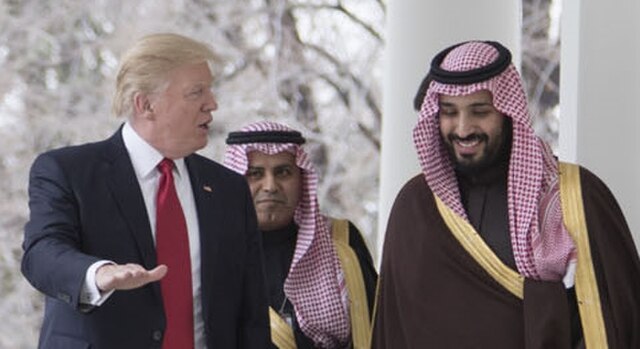
Mohammed bin Salman wants to bring Saudi Arabia into the Abraham accords, the network of agreements to normalise relations between Israel with other countries in the Middle East and, increasingly, beyond. Donald Trump would have enjoyed hearing this when the Saudi crown prince visited the White House on November 18.
It was Trump’s first administration that brokered the initial agreements between Israel and the UAE, Bahrain, Morocco and Sudan in 2020. It’s an achievement that is often trumpeted by his supporters as the key foreign policy win of the US president’s first term in power.
But the Saudi leader’s plan to normalise with Israel comes with a price. He wants to see a “clear path [towards a] two-state solution”, he told reporters as he sat alongside Trump in the Oval Office.
The Abraham accords were the first instance of Arab countries formally recognising Israel since 1994, when Jordan and Israel signed a peace agreement. For Trump, Benjamin Netanyahu and others, the signing of the accords was a diplomatic breakthrough. It would, they believed, usher in a new age of peace and prosperity across the Middle East driven by economic aspirations.
But little substantive progress has been made on securing additional signatories since 2020. And when Kazakhstan announced its plan to join the accords and normalise diplomatic relations with Israel at the start of November, it came as something of an anticlimax.
Rumours had begun to spread about a new signatory – and advocates of the accords were almost certainly hoping for a more high-profile signatory. But the Kazakh move reveals much about the current status of the accords.
Big deal
For Trump and Israel’s prime minister, Benjamin Netanyahu, the accords were a significant move – a major effort to reshape the Middle East. But things have not quite gone according to plan in the five years since the first agreements were signed.
Prior to the terrorist attacks of October 7 2023, there was a growing expectation that Saudi Arabia would soon join the accords. Diplomatic overtures from Israel to Saudi Arabia and vice versa, were built on a form of tacit security collaboration that had long endured between the two states. This collaboration was in part driven by a shared fear of Iranian aspirations across the Middle East.
The apparent threat from Iran was a key driving force behind the accords. The UAE, Bahrain and Israel had all expressed concerns about Tehran’s nefarious activity across the Middle East.
According to US inteligence documents published by Wikileaks, Hamad bin Isa Al Khalifa, the king of Bahrain, had been telling US officials of his desire to normalise with Israel as far back as 2007.
By 2023, however, Saudi Arabia was beginning to see Iran as less of a threat. The two countries had embarked on their own process of normalisation earlier that year. They signed a deal to restore full diplomatic and security ties, an agreement seen by some in the Gulf as an indication that the region was moving towards what one scholar called a “post-American Gulf era”.
The Beijing-mediated agreement pointed to a new way of thinking about regional politics, driven by a desire for a more stable regional security environment shaped by states from the region rather than outside it.
Meanwhile, Hamas’s attack on Israel on October 7 2023 and Israel’s destruction of Gaza halted Saudi overtures to Israel. Since then, Saudi officials have declared that, in order for the kingdom to normalise relations with Israel, the establishment of a Palestinian state with East Jerusalem as its capital is a necessary step.
In the months that followed, Bin Salman was increasingly steadfast in his refusal to normalise relations with Israel without a Palestinian state. In the summer of 2024, he reportedly expressed fears about being assassinated because of normalisation with Israel. He indicated he was still pursuing normalisation, but very publicly linked this aspiration with a requirement for Palestinian statehood.
Reassessing Middle East threats
Israeli policy across the Middle East since the October 7 attacks has also shifted threat perceptions away from Iran. Israel’s strikes on Gaza, Lebanon, Syria, Iran, Qatar, Yemen, Iraq and Tunisia – coupled with raids on sites across the West Bank – have created an increasingly unstable regional security landscape.
The focus is now on deeper inter-regional collaboration. This was emphasised in the way that, in the aftermath of Israeli strikes on Iran, leaders from across the Middle East almost unanimously condemned the attacks.
At the same time, Iran has held discussions with the UAE and Saudi Arabia over an arrangement for a uranium enrichment programme which would ensure that Iran’s programme did not provide a means to developing nuclear weapons.
The words and deeds of Israeli politicians have also angered many. Benjamin Netanyahu has repeatedly spoken of his ongoing efforts to prevent the establishment of a Palestinian state.
Israel’s finance minister Bezalel Smotrich has repeatedly called for the annexation of the West Bank. The national security minister, Itamar Ben-Gvir, has provoked anger and concern across the Muslim world by praying at the site of the al-Aqsa Mosque in Jersualem, violating the agreement that only Muslims should worship there.
There was been little or no progress on the implementation of the second phase of Trump’s 20-point Gaza peace deal – a deal that has no concrete steps towards the establishment of a Palestinian state. When you consider this, and the Israeli political elite’s explicit rejection of a Palestinian state, it feels unlikely there will be any more signatories to the Abraham accords for the foreseeable future.
ZNetwork is funded solely through the generosity of its readers.
Donate




