

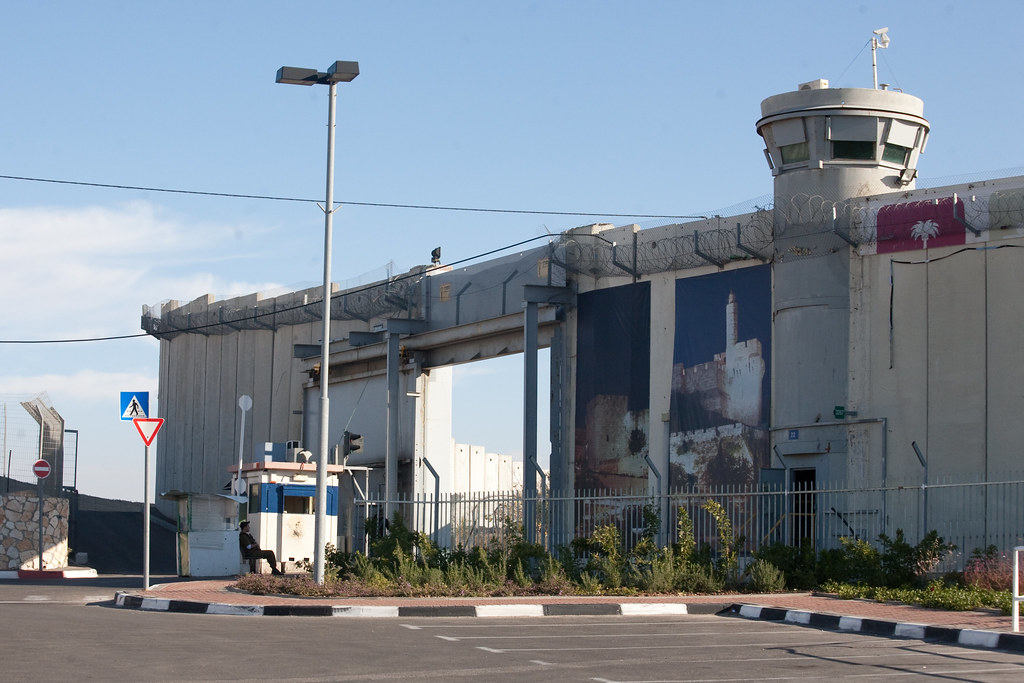
The Israeli military installed an automatic weapon at a heavily-trafficked checkpoint in the occupied West Bank city of al-Khalil in September. While it was initially reported that the weapon will fire a wide range of projectiles, the army now states the device is only capable of firing sponge-tipped bullets. Reiterating the remote-controlled gun will not use live fire, the IDF hopes this system will be used to test approved crowd dispersal methods. But critics assert the device is yet another example of Israel using Palestinians as guinea pigs so they can market their military technology as field-tested to governments around the world.
The weapon was placed at a military checkpoint on Al-Shuhada Street, a once vibrant center of Palestinian life in al-Khalil, but is now recognized as a symbol of Israel’s occupation. After Israeli-American settler Baruch Goldstein gunned down 29 worshipers at the Ibrahimi Mosque in 1994, Israel shut down the busy road and eventually declared it a closed military area where only residents can pass through. According to Issa Amro, an al-Khalil resident and founder of Palestinian activist group Youths Against Settlements, the area is home to 200 families and the checkpoint is used by around 300 families every day.
The army argues this weapon will be used for riot dispersal, given the checkpoint’s history of demonstrations. But Amro says this area is not a security threat. “There is no security need to install this automatic weapon there,” he told MintPress News. “There is no violence. The checkpoint is well-protected with many fences, doors, and gates.”
While the weapon will not shoot live fire, sponge-tipped bullets have proven to be fatal, with several cases of Palestinians being seriously injured (such as Palestinians losing their eyes after being hit by sponge rounds) or killed by these bullets. The Al-Shuhada Street checkpoint has also been the site of several killings of Palestinians by Israeli forces.
Amro, who passes through the checkpoint daily, is concerned about the accuracy and potential failure of this machine technology. “I’m afraid every time I pass [through this checkpoint] that this weapon is pointing at me, pointing at children, or women,” he said. “People are terrified.”
ISRAEL’S SMART SHOOTER WORKING WITH ARMIES AROUND THE WORLD
Palestinians argue the remote-controlled gun has a more sinister intention than the army is letting on. “Israeli security companies use Palestinians as training objects,” Amro said. “The Israeli army practices their new technology [on Palestinians] to check if it’s working or not, then they sell it to other countries.”
Smart Shooter is the company behind the newly-installed weapon. According to its website, the Israeli arms manufacturer uses artificial intelligence, machine learning, and computer vision to turn traditional firearms into smart weapons. The company’s slogan boasts “one shot, one hit”, indicating its target detection capabilities are so precise they’re able to hit moving objects with incredible accuracy.
Currently, Smart Shooter has several agreements with foreign militaries across the world and appears to be expanding its clientele. The firm holds contracts with the Israeli army, the U.S. Department of Defense, the U.S. Marine Corps, the Dutch Army, the Indian Navy, the German Army, and its technology was selected for a NATO Defense Against Terrorism Program of Work exercise in fighting small unmanned aerial vehicles in 2020. The Singaporean Army is also conducting trials of Smart Shooter weapons.
Smart Shooter has been showcasing its technology to new countries as well, including at conferences in the United Arab Emirates, Greece, England, France, Spain, Germany, and Poland. It also has upcoming exhibitions in Australia and the Czech Republic. Additionally, the firm is looking to hire a marketing director to lead business development in India and Central Asia, suggesting that it’s looking to expand its influence in Asia.
Smart Shooter’s executive management is made up of Israeli weapons industry veterans. The company was founded by Michal Mor and Avshalom Ehrlich, who both previously worked at Israeli arms company Rafael Advanced Defense Systems. Rafael created Israel’s infamous Iron Dome air defense system and developed missile technology that has displaced and killed countless Palestinians. Smart Shooter’s vice president of business development, Abraham Mazor, and vice president of research and development, Sharone Aloni, worked at Elbit Systems and the Israeli Air Force before coming to Smart Shooter. Elbit Systems is a major supplier of drones to the Israeli military, works with the Israeli police, and is one of the main providers of the electronic detection fence system to the Apartheid Wall in the West Bank. The company’s vice president and general manager of U.S. operations, Scott Thompson, worked at Israel Aerospace Industries. And Major General Nitsan Alon, who served in the Israeli army for more than 30 years, is also on the company’s board of directors.
PALESTINE AS A SURVEILLANCE TESTING LAB
Israel’s technological advancements have digitized its occupation of Palestine and turned the occupied territories into a testing ground for surveillance, spyware, and arms technologies.
This manifests in a variety of ways and often in collaboration with private companies. Social media behemoths work with the Israeli government to collect user data and censor Palestinian content. Digital monitoring is used at checkpoints and protests, but has been significantly enhanced with the use of facial recognition. The Jerusalem municipality installed around 1,000 cameras able to detect objects, with 10% of the cameras connected to servers that analyze data. Face-scanning cameras are used in al-Khalil to identify Palestinians without checking IDs. Israel’s facial recognition technology was revealed to be even more eerily dystopian with the news of Blue Wolf, a database collecting images of Palestinians’ faces through smartphone technology. Yet Blue Wolf is just one cog in the tech apartheid machine. The smartphone app stems from a larger project entitled Wolf Pack designed to profile every Palestinian in the West Bank with details including their family history, education, and security rating. And the Pegasus software, created by Israeli cybersecurity company NSO group, is another example of Israel piloting surveillance technology on Palestinians before deploying it around the world. In 2021, it was revealed devices belonging to six Palestinian human rights defenders were hacked using Pegasus. Today, at least 45 countries are known to have experienced Pegasus hacks.
With the Israeli military’s stamp of approval, the state’s weapons industry is better able to market its new products to other countries, specifically claiming they are “battle-tested.” For instance, skunk water, a sour-smelling liquid sprayed at protesters as a crowd dispersal technique, was first used in the West Bank village of Bilin, and Elbit’s Hermes-900 drone debuted during Israel’s war on Gaza in 2014. This tried and tested seal has paved the way for Israel to become the world’s eighth-largest arms exporter. And backed by a booming Tel Aviv tech sector, Israel’s weapons business is set to become even more lucrative — all at the cost of Palestinian lives.
ZNetwork is funded solely through the generosity of its readers.
Donate




