


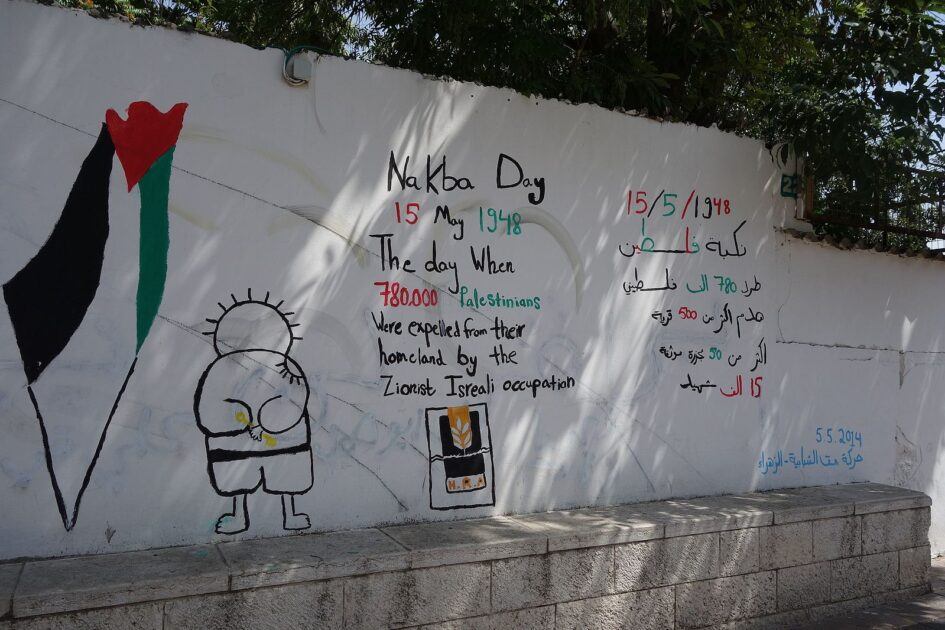
On the 75th anniversary of the Palestinian Nakba, it seems apt to think about how the events of 1948 have shaped not only the history of the Palestinian people, but also their present colonial reality.
For Palestinians, the Nakba is a “ghostly matter” – to use a phrase first introduced by sociology professor Avery Gordon. It has become a psychic force that ceaselessly haunts the present.
Haunting, as Gordon explains, is one of the ways in which oppressive forms of power continue to make themselves known in everyday life.
The Nakba – the displacement of 750,000 Palestinians from their ancestral homes in Palestine and the destruction of 500 villages and towns – is not simply an event that occurred some 75 years ago.
As many Palestinians insist, it is also an ongoing process characterised by lasting forms of state-sanctioned violence. It is something that Zionist forces continue to practise. Indeed, every time a Palestinian is executed by Israeli soldiers or a home that took years to build is demolished, this specific act of violence not only shocks, but also summons the memory of the Nakba.
The permanence of the Nakba was made quite apparent when in February, Jewish vigilantes carried out a pogrom in the Palestinian town of Huwara, and instead of condemning the crime, Israel’s Finance Minister Bezalel Smotrich complained that state forces rather than private citizens should be erasing Palestinian villages.
But the Israeli state’s strategy to create new memories of violence among Palestinians and thus ensure that the Nakba remains a constant presence seems to contradict its official policy of denying it ever occurred.
Israeli officials and pro-Israel activists have repeatedly rejected the term, calling it an “Arab lie” and a “justification for terrorism”. The Israeli authorities have also sought to eradicate any public references to the Nakba.
In 2009, the Israeli Education Ministry banned the use of this word in textbooks for Palestinian children.
In 2011, the Knesset adopted a law prohibiting institutions from holding any events commemorating the Nakba. This law is actually an amendment to the Budget Foundation Law, and conflates any ceremony marking the Nakba – in say, a public high school in Nazareth – with incitement to racism, violence and terrorism and the rejection of Israel as a Jewish and democratic state.
In other words, the Israeli state considers the Palestinian effort to consciously mark and preserve the Nakba in living memory as extremely dangerous and is consequently determined to penalise anyone who carries out such public ceremonies.
Israel, however, is not really interested in imposing social amnesia about the events of 1948, but rather aims to shape and control Palestinian memory.
The strategy is clear: ensure through daily acts of violence that Palestinians remain haunted by the Nakba, lest they forget what Israel is capable of doing. At the same time, however, the state makes every effort to bar Palestinians from determining how they remember this history in public lest they use forms of commemoration to incite people against colonial rule.
This paradoxical policy – wavering between memory and commemoration, where the first is continuously reproduced and the second is banned – is an essential component of the settler-colonial logic which aims to violently erase the history and geography of the native people in order to justify their displacement and replacement by settlers.
The suppression of the Nakba as an historical event worthy of commemoration is part of Israel’s effort to invert the history of colonial dispossession. Israel’s fear is that Nakba ceremonies will undermine the Zionist narrative that presents Jewish settlers as perpetual victims of Palestinian violence and reveal, instead, the horrific forms of violence that Zionist forces deployed in 1948 and are still deploying to achieve their goal.
In other words, Israel also aims to control the narration of history to advance the Zionist moral framework.
This objective is, however, destined to fail. Israel may prohibit its Palestinian citizens from commemorating the 1948 events in public ceremonies, but for them and their diasporic brethren across the globe, the Nakba is never dead; it is not even past.
For as long as Israel’s objective to eliminate the idea of a Palestinian nation – either through genocide, ethnic cleansing, or the creation of enclaves and ghettos – has not been fully accomplished or, alternatively, fully negated by Palestinians achieving self-determination, the Nakba will continue to serve both as ghostly presence and as a concrete, integral part of Israel’s colonial structure. The Nakba can be transcended only when the settler colonial project reaches an end.


During the first intifada Neve Gordon was the director of Physicians for Human Rights - Israel. He is the co-editor of Torture: Human Rights, Medical Ethics and the Case of Israel, the editor of From the Margins of Globalization: Critical Perspectives on Human Rights and the author of Israel's Occupation, .
ZNetwork is funded solely through the generosity of its readers.
Donate




