

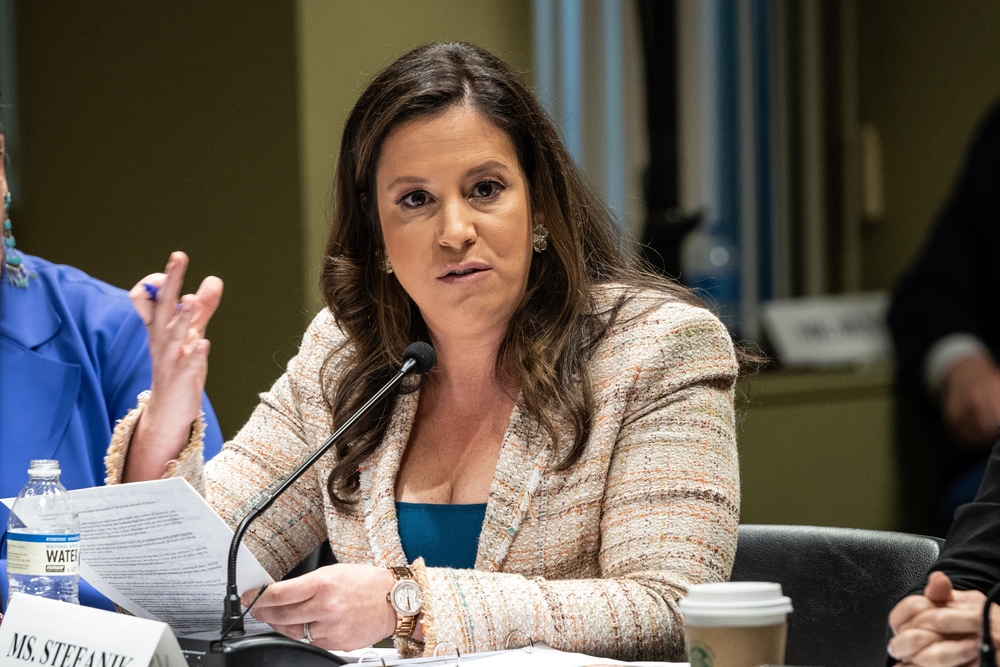
The “New McCarthyism” has been announced so many times that it is at risk of losing real meaning. But the campus “anti-Semitism” investigations being conducted by the U.S. House of Representatives are remarkably reminiscent of the legislative smear campaigns that destroyed thousands of careers and livelihoods across the country during the early Cold War.
While these investigations claim to be concerned with the serious and very real problem of anti-Semitism, they have been led by congressional Republicans who have displayed no interest in exposing the growing anti-Semitism on the right. Their real goal is to discredit constitutionally protected criticism of the Israeli government.
What is McCarthyism?
“McCarthyism” is an indirect form of censorship — when an opinion is not necessarily criminalized, but is so emphatically ostracized that the professional and personal costs of expressing it become almost intolerable. The peak era of McCarthyism — between roughly 1946 and 1956 — was orchestrated by congressional committees in the House of Representatives and the Senate, various state-level copycats, the Federal Bureau of Investigation, the American Chamber of Commerce, the American Legion, the Catholic Church, and, much more reluctantly, the Truman White House.
The targets were varied: Communist Party leaders, civil rights activists who associated with Communists, State Department officials who questioned the wisdom of U.S. support for the losing side in the Chinese Civil War, union leaders, Puerto Rican independence activists, school teachers, and college professors. Some — especially the Communist Party leaders, along with lower-level party members — were criminally prosecuted under the 1940 Smith Act. Others were left unemployed and unemployable after being publicly accused of disloyalty.
Senator Joseph McCarthy himself is not remembered for any legislative achievements, because he didn’t really have any. Instead, he and his like-minded counterparts in the House of Representatives succeeded in creating an atmosphere of widespread conformity and fear primarily through the investigative tools of the U.S. Congress.
These tools are formidable. Congressional committees can demand written or oral testimony from anyone under penalty of a contempt of Congress citation and prosecution, so long as the demand is tied to a “valid legislative purpose.”
Witnesses can, of course, fight congressional subpoenas with their Fifth Amendment privilege against self-incrimination, but prolonged confrontations with Congress — either in Congress or in court — are financially and reputationally damaging, while the U.S. Supreme Court has interpreted Congress’s contempt power very generously.
For a witness, the costs of defiance tend to outweigh the costs of cooperation, including during testimony — when they cannot appeal to a judge when they face an objectionable line of questioning, summon witnesses in their defense, cross-examine the other side, or sue members of Congress for any libelous statements made during a hearing.
Rep. Elise Stefanik: A Fitting Heiress to McCarthy
The far-reaching ability of Congress to compel testimony can be an essential part of the legislative process. But it can also be a license to slander, defame, and intimidate — as the House Committee on Education and the Workforce has been demonstrating in its recent investigations of anti-Semitism on college campuses.
Although the presidents of Harvard, MIT, and the University of Pennsylvania all agreed to testify before the committee voluntarily, they were subsequently subjected to a classic McCarthyite routine by a fitting 21st Century version of Joseph McCarthy: New York Republican Congresswoman, Elise Stefanik.
Stefanik’s political ideology, like McCarthy’s, seems to be rooted in opportunism above all else. Several Jewish politicians and public figures were uneasy about Stefanik’s apparent transformation into a warrior against anti-Semitism in recent weeks given her past willingness to tolerate anti-Semitic tropes within the Republican Party.
Nevertheless, Stefanik has been widely praised for precipitating the resignation of the President of the University of Pennsylvania, Liz Magill, on December 9. In response to Stefanik’s questions about whether advocacy of genocide against Jews would violate Penn’s code of conduct, Magill said the answer is “context specific.”
This is basically what the First Amendment requires: vague advocacy of an abhorrent idea is constitutionally protected, but when such an idea is put into action or part of a campaign of targeted harassment, it can and should be prohibited.
If the First Amendment were not so strict, some of Stefanik’s colleagues might be in legal trouble — such as Senator Lindsey Graham, who has encouraged Israel to “level” Gaza, or Congressman Max Miller, who has fantasized over turning all of the Palestinian territories into a “parking lot,” or even Democratic Senate Majority Leader Chuck Schumer, who said back in 2010 that the people of Gaza needed to be “economically strangled” until they were forced to recognize that “Israel is here to stay.”
Although President Magill was doing little more than educating Stefanik on the Constitution that the Congresswoman is oath-bound to uphold, Magill was accused of evasiveness and obfuscation, including by a prospective $100 million donor to Penn’s Wharton School of Business, who said he couldn’t in good conscience support an institution that was turning a blind eye to anti-Semitism. After Magill’s resignation, Stefanik promised that the presidents of Harvard and MIT would be next.
No one should be particularly worried about the livelihoods of these college presidents: Magill is returning to the faculty at Penn, tenured, and still very well paid.
Nor should anyone be particularly impressed with their testimony, which included Harvard President Claudine Gay uncritically condemning the use of the term “intifada,” just as she earlier condemned the phrase “from the river to the sea, Palestine will be free.” By accepting the ludicrous assumption that these slogans are inherently either hateful or genocidal, Gay played Stefanik’s game, and gave more ammunition to those who want to discredit advocacy for Palestine. Real martyrs for Palestinian advocacy exist in American academia — such as Professors Norman Finkelstein and Steven Salaita. Liz Magill does not belong in such distinguished company.
Still, the fact that a college president can be forced to resign for failing to publicly defy the First Amendment is not a positive development. Nor is it particularly surprising, given what appears to be an increasingly aggressive campaign against constitutionally protected Palestinian activism on American college campuses — a campaign that has been supported by members of Congress, state governors, the Anti-Defamation League and the Brandeis Center (who jointly called for investigations of Students for Justice in Palestine under the federal material support for terrorism statute), as well as a handful of Big Tech executives.
Thankfully, the First Amendment prohibits the outright criminalization of political activism in this country. But censorship through more devious means is an old and enduring American tradition — one that can only be fought through collective courage, integrity, and defiance on a national scale.
ZNetwork is funded solely through the generosity of its readers.
Donate




