

Republican-led states are asking federal regulators to block the world’s largest investment firm from imposing climate-related financial practices on utilities. While the GOP’s war on so-called “woke finances” has had limited success in stemming the flow of money into clean energy, there’s growing evidence the political pressure could be delaying climate action.
On Wednesday, Republican attorneys general from 17 states filed a motion with the Federal Energy Regulatory Commission asking the agency to stop BlackRock from buying $10 million voting shares in any utility that adopts the firm’s environmental, social and governmental investing priorities—also known as ESG. That acronym has become synonymous with climate-conscious investing, meaning money managers are taking climate change and other sustainability measures into account in their decision-making.
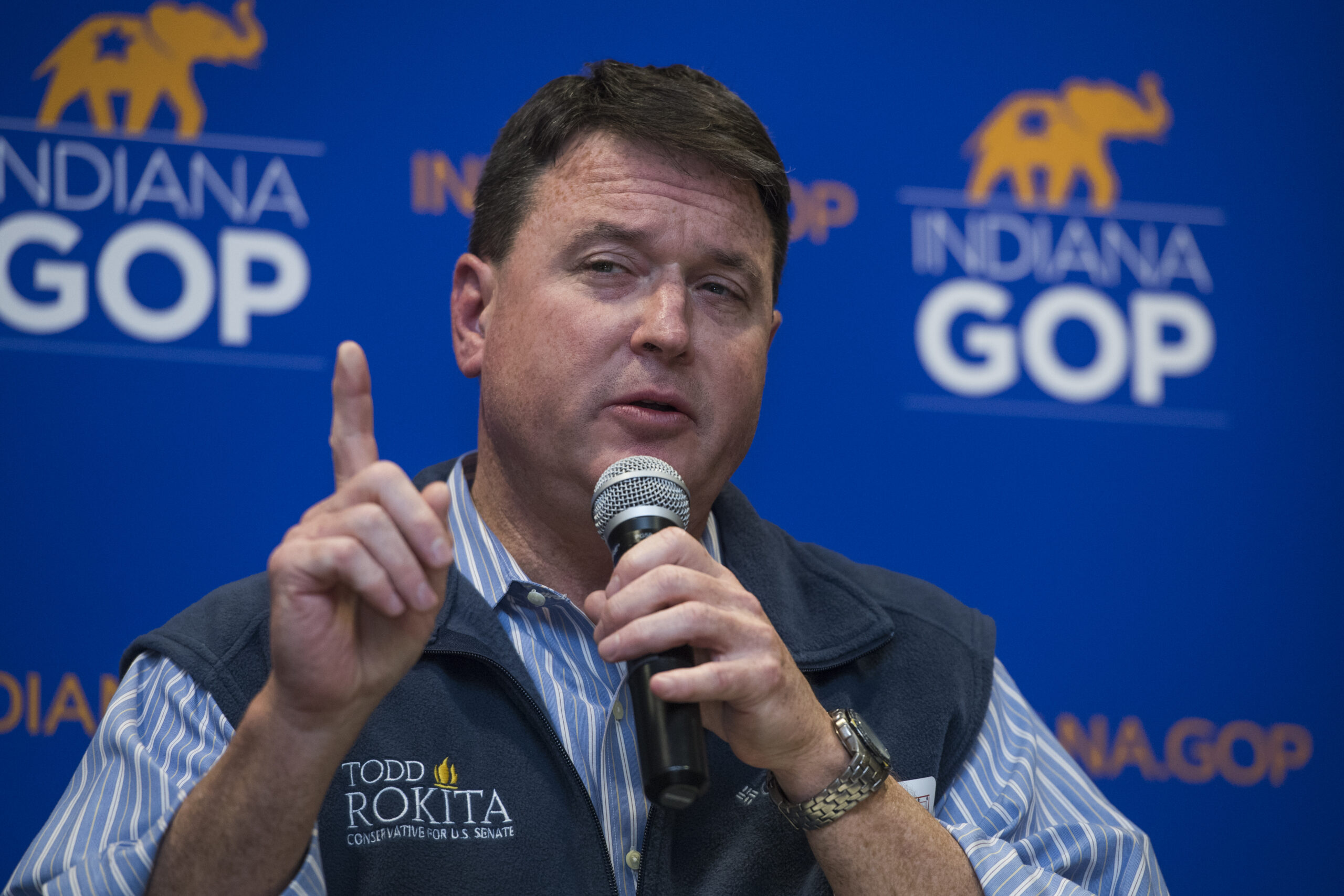
Because the practice inherently devalues fossil fuel companies and other carbon-intensive industries, Republicans have been particularly aggressive critics of the practice. Indiana Attorney General Todd Rokita led Wednesday’s motion, joined by his counterparts from Utah, Alabama, Alaska, Arkansas, Iowa, Kentucky, Louisiana, Mississippi, Missouri, Montana, Nebraska, Ohio, South Carolina, South Dakota, Texas and West Virginia.
“These elitists are trying to impose restrictions on energy companies and utilities that would never win approval at the ballot box,” Rokita said in a press release. “Their schemes could raise utility bills for regular Americans, including elderly Hoosiers on fixed incomes, and they could diminish the value of investment accounts.”
It’s hard to definitively say how much success Republicans have had in their pushback against ESG investing. And climate activists in general are skeptical that the investment practices go far enough to make any real difference in curbing global warming—ESG funds often ignore the massive climate impact of the food and agricultural industry, for example.
But there’s growing evidence that the political pressure from Republicans is confusing the global market, which can spook investors on the fence about climate-related financing and generally slow progress when it comes to diverting money away from fossil fuels and toward renewable energy. That’s a problem, experts say, mostly because society is quickly running out of time to keep rising temperatures below tipping points that, once crossed, could make the climate crisis far more difficult to manage.
The political pressure has prompted Biden administration officials with the Securities and Exchange Commission to consider watering down a new rule that would require large companies operating in the United States to disclose their greenhouse gas emissions and climate-related risks. It has also led to several delays of the rule, which was drafted last spring but has yet to be finalized. In fact, former SEC Commissioner Robert Jackson said in late April, when a final rule was expected to be released, that it could now take until this fall for regulators to put out the final version.
Last month, shareholders also failed by wide margins to pass climate-related resolutions at three of the biggest U.S. banks: Citigroup, Bank of America and Wells Fargo. The resolutions called for the lenders to wind down new fossil fuel financing, but garnered just 10 percent support at Citigroup and 7 percent at Bank of America. Wells Fargo shareholders also failed to pass its proposed resolution, but the exact tally wasn’t disclosed publicly.
“It seems pretty clear that the big banks are going to keep financing fossil-based energy development, even though that is enabling the growing systemic risks and costs that are already hitting us from climate change,” Heidi Welsh, executive director of the Sustainable Investments Institute, told Reuters in reaction to the failed resolutions.
Despite warnings from global economic experts who say any new oil and gas development is incompatible with the world’s climate goals, new reports have shown that banks continue to pump hundreds of billions of dollars into fossil fuel companies, including spending at least $150 billion last year on fossil fuel expansion projects.
That news could be an ominous sign for climate-related resolutions that will be voted on next month at some of the biggest fossil fuel companies, starting with Shell. Activist investors are ramping up pressure on Shell’s shareholders to support the measure.
But investors continue to get conflicting messages, especially from conservative-leaning policymakers in the U.S. On Thursday, Christopher Waller, a governor for the Federal Reserve who was appointed by former President Donald Trump, said there’s no need for central bankers to pay special attention to the risks climate change poses to the global financial system—contradicting major economic reports in recent years that claim the opposite.
Climate-related natural disasters in the U.S. alone caused a staggering $165 billion in damages in 2021, recent government data revealed. And some of the world’s largest financial analysis firms have estimated that without stronger intervention, the impacts of global warming could slash the world’s gross domestic product anywhere from 4 percent to 18 percent by 2050, which translates to trillions of dollars in potential lost revenue.
Waller, however, apparently hasn’t seen those reports.
“Based on what I’ve seen so far, I believe that placing an outsized focus on climate-related risks is not needed,” he said Thursday at a conference in Madrid. “Climate change is real, but I do not believe it poses a serious risk to the safety and soundness of large banks or the financial stability of the United States.”
ZNetwork is funded solely through the generosity of its readers.
Donate




