


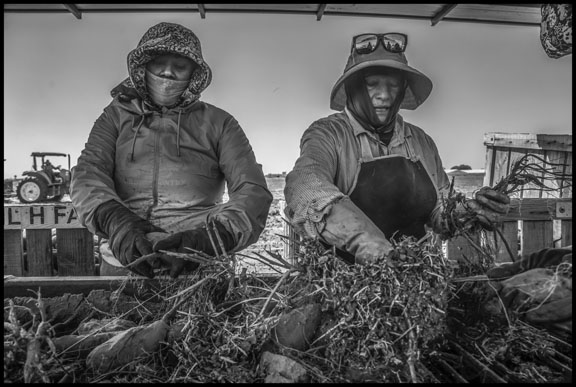
Carmen Hernandez lives in a small home on Chateau Fresno Avenue, one of the three streets that make up Lanare, a tiny unincorporated settlement in the San Joaquin Valley. The street’s name sounds more appropriate to an upscale housing development. In reality it is a potholed tarmac lane leading into the countryside from the highway.
In Lanare live the descendants of its original African American founders, excluded by racial covenants from renting or buying homes in surrounding cities. Here they rub shoulders with their Mexican neighbors – the farmworkers who make up the valley’s agricultural workforce.
Hernandez’s house sits behind a white-painted fence of bricks and wrought iron, and a neat lawn dotted with a few small trees. On the other side of the road are the pistachio trees that make her home almost uninhabitable four times each year.
Just before the nuts are harvested in September, a tractor drags a tank with long arms down the rows, spraying a thick fog of pesticide into the trees. Quickly the chemical travels across the dozen yards between the orchard and Hernandez’s house. During other times of the year, the spray rig lays down weed killer, or a chemical that causes leaves to drop from the branches after harvest. Fertilizer is another evil-smelling chemical the neighbors have to contend with. The families on Chateau Fresno don’t let their kids play outside much anyway, but when the spray is in the air, they make sure to keep them inside.
One might ask, why did Hernandez build a house across the street from such dangers? She didn’t. When Self-Help Enterprises helped Lanare’s low-income families to build homes they’d never otherwise have been able to afford, the field across the street grew cotton or wheat. Those crops also use a lot of chemicals in California’s industrial agriculture system, but when pistachio trees were planted eight years ago, the contamination grew by an order of magnitude.

Carmen Hernandez stands at her front gate on Chateau Fresno Road, across the street from a pistachio grove. Pesticides, fertilizer and dust from the grove drift into her house and yard.
“Why did the state or county let them do this?” Hernandez asks. “They don’t even put up notices to warn us.” She’s asked the tractor driver what the chemicals are, but he doesn’t know. “He doesn’t even know the name of the owner of the orchard. He’s just hired by a labor contractor.”
For farmworkers, Hernandez’s predicament is familiar. PolicyLink’s 2013 study “California Unincorporated: Mapping Disadvantaged Communities in the San Joaquin Valley” found that over 300,000 people live in small, unincorporated communities spread across rural valleys where California’s agricultural wealth is produced. For them, living in a town like Lanare is a double threat to their health. Farm laborers work and live in a chemical soup, a source of interrelated health problems. And because their homes are in remote rural areas, getting adequate health care creates additional obstacles.

Near Lanare the Kings River has gone dry, its water diverted into irrigation canals.
These unincorporated towns, however, are also often organized communities. Grassroots groups deal with the social determinants of health, from air pollution to water scarcity and contamination. Their experience gave them a head start when the pandemic hit. They were often better able to respond to the needs of farmworkers than the government or large health care institutions.
Living in the Chemical Soup
According to the Environmental Protection Agency, the San Joaquin Valley has some of the worst air quality in the United States. One study in BioMed Research International found “Seasonal agricultural workers are exposed to the worst conditions of working groups” and called asthma “an important health problem among seasonal agricultural workers.”
Children living in this environment suffer asthma as well. In the Imperial Valley, one of the poorest counties in California, 12,000 children have asthma, and go to the emergency room for it at twice the rate of the other kids in the state. Residents of that valley’s unincorporated communities, like Seeley and Heber, live in the same proximity to the fields as Carmen Hernandez does in Lanare.
The relationship between illness and chemical contamination is often hard to pin down. Nevertheless, the connection to living in small towns where pesticides, fertilizers and dust are in the air and water seems obvious to many residents.
Rosario Reyes and Wilfredo Navares lived their married lives in Poplar, another small community in the southern San Joaquin Valley surrounded by orchards and grape vineyards. She remembers that when her husband’s doctor told him that he had amyotrophic lateral sclerosis, commonly known as ALS or Lou Gehrig’s disease, the first question she asked was whether he worked in the fields.

Rosario Reyes, widow of Wilfredo Navares, stands in front of the Larry Itliong Resource Center in Poplar, where the couple received food and support during his illness.
“He believed it came from the chemicals he was exposed to during his 31 years as a farmworker,” Reyes says. “He worked with weed killers like Roundup, and there wasn’t much known about it then. He knew the dangers in general, but he had to earn a living. Before he got ALS he never really got any health care.”
As his incurable disease progressed, Navares gradually lost the ability to control the muscles responsible for walking, talking and eating. For two years Reyes couldn’t work. “I had to bathe and dress him like a baby,” she says. At the end, before Navares died, Medi-Cal covered his medical visits. “But with or without it, he would have died just the same.”
Reyes has asthma and diabetes, and got COVID-19 last year. She’s 59, the age when people begin to think of retiring. But Reyes had to go back to work, even though it will likely prejudice her health. “I don’t have papers,” she explains. “Even though we were married, they won’t give me his Social Security.”
How Many, and How Unequal?
Farmworkers looking for environmental solutions and better health care first confront a major problem. The state doesn’t really know how many people make their living from agricultural labor in California.
According to researcher Ed Kissam, “population estimates in the American Community Survey that determine the allocation of federal and state funding for more than 300 programs are very low.” The ACS, he added, is a long survey that only one-third of the households in farmworker communities answer. While Kissam said it shows about 350,000 agricultural workers in California, Zachariah Rutledge of Michigan State University reported an annual average of 882,000 California farmworkers between 2018 and 2021. About 550,000 are field workers or processing and packing-shed workers, according to Kissam’s estimate. “This is the low-income, predominantly immigrant, often undocumented Latino population facing barriers to accessing health care,” says Kissam.
Kissam points out that the rural agricultural workforce is very diverse in terms of income and immigration status. “About 300,000 work in the San Joaquin Valley alone,” he says, “and live with another 350,000 family members. Most are long-term settled immigrants, in low-income households that include undocumented immigrants. Their eligibility is compromised for a broad range of social programs because they’re conditioned on immigration status. Almost a quarter of legally authorized farmworkers interviewed in the National Agricultural Workers Survey in California lacked health insurance and almost two-thirds of undocumented farmworkers lacked it.”

Ronaldo Manaay is a disabled farmworker and welder who suffers from advanced diabetes. He is on dialysis awaiting a liver transplant. “I’m scared,” he says. “I don’t know how long I’ll live.”
A study by Kissam in September 2020 showed that COVID-19 cases in 25 farmworker communities overall were about 2.5 times higher than the state average. “Even within Fresno County, farmworker communities are disproportionately impacted – 26.4% – about 2.5 times [above] the county-wide rate.”
Farmworker communities were particularly vulnerable to COVID-19 when the pandemic started, at a much greater rate than people living in urban areas. By August 2020 Tulare County’s COVID-19 infection rate (1.96% of the population infected) was much greater, per capita, than that of large cities like San Francisco or Sacramento.
The per capita income of a county resident was $22,092 in 2020, compared to a U.S. average of $35,384. In unincorporated towns like Poplar and Lanare, poverty forces people to live closer together to share rent and living costs, making social distancing difficult. “The strategy of ‘doubling up’ to afford a place to live is ubiquitous in farmworker communities throughout the San Joaquin Valley,” Kissam says. Traveling to and from the fields in crowded cars or buses also places workers in close proximity.

Poplar resident Antonio Lopez has cirrhosis of the liver, sciatica and problems with his eyes. He shows his recent hernia. “I never ate well,” he says, “but I don’t smoke and don’t drink.” When he began to suffer acute problems eight years ago and couldn’t work, he drove to Mexico for treatment. “Because I didn’t have insurance then, here they’d just throw my papers back at me and send me to another hospital.”
People go to work because they can’t afford not to go. A day without pay can be difficult; a week could be ruinous. “Undocumented farmworkers with mild cases of COVID-19 are also reluctant to self-isolate,” Kissam adds, “because they’re ineligible for both unemployment insurance and CARES Act-funded pandemic assistance. In addition, people worry about the government using personal information for immigrant enforcement.” As a result, Dr. Alicia Riley reported that deaths of people employed in agriculture were about 1.6 times the average in 2020.
The Pandemic Comes to Lanare
In Lanare, the pandemic arrived after years of a crisis affecting the community’s water. The water under Lanare contains arsenic, which occurs naturally in the San Joaquin Valley’s arid, alkaline soil. When residents dug wells, Sam White remembers, county authorities minimized the danger. “We’d complain and they’d tell us to boil the water. They say arsenic cuts your life span by two years,” he says. Indeed, arsenic exposures can cause rashes and even in small doses have been linked to Alzheimer’s. “My mother had all that.”
Connie and Charlie Hammond live in a small house next to the highway. “My mom had a lot of illnesses that I think were connected to arsenic. We’d have to take her to Fresno [28 miles away], although at the end she went to a clinic in Riverdale [4 miles away] before she died.”
Eventually a water treatment plant was built to remove the arsenic, but it only ran for a few months before the local water company went broke. Nearly 40% of Lanare’s residents live below the poverty line and could not pay the bills. They organized Community United in Lanare and finally got the state to step in and dig new wells. After a year, the water was declared free of arsenic, but it smells and leaves a residue on sinks and toilets. Residents say no one will drink it.
Meanwhile the water table keeps dropping. The Hammonds, who moved across the highway a few years ago, had their well go dry. “Our neighbor ran out first, and we helped them. Then ours ran out a month ago,” Connie Hammond says. “Having water would certainly make our health better. We’re fortunate to have kids who bring us water, but not having it causes a lot of stress, especially for seniors like us.”
While fighting for water, Lanare faced the onset of the pandemic and hunger among residents isolated in their homes. Community United in Lanare was already distributing food several times a month when the lockdown began. “We were handing out food to 150 families,” Lanare food bank volunteer Isabel Solorio recalls, “and the number doubled and kept growing. The stores were empty. In Raisin City and Laton [other unincorporated communities], they were afraid and stopped their distributions. We didn’t.”

Connie Hammond receives groceries at a food distribution event held at the Lanare Community Center.
Due to a shortage in protective equipment, Solorio and other women sewed their own masks. “A hundred people got the virus here and three died,” she says. Community United in Lanare asked the Leadership Counsel for Justice and Accountability in Fresno for help because the county was unable to provide adequate testing or vaccinations, says Solorio. They used their relationships with health authorities and elected officials, she adds, to get the state to set up a mobile testing and vaccination station.
“We asked for priority – farmworkers first,” she recalls. “Four or five hundred came the first day. You could tell by their boots they were coming from the fields. We were the first people to give vaccinations, before the local clinics, and we were distributing food at the same time. Since then we must have tested and vaccinated thousands of people.”
Poplar’s Organizing Project
In the summer Poplar is the center of the valley’s oppressive heat, where the temperature soars to over 110 degrees. Almost none of its homes have air conditioning, and swamp coolers, used to chill off, also produce mold. The resulting respiratory problems are complicated by the almond harvest. “There’s dust over everything and in everyone’s lungs,” says Arturo Rodriguez, co-director of the Larry Itliong Resource Center. “It’s hard just to breathe.”

A poultry farm on the outskirts of Lanare. Dust from the poultry sheds blows into the town.
Rodriguez and co-director Mari Perez-Ruiz opened the center on June 15, 2020, and by June 19 they started food distributions. When they had problems getting food from the local food bank, they convinced a county supervisor to give them two pallets of groceries every week from the food he had available.
When the pandemic started, several residents died. “Often three generations live in small houses or trailers where there’s no space to quarantine,” Rodriguez says. “Our harvest season used to last nine months, and now, with growers bringing in more H-2A workers, people living here get only four months of work. Local farmworkers feared not having enough work to feed their families, so they went to work even when they were sick. Often several family members work in the same crew, and they were afraid to report anything to the boss, because then everyone in the family would have to stay home.”
The center got some computers donated and built booths where people could go online to get telehealth advice. “When the pandemic began, the service providers closed. We stayed open,” Perez-Ruiz says. “We were one of the first to provide free testing. We coordinated with Tulare County to do free events, and gave out PPE [personal protective equipment] and clothing with food. We had to push, so we were a little loud. But our first event had 600 families.”

Farmworkers pick oranges in a field near Poplar, in the San Joaquin Valley. Many workers wear facemasks or bandannas as a protection against spreading the coronavirus.
In January 2021 the vaccines came. The center became a site, and has vaccinated over 5,000 people in total, providing test kits and shots at the same time. “We’re an organizing project, and our campaigns are led by the community,” Perez-Ruiz says. “The county spent a hundred thousand dollars, and we only spent a few hundred, but we vaccinated more people.”
Poor But Organized
Unincorporated communities may be poor, but they’re often organized. Those organizations fighting for basic social services like water before the pandemic became vehicles for fighting the virus. The residents and activists involved see a lesson for improving community access to health care generally.
“In Poplar, just to make a doctor’s visit to a clinic in Porterville [12 miles away] you have to give up your whole day,” Rodriguez says. “That’s why Picho [his uncle Wilfredo Navarez] never went. And if the husband has to use the car to get to work, [the wife] and kids can’t go.”
The Larry Itliong Resource Center partnered with Dr. Omar Guzman, a physician who grew up in Woodville, a nearby community, where he returned to practice after medical school. Every month he comes to the center, bringing medical students, in a mobile clinic called Street Medicine. He organizes screenings, brings in mental health professionals and visits encampments of unhoused people on the Tule River. His young colleagues even drive into Visalia, 30 miles away, to pick up baby formula. At the end of clinic day, they gather in the center to talk about the needs of rural communities.
“People I grew up with haven’t seen a doctor in a very long time,” Rodriguez says. “Health care in our communities isn’t proactive. People don’t get regular checkups – [they] just go when there’s an emergency. The infrastructure of healthcare has failed them. So this is a way to change.”
Ed Kissam believes that the model for health care serving small farmworker communities has to be community based. “Community centers are established, widely trusted resources for farmworker families,” he explains. “County/clinic partnerships are very useful in reducing language and access barriers that keep some people, including farmworkers, from being tested and treated.”

A COVID testing station organized by Community United in Lanare.
He argues for a critical assessment of the pandemic’s lessons. “The system was slower in expanding to outlying farmworker communities than in setting up testing sites in urban areas,” he cautions. “Structural factors and social determinants of health have been the primary factors in the virus’ spread. If we look at the real-world dynamics of life in farmworker communities, and respond thoughtfully and innovatively, we can overcome many barriers.”
In Lanare, Isabel Solorio would like to see mobile testing and vaccination clinics become a way to give farmworker families much broader access to care. “We need a clinic bus with all the equipment for everything from mammograms to dentists and optometrists. Our kids are ashamed to say they can’t see in school because they know their parents don’t have money for glasses, so everything is blurry and they fall behind. Why can’t they get free ones here in Lanare and stay in school? And if people can control their asthma with a mobile clinic here, isn’t that a lower cost for the government than ambulances and visits to the emergency room? So the clinic should come to the people instead of people coming to the clinic.”
But service by itself is not enough, she believes. “Why was Lanare prepared when the county wasn’t? When the water stopped, who came to help us? We helped ourselves by learning to organize. That showed us we can change other things too. We pay taxes, and we have a right to survive.”
ZNetwork is funded solely through the generosity of its readers.
Donate

