

Monica Burks has knocked on thousands of doors across low-income neighborhoods in Philadelphia this year to try to turn out midterm election voters, and she’s heard it all. But one recent conversation nearly brought her to tears.
An elderly woman living in North Philadelphia public housing told Burks, a canvasser with a labor union, that nobody had ever come to her door before to ask for her vote.
“People are really glad we’re out here,” said Burks, a 61-year-old hotel worker from West Philly. “And it means something when it’s somebody that knows what they’re going through.”
“People are really glad we’re out here,” said Burks, a 61-year-old hotel worker from West Philly. “And it means something when it’s somebody that knows what they’re going through.”
Burks is a member of Unite Here, a labor union that represents Philadelphia hospitality workers and has one of the city’s most robust get-out-the-vote operations. Democrats are banking on conversations like the one Burks had in North Philadelphia — done thousands of times over — to motivate base voters to turn out in Tuesday’s midterm election.
In the final weekend of the campaign, national leaders of four of the country’s largest labor unions came to Philadelphia to convene with candidates and coordinate a last-minute push to reach voters in the state’s most populous city, a labor stronghold where Democrats have a 7-to-1 voter registration advantage.
Organized labor typically takes a leading role in get-out-the-vote efforts, but the push this year underscores the national role that voter-rich Southeastern Pennsylvania can play — particularly as the Senate race between Democratic Lt. Gov. John Fetterman and Republican Mehmet Oz appears a dead heat and control of the upper chamber is in play.
On Saturday morning, Liz Shuler, president of the AFL-CIO, the largest labor union conglomerate in the country, rallied in South Philadelphia with gubernatorial candidate Josh Shapiro and a bevy of local elected officials who spoke to 150 workers preparing to knock on doors through the city.
“All these important labor leaders, national people, are coming into Pennsylvania because this race is the race,” Shuler said, pointing to the Senate campaign. “And you all are the most important people that will make this victory happen.”
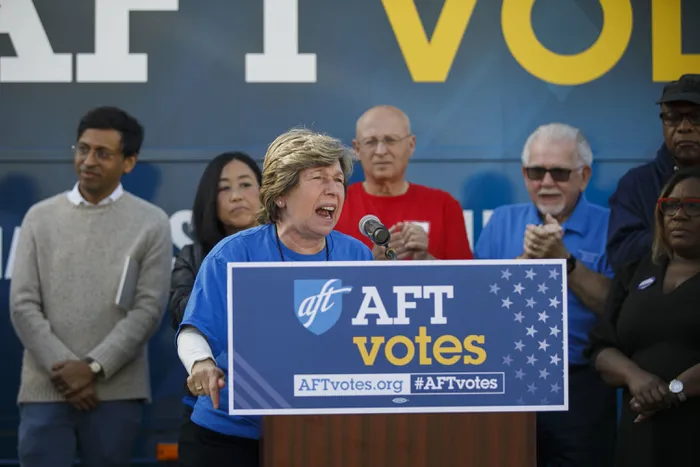
She was joined by Lee Saunders, president of the national union that represents 1.4 million public-sector workers, and Randi Weingarten, president of the American Federation of Teachers, who had appeared at several other events on Friday in Philadelphia and Montgomery County.
The last-minute push to reach voters in the region comes as Democrats, up against already significant headwinds this fall, try to win back working-class voters who they fear are increasingly drifting to the right. Republicans have for years made inroads with white working-class voters, and polls show they’ve become increasingly competitive with Black and brown voters without college degrees.
Even small shifts in a city like Philadelphia — where people of color make up a majority of the city — can swing an election.
“If we don’t get the people in Philadelphia to vote in the numbers we need,” said Philadelphia AFL-CIO President Pat Eiding, “we’re going to lose out on a governor and a senator who care about us.”
Union leaders who back Democrats hope they can excite voters by deploying members to deliver their message and sway those who are considering staying home. Unite Here, for example, has spent months knocking on doors in working-class communities and targeting people who often vote in presidential elections but don’t show up in midterm years.
“So many people have lost faith,” said Rosslyn Wuchinich, president of Unite Here Local 274. “We’re out there to pull people back into the process.”
Similarly, the Philadelphia Federation of Teachers revamped its political operation this year to more specifically target low-income neighborhoods and lean more heavily on door-knocking and one-on-one interactions.
Members have knocked on some 10,000 doors and blanketed neighborhoods with thousands of fliers that compare the education plans of Shapiro and his Republican opponent, State Sen. Doug Mastriano. They’ve sent a combined 60,000 text messages in the last two months, and they’re not automated, meaning they allow for conversation with voters via text.
Jerry Jordan, president of the 13,000-member PFT, said the union “really needed to take a different approach” to emphasize one-on-one conversations between voters and educators who work in their neighborhood schools. They’re having conversations with still-undecided voters, helping residents find their polling place, and directing people to information about mail voting.
Jordan said his members have found that voters trust the teachers they know.
“If you’re an educator in that building, the people in that neighborhood know it, whether they have kids in school or not,” he said. “They can ask questions. And we can answer them.”
ZNetwork is funded solely through the generosity of its readers.
Donate




