


There was a massacre in Jerusalem on Tuesday in which five Israelis were killed. There was a war in Gaza over the summer in which 2,200 Palestinians were killed, most of them civilians. A massacre shocks us; a war, less so. Massacres have culprits; wars don’t. Murder by ax is more appalling than murder by rifle, and far more horrendous than bombing helpless people trying to take shelter.
Terror is always Palestinian, even when hundreds of Palestinian civilians are killed. The name and face of Daniel Tragerman, the Israeli boy killed by mortar fire during Operation Protective Edge, were known throughout the world; even U.S. President Barack Obama knew his name. Can anyone name one child from Gaza among the hundreds killed?
A few hours after the attack in Jerusalem, journalist Emily Amrousi said at a conference in Eilat that the life of a single Jewish child was more important to her than the lives of thousands of Palestinian children. The audience’s response was clearly favorable; I think there was even some applause.
Afterward Amrousi tried to explain that she was referring to the way the Israeli media should cover events, which is only slightly less serious. This was during a discussion on the ridiculous question: “Is the Israeli media leftist?” Almost no one protested Amrousi’s remarks and the session continued as if nothing had happened. Amrousi’s words reflect Israel’s mood in 2014: Only Jewish blood elicits shock.
Israeli deaths touch Israeli hearts more than the deaths of others. That’s natural human solidarity. The bloody images from Jerusalem stunned every Israeli, probably every person.
But this is a society that sanctifies its dead to the point of death-worship, that wears thin the stories of the victims’ lives and deaths, whether it be in a synagogue attack or a Nepal avalanche. It’s a society preoccupied with endless commemorations in the land of monuments, services and anniversary ceremonies; a society that demands shock and condemnation after every attack, when it blames the entire world.
Precisely from such a society is one permitted to demand some attention to the Palestinian blood that is also spilled in vain; some understanding of the other side’s pain, or even a measure of empathy, which in Israel is considered treason.
But this doesn’t happen. Aside from exceptional murders and hate crimes by individuals, there is total apathy — and the obtuseness is frightening. Killings (we dare not say murders) by soldiers and policemen will never shock Israel. The propaganda machine will whitewash everything, and the media will be its mouthpiece. No one will demand condemnations. No one will express shock. Few will even consider that the pain is the same pain, that murder is murder.
How many Israelis are willing to give a thought to the parents of Yousef Shawamreh, the boy who went out to pick wild greens and was killed by an army sniper? Why is it exaggerating to be upset by, or at least give some attention to, the killing of Khalil Anati, a 10-year-old boy from the Al-Fawar refugee camp?
Why can’t we identify with the pain of bereaved father Abd al-Wahab Hammad, whose son was killed in Silwad, or with the Al-Qatari family from the Al-Amari refugee camp, two members of which were killed by soldiers within a month? Why do we reserve our horror for the synagogue and not consider these killings disturbing?
Yes, there is the test of intent. The typical Israeli argument is that soldiers, unlike terrorists, do not intend to kill. If so, then what exactly is the intent of the sniper who fires live bullets at the head or chest of a demonstrator a distance away who poses no threat? Or when he shoots a child in the back as he’s running for his life? Didn’t he intend to kill him?
The attack in Jerusalem was a horrendous crime; nothing can justify it. But the blood that flowed there is not the only blood being spilled here murderously. The degree to which it is forbidden to say that is incredible.

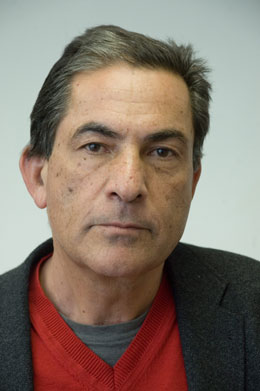
Gideon Levy is a Haaretz columnist and a member of the newspaper's editorial board. Levy joined Haaretz in 1982, and spent four years as the newspaper's deputy editor. He is the author of the weekly Twilight Zone feature, which covers the Israeli occupation in the West Bank and Gaza over the last 25 years, as well as the writer of political editorials for the newspaper. Levy was the recipient of the Euro-Med Journalist Prize for 2008; the Leipzig Freedom Prize in 2001; the Israeli Journalists’ Union Prize in 1997; and The Association of Human Rights in Israel Award for 1996. His new book, The Punishment of Gaza, has just been published by Verso Publishing House in London and New York.
ZNetwork is funded solely through the generosity of its readers.
Donate




