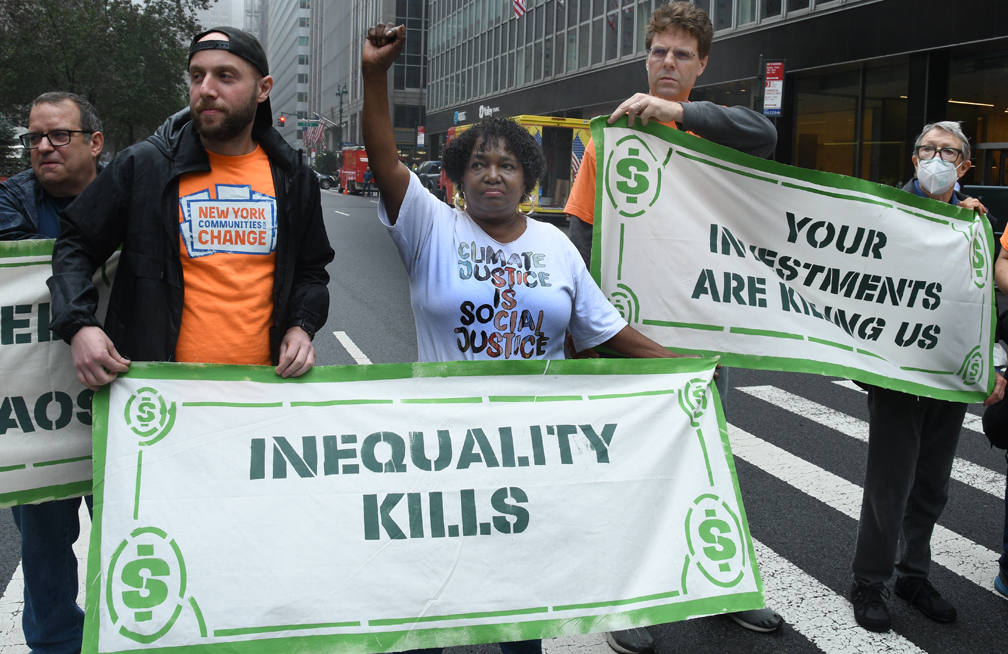
October 28, 2022: Occupy Park Avenue, New York City. (Credit: Diane Greene Lent)
In this episode, I’m joined by economic anthropologist Jason Hickel, author of The Divide: Global Inequality from Conquest to Free Markets (W.W. Norton, 2018), to discuss the complex and interconnected relationship between imperialism—both past and present—and global economic inequality. We examine why mainstream liberal frameworks for understanding the divide between rich and poor countries inevitably fall short, instead presenting an alternative account of global inequality that centers the crucial role of colonial plunder (as well as unequal exchange in the supposedly ‘postcolonial’ era) in keeping vast swaths of the world trapped in conditions of poverty, underdevelopment, and economic dependency.
This article was originally published by Return to Bandung; please consider supporting the original publication, and read the original version at the link above.
Jason Hickel is an author and Professor at the Institute for Environmental Science & Technology (ICTA-UAB) at the Autonomous University of Barcelona. He is also a Visiting Professor at the International Inequalities Institute at the London School of Economics, and a Fellow of the Royal Society of Arts. He serves on the Climate and Macroeconomics Roundtable of the US National Academy of Sciences, the advisory board of the Green New Deal for Europe, the Rodney Commission on Reparations and Redistributive Justice, and the Lancet Commission on Sustainable Health.
Jason's research focuses on political economy, inequality, and ecological economics, which are the subjects of his two most recent books: The Divide: A Brief Guide to Global Inequality and its Solutions (Penguin, 2017), and Less is More: How Degrowth Will Save the World (Penguin, 2020), which was listed by the Financial Times and New Scientist as a book of the year.
Pranay Somayajula is the host of Return to Bandung , an Indian-American writer, researcher, and organizer based in Minneapolis, Minnesota. His work explores themes of diaspora, (inter)nationalism, anticolonial politics, and the many lives and afterlives of empire.
ZNetwork is funded solely through the generosity of its readers.
The Wind Cries Freedom, the new book from Z co-founder Michael Albert, is a sweeping oral history of a future American revolution.
Through thirty interconnected chapters, it draws out the strategies, failures, turning points, and hard-won wisdom of a movement that called itself the Revolutionary Participatory Society. These are not the polished memoirs of politicians: they are the unfiltered accounts of people who organized in neighborhoods, hospitals, universities, stadiums, courthouses, and places of worship, and kept a shared vision alive through cynicism and exhaustion.
The result is speculative political fiction that reads like history: messy, human, and quietly hopeful in the way that only real experience and long thought can produce.
Get your copy and peruse more features on the book’s website below.
“Read it, argue with it, but don’t look away. The future it recalls is one we must still fight to deserve.”
Yanis Varoufakis
“The most unusual and intriguing combination of prophecy, manifesto, and movement building manual that I have ever encountered.”
Bill Fletcher Junior
“This work fills a huge gap in our social movement literature.”
Cynthia Peters
This is your article this month.
We’re glad you keep coming back. If Z’s work has informed, challenged, or inspired you, that’s no accident: there are no paywalls, no ads, and no billionaire owners here, and there never will be. Independent media survives because readers choose to support it.
Billionaires fund their own media. We fund ours. Help us reach 1,000 sustaining donors:
Your reading count is stored only in your browser and is never sent to us.
Sound is muted by default. Tap 🔊 for the full experience
CRITICAL ACTION
Critical Action is a longtime friend of Z and a music and storytelling project grounded in liberation, solidarity, and resistance to authoritarian power. Through music, narrative, and multimedia, the project engages the same political realities and movement traditions that guide and motivate Z’s work.
If this project resonates with you, you can learn more about it and find ways to support the work using the link below.
Independent media is not disappearing because the ideas are weak.
It is disappearing because platforms reward speed, outrage, and algorithmic visibility over thoughtful analysis.
More than 100,000 people read Z every month, free of paywalls, ads, and billionaire owners. It takes fewer than 1 in 100 of them to fund all of it: 1,000 donors who keep Z independent, for everyone, and build what comes next.

