


It goes without saying that what happens in the US has an enormous impact on the rest of the world ‘ and conversely: what happens in the rest of the world cannot fail to have an impact on the US, in several ways. First, it sets constraints on what even the most powerful state can do. And second, it influences the domestic US component of ‘the second superpower,’as the New York Times ruefully described world public opinion after the huge protests before the Iraq invasion. Those protests were a critically important historical event, not only because of their unprecedented scale, but also because it was the first time in hundreds of years of the history of Europe and its North American offshoots that a war was massively protested even before it was officially launched. We may recall, by comparison, the war against South Vietnam launched by JFK in 1962, brutal and barbaric from the outset: bombing, chemical warfare to destroy food crops so as to starve out the civilian support for the indigenous resistance, programs to drive millions of people to virtual concentration camps or urban slums to eliminate its popular base. By the time protests reached a substantial scale, the highly respected and quite hawkish Vietnam specialist and military historian Bernard Fall wondered whether ‘Viet-Nam as a cultural and historic entity’would escape ‘extinction’as ‘the countryside literally dies under the blows of the largest military machine ever unleashed on an area of this size’ ‘ particularly South Vietnam, always the main target of the US assault. And when protest did finally develop, many years too late, it was mostly directed against the peripheral crimes: the extension of the war against the South to the rest of Indochina ‘ hideous crimes, but lesser ones.
It’s quite important to remember how much the world has changed since then ‘ as almost always, not as a result of gifts from benevolent leaders, but through deeply committed popular struggle, far too late in developing, but ultimately effective. One consequence was that the US government could not declare a national emergency, which should have been healthy for the economy, as during World War II when public support was very high. Johnson had to fight a ‘guns-and-butter’war, buying off an unwilling population, harming the economy, ultimately leading the business classes to turn against the war as too costly, after the Tet Offensive of January 1968 showed that it would go on a long time. The memoirs of Hitler’s economic Czar Albert Speer describe a similar problem. The Nazis could not trust their population, and therefore could not fight as disciplined a war as their democratic enemies, possibly affecting the outcome seriously, given their technological lead. There were also concerns among US elites about rising social and political consciousness stimulated by the activism of the ’60s, much of it reaction to the miserable crimes in Indochina, then at last arousing popular indignation. We learn from the last sections of the Pentagon Papers that after the Tet offensive, the military command was reluctant to agree to the President’s call for further troop deployments, wanting to be sure that ‘sufficient forces would still be available for civil disorder control’ in the US, and fearing that escalation might run the risk of ‘provoking a domestic crisis of unprecedented proportions.’
The Reagan administration ‘ the current administration or their immediate mentors — assumed that the problem of an independent aroused population had been overcome, and apparently planned to follow the Kennedy model of the early 1960s in Central America. But they backed off in the face of unanticipated public protest, turning instead to ‘clandestine war’employing murderous security forces and a huge international terror network. The consequences were terrible, but not as bad as B-52s and mass murder operations of the kind that were peaking when John Kerry was deep in the Mekong Delta in the South, by then largely devastated. The popular reaction to even the ‘clandestine war,’so called, broke entirely new ground. The solidarity movements for Central America, now in many parts of the world, are again something new in Western history.
State managers cannot fail to pay attention to such matters. Routinely, a newly elected President requests an intelligence evaluation of the world situation. In 1989, when Bush I took office, a part was leaked. It warned that when attacking ‘much weaker enemies’ the only sensible target ‘ the US must win ‘decisively and rapidly.’Delay might ‘undercut political support,’recognized to be thin, a great change since the Kennedy-Johnson years when the attack on Indochina, while never popular, aroused little reaction for many years.
The world is pretty awful today, but it is far better than yesterday, not only with regard to unwillingness to tolerate aggression, but also in many other ways, which we now tend to take for granted. There are very important lessons here, which should always be uppermost in our minds ‘ for the same reason they are suppressed in the elite culture.
We might tarry for a moment to recall Canada’s role in the Indochina wars, some of the worst crimes of the last century. Canada was a member of the International Control Commission for Indochina, theoretically neutral, in fact spying for the aggressors. We learn from recently released Canadian archives that Canada felt ‘some misgivings about some specific USA military measures against [North Vietnam],’but ‘supports purposes and objectives of USA policy’in opposing North Vietnamese ‘aggression of [a] special type.’This Vietnamese aggression against Vietnam must not be allowed to succeed, not only because of the possible consequences in Vietnam, still not facing the threat of ‘extinction’at this time, but also because if Vietnam survives ‘as a viable cultural and historic entity,’the aggression of the Vietnamese might set a precedent ‘for other so-called liberation wars.’The concept of Vietnamese aggression in Vietnam against the American defenders of the country has interesting precedents, which out of politeness I will not mention. It is particularly striking because the Canadian observers surely were aware that at the time there were more US mercenaries in South Vietnam as part of the invading US army than there were North Vietnamese ‘ even if we assume that somehow North Vietnamese are not allowed in Vietnam. And the US mercenaries, along with the far greater US army, were threatening South Vietnam with ‘extinction’by mass terror operations right at the heart of the country, while the North Vietnamese ‘aggressors’were at the periphery, mainly trying to draw the invading forces to the borders, at a time when North Vietnam too was being bombed. That remained true, according to the Pentagon, until many years after these Canadian government reports.
The diplomatic historians who have explored the Canadian archives have not reported any misgivings about the attack against South Vietnam, which by the time of these internal communications, was demolishing the country. The distinguished statesman Lester Pearson had gone far beyond. He informed the House of Commons in the early 1950s that ‘aggression’by the Vietnamese against France in Vietnam is only one element of worldwide ‘communist aggression,’and that ‘Soviet colonial authority in Indochina’appeared to be stronger than that of France ‘ that’s when France was attempting (with US support) to reconquer its former Indochinese colonies, with not a Russian anywhere in the neighborhood, and not even any contacts, as the CIA had to concede after a desperate effort to find them. One has to search pretty far to find more fervent devotion to imperial crimes than Pearson’s declarations.
Without forgetting the very significant progress towards more civilized societies in past years, and the reasons for it, let’s focus nevertheless on the present, and on the notions of imperial sovereignty now being crafted. It is not surprising that as the population becomes more civilized, power systems become more extreme in their efforts to control the ‘great beast'(as the Founding Fathers called the people). And the great beast is indeed frightening: I’ll return to majority views on major issues, which are so far to the left of the spectrum of elite commentary and the electoral arena that they cannot even be reported ‘ another fact that teaches important lessons to those who do not like what is being done in their names.
The conception of presidential sovereignty crafted by the radical statist reactionaries of the Bush administration is so extreme that it has drawn unprecedented criticism in the most sober and respected establishment circles. These ideas were transmitted to the President by the newly appointed Attorney-General, Alberto Gonzales ‘ who is depicted as a moderate in the press. They are discussed by the respected constitutional law professor Sanford Levinson in the current issue of the journal of the American Academy of Arts and Sciences. Levinson writes that the conception is based on the principle that ‘There exists no norm that is applicable to chaos.’ The quote, Levinson comments, is from Carl Schmitt, the leading German philosopher of law during the Nazi period, who Levinson describes as ‘the true éminence grise of the Bush administration.’The administration, advised by Gonzales, has articulated ‘a view of presidential authority that is all too close to the power that Schmitt was willing to accord his own Führer,’Levinson writes.
One rarely hears such words from the heart of the establishment.
The same issue of the journal carries an article by two prominent strategic analysts on the ‘transformation of the military,’a central component of the new doctrines of imperial sovereignty: the rapid expansion of offensive weaponry, including militarization of space ‘ joined apparently by Canada — and other measures designed to place the entire world at risk of instant annihilation. These have already elicited the anticipated reactions by Russia and recently China. The analysts conclude that these US programs may lead to ‘ultimate doom.’They express their hope that a coalition of peace-loving states will coalesce as a counter to US militarism and aggressiveness, led by ‘ China. We’ve come to a pretty pass when such sentiments are voiced in sober respectable circles not given to hyperbole. And when faith in American democracy is so slight that they look to China to save us from marching towards ultimate doom. It’s up to the second superpower to decide whether that contempt for the great beast is warranted.
Going bac

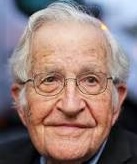
Noam Chomsky (born on December 7, 1928, in Philadelphia, Pennsylvania) is an American linguist, philosopher, cognitive scientist, historical essayist, social critic, and political activist. Sometimes called "the father of modern linguistics", Chomsky is also a major figure in analytic philosophy and one of the founders of the field of cognitive science. He is a Laureate Professor of Linguistics at the University of Arizona and an Institute Professor Emeritus at the Massachusetts Institute of Technology (MIT), and is the author of more than 150 books. He has written and lectured widely on linguistics, philosophy, intellectual history, contemporary issues, and particularly international affairs and U.S. foreign policy. Chomsky has been a writer for Z projects since their earliest inception, and is a tireless supporter of our operations.
ZNetwork is funded solely through the generosity of its readers.
Donate




