

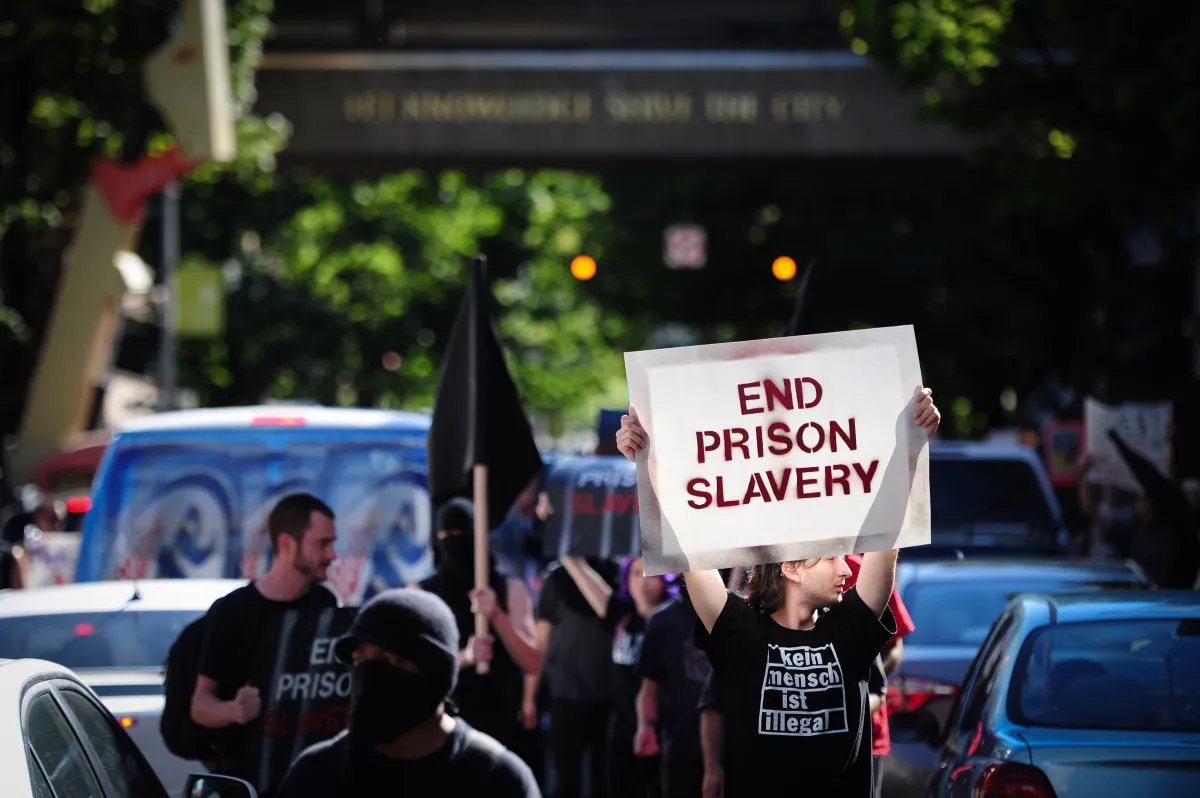
Prison labor is a staple of the American economy. Whether it’s fish farms or electronics recycling, woodworking or vehicle remanufacturing, our nation’s supply chain is bolstered by a hidden labor force of overworked and underpaid incarcerated people. I would know — I was one of them.
Throughout my 13 years of incarceration, I held a prison job whenever possible. From the kitchen of the city jail in Bristol, Virginia, to the mess halls of federal prisons in West Virginia, North Carolina, and Pennsylvania, I worked. At first, I didn’t think of myself as exploited. As far as I was concerned, I was just doing my job and my time the best way I knew how.
It wasn’t until I worked at the UNICOR factories in Butner, North Carolina, and Allenwood, Pennsylvania, where I was housed for a combined five years, that I made the connection between capitalism and captivity. Other prison jobs I had, such as kitchen worker or janitor, simply facilitated the operation of the institution. But once I clocked in at UNICOR, I became more than a prison worker: I was an employee, ushered into the world of big business. I tracked my hours, signed documents for vacation days, and strove to meet the quarterly and annual revenue targets displayed prominently on a digital bulletin board. I thought these experiences would one day help me find a good job on the outside. I was wrong.


Aaron M. Kinzer sits down to write, while incarcerated at FCI Allenwood, in Allenwood, Pa., in 2022.
Photo: Courtesy of Aaron M. Kinzer
Federal Prison Industries, now known by its trade name UNICOR, was created in 1934 to provide incarcerated people with job readiness skills. The government-owned corporation now spans seven different business segments and employs more than 17,000 people. Under the guise of reducing recidivism and providing training, UNICOR extracts hundreds of millions of dollars in annual revenue from an incarcerated population that has been denied most workplace protections granted by our country’s labor laws.
While UNICOR primarily sells its goods to other federal agencies — which are often required to purchase them — it’s been permitted to do business with the private sector since 2012. “Commercial entities can now explore competitive bids and higher profits through our high-quality, competitively priced labor,” states the UNICOR website. That “competitively priced labor” comes at a great cost to the incarcerated folks who work for next to nothing while inside. The vast majority have toiled under-compensated and unappreciated for decades.
Pharaoh Nkosi, a 70-year-old Air Force veteran and friend of mine, has been employed by UNICOR for over 20 years and incarcerated more than 40. Throughout that time, he’s developed an impressive skill set across the wide range of UNICOR industries, and his resume is likely unmatched by many free citizens in both white and blue-collar America. Unfortunately, however, Pharaoh’s 401(k) and IRA are worse than empty; they’re nonexistent. He has now aged out of society’s workforce, and if ever released, he’ll be virtually unemployable. He is a characteristic example of the scores of people exploited by the prison labor system.
At the UNICOR Office Furniture Group factory in Allenwood, we assembled chairs and lounge seating for as little as 23 cents per hour; they were then sold for as much as $3,000 a piece. We were well aware of the gulf between the cost of our labor and the astronomical revenue it generated. Knowing that it would take years of dedicated employment at the factory to earn up to $1.15 per hour was no soothing balm.
“What’s worse is that I understand that I am a part of American hypocrisy in action.”
William Talley, currently finishing his 20-year sentence at Allenwood federal prison, told me, “This is forced labor, plain and simple. This factory, for me, is the lesser of other evils, such as shoveling snow in the harsh Pennsylvania winter or scooping up geese poop in the hot summer sun.” He compared our prison labor to sweatshops in other countries, adding, “What’s worse is that I understand that I am a part of American hypocrisy in action.”
William’s viewpoint is common and discussed openly among incarcerated men. Yet at each of the four federal prisons where I served time, a UNICOR job was the most coveted. Along with the ability to make triple the pay of a regular prison job, UNICOR employment offered perks like eating first in the cafeteria and not being subject to lockdown in the event of a stabbing or riot. After all, there were deadlines to meet and deliveries to make, and nothing could get in the way.
More than 150 years after the 13th Amendment abolished slavery except for “as punishment for a crime,” prisons don’t need to use physical force or coercion to ensure the continuation of a cheap and slave-like workforce. Chasing UNICOR’s promise of vocational training, many incarcerated people continue to punch the clock every day for meager pay.
Since most inmates come from poverty-stricken environments, with little financial help from the outside, working on the inside — for any amount — becomes all the more critical. Most of all, work offers the opportunity to mentally escape from the pains of family separation, broken marriages, and monotony that accompany decadeslong sentences.
My certifications as a flagger and forklift driver have proved incapable of outshining the glaring label of convicted felon that accompanies them on applications.
Government officials and business leaders know that our desperation is real, and UNICOR preys on this stigmatized population. The internal compromises that incarcerated workers make sting in the face of the millions of dollars siphoned off their handiwork. Pride in a finished product doesn’t make knowledge of one’s own exploitation any easier.
Since my release in April, I have listed the many jobs I held in prison on my resume, but my certifications as a flagger and forklift driver have proved incapable of outshining the glaring label of convicted felon that accompanies them on applications. To no avail, I have attempted to use my writing skills to dress up the fact that I was in prison when I held these positions. On the inside, this work served great purpose — and generated great revenue. But now that I’m free, my biggest struggle is turning what once allowed me to cope into my own cash. I continue to be only offered menial labor positions for meager pay.
“I can only speak for my experience in UNICOR, but I truly believe that no dignified American would risk at times safety, life, and limb in exchange for barely a dollar per day,” Taj Gregory, from Richmond, Virginia, told me as we walked back to our dorm after a seven-hour work day. Taj, one of many former drug dealers-turned-inmate office workers, uses data software and Excel spreadsheets to help run the daily operations of Federal Prison Industries. “Maybe I’ve lost my dignity, or maybe I willingly gave it up,” he went on to say, “because every day I clock in ready to do my best.”
ZNetwork is funded solely through the generosity of its readers.
Donate




