

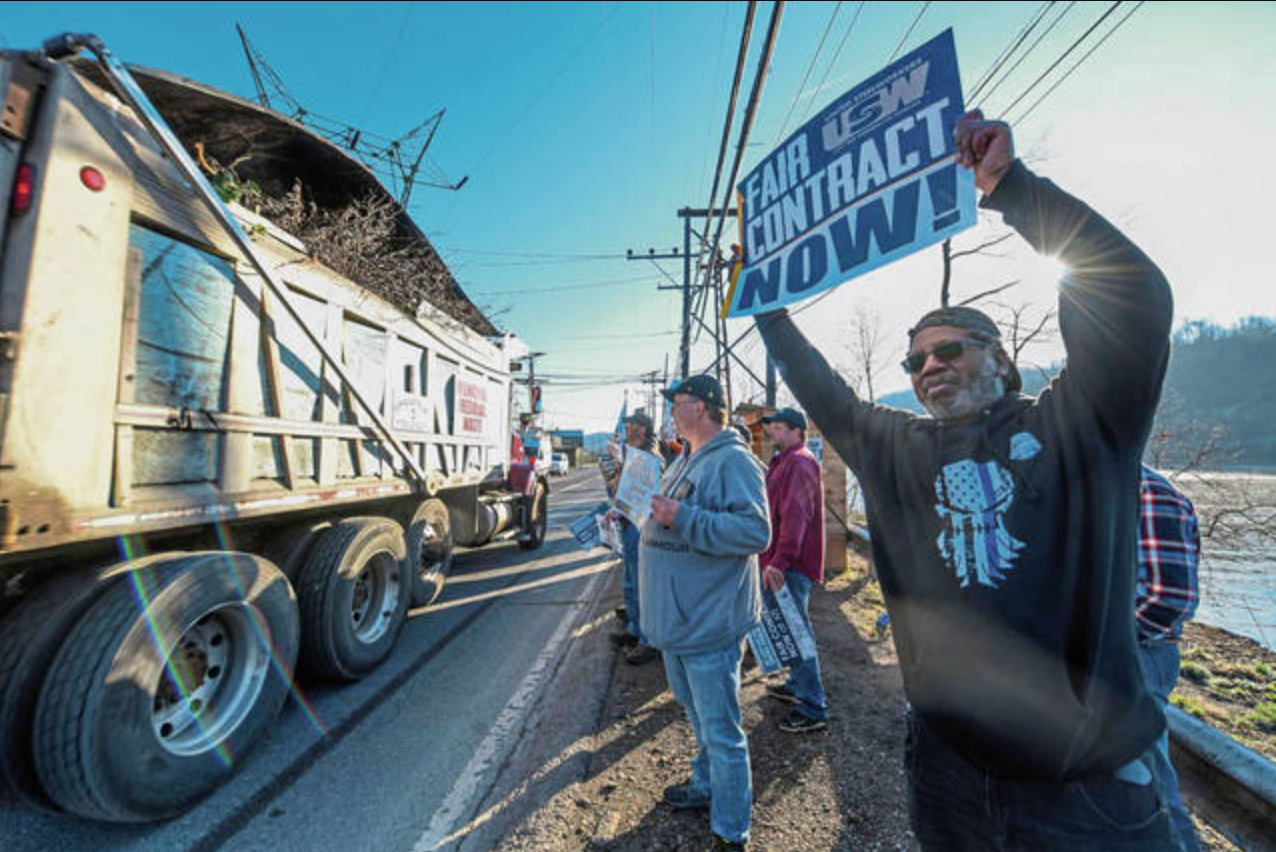
Keith Beavers began to cut household expenses and raid his savings when Allegheny Technologies Inc. (ATI) forced him and other union members into an unfair labor practice strike in 2021.
As difficult as it was for Beavers to get by without a paycheck, however, it pained him even more to see colleagues struggle and to know that the multibillion-dollar company intended to hold out long enough to squeeze workers into accepting deep concessions.
Beavers and other members of the United Steelworkers (USW) ultimately turned the tables and beat ATI at its own game, standing strong together for three months until the company signed a fair contract.
Now these USW members are battling to ensure that workers in Pennsylvania never face that kind of unfair fight again. They’re advocating for state-level legislation that would provide unemployment compensation to striking workers and keep employers like ATI from attempting to starve them into submission.
Pro-worker Democrats, led by Representatives. Dan Miller and Mandy Steele of Allegheny County, pushed the measure through the state House on a bipartisan basis in November. Now, the bill goes to the Senate.
“This is a tool that would give people the ability to stand up to corporations and help the middle class,” explained Beavers, president of the USW Local 1138 unit representing about 200 workers at ATI’s plant in Vandergrift, Pennsylvania.
“We’d be able at the very least to keep food on the table for our families and pay some of our bills and fight the good fight without losing everything,” said Beavers, who advocated for the legislation at a press conference. “All we’re looking for is a way to level the playing field.”
Right now, workers in Pennsylvania receive unemployment compensation benefits when they experience cuts in full-time work hours or lose their jobs because of layoffs, closures, or other factors outside their control.
But it’s just as essential for workers to access this lifeline during labor disputes, especially when companies like ATI refuse to bargain in good faith or commit unfair labor practices that force workers onto the picket line.
Unemployment benefits don’t cover workers’ full paychecks. They provide a basic level of support to help workers get by temporarily.
“We aren’t asking for a handout. This is money we put in. This is money we contributed,” said Beavers, noting that workers pay a withholding tax to help support the unemployment compensation program and only seek a return on that investment during strikes.
In all, the 2021 unfair labor practice strike affected about 1,300 workers at ATI sites in Connecticut, Massachusetts, New York, Ohio, and Pennsylvania. USW members in Connecticut, Massachusetts, and New York received unemployment compensation, while those in the other states went without.
“It would have made a huge difference in my eyes,” recalled Eric Poydence, vice president of USW Local 1196, which represents workers at the ATI plant in Brackenridge, Pennsylvania. “We have the right to strike. But without unemployment compensation, it’s difficult to exercise that right.”
Months before a contract expires, Poydence noted, companies often scale back overtime to siphon resources away from workers and undermine their financial footing. Then the employers provoke an unfair labor practice strike and sit back while workers struggle to provide for their families.
“You automatically start thinking, ‘What is most important to me? My house, clearly. The power. The heat,’” recalled Poydence, emphasizing that union members want nothing more than to continue working and strike only as a last resort.
“Then you start thinking about what you do not need and how soon you have to start leaving these things behind,” he continued. “You have to start making some real choices very quickly.”
Union strike and defense funds provide crucial assistance. But the only other options, Poydence said, are to “blow through savings” and go into debt.
“We’re put in a situation where we have to bury ourselves,” he said, adding that the consequences can affect workers and families for decades.
Growing numbers of Americans are joining unions and staging strikes on the heels of the pandemic, making access to unemployment benefits more critical than ever.
In addition to Pennsylvania, union activists and pro-worker lawmakers in Massachusetts and Connecticut are advancing legislation that would make it easier for workers in those states to access unemployment benefits during strikes.
Separately, U.S. Representative Adam Schiff of California and dozens of other congressional Democrats introduced legislation in October that would extend this assistance to striking workers throughout the country. The USW is among dozens of unions and other forward-looking organizations supporting the legislation.
However, the bills often face stiff opposition from corporations and business groups. California’s governor just vetoed legislation that would have provided unemployment benefits to striking workers in that state, where big, influential employers have a long history of mistreating workers just because they think they can get away with it.
In 2015, for example, Tesoro and other oil companies forced USW members into an unfair labor practice strike despite the industry’s deep pockets and workers’ concerns about unsafe working conditions.
“It was just a matter of them making a power play,” recalled Dave Campbell, secretary-treasurer of USW Local 675, which represented workers at the Tesoro refinery in Carson, California, during the strike.
Instead of truly negotiating, Campbell and Poydence said, more and more companies prefer to make regressive contract proposals deliberately aimed at stonewalling bargaining and forcing union members into labor disputes.
Providing unemployment compensation to striking workers, however, would prompt employers to correct course.
“The companies would have to negotiate with us differently,” Poydence said. “The whole dynamic would change. I do think the workers deserve this.”
David McCall is the international president of the United Steelworkers Union (USW).
This article was produced by the Independent Media Institute.
ZNetwork is funded solely through the generosity of its readers.
Donate




