


As predictable as August vacations, numerous economists and Federal Reserve watchers are arguing that the nation’s central bank must raise interest rates or risk an outbreak of spiraling inflation. Their campaign has heated up a bit in recent months, as one can cherry pick an indicator or two showing slightly faster growth in prices or wages.
But an objective analysis of the recent data, along with longer-term wage trends, reveals that the stakes of premature tightening are unacceptably high. The vast majority of the population depends on their paychecks, not their stock portfolios. If the Fed were to slam on the breaks by raising interest rates as soon as workers started to see some long-awaited real wage gains, it would be acting to prevent most of the country from seeing improvements in living standards.
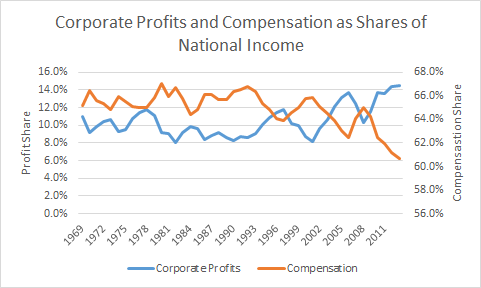
To understand why continued support from the Fed is unlikely to be inflationary, consider three factors: the current state of key variables, the mechanics of inflationary pressures and the sharp rise in profits as a share of national income in recent years, along with its corollary, the fall in the compensation share. (See figure.)
First, while inflation has firmed up a bit, the Fed’s preferred inflation measure (which omits volatile price movements in food and energy) is up 1.5 percent over the past year, well below the 2 percent target. Since the Fed must also worry about where people think inflation is headed, it’s worth noting this point from the central bank’s statement last week: “Longer-term inflation expectations have remained stable.”
Turning to wage pressures, while one wage report out last week showed a spike in employers’ costs, another one from a few days later showed a slight deceleration.
The best way pull out the signal from the noise here is to combine all the available series using a statistical “mash-up” technique (principal components analysis). This analysis finds that nominal wage growth has held at 2 percent since 2009, which happens to be about the rate of consumer inflation over this period. In other words, real wages have stagnated on average throughout the recovery. Moreover, this is the continuation of a long-term problem: real pay has been stagnant or worse for many in the workforce for much of the past 30 years.
Let’s say wages did significantly accelerate. Would this be a sign for the Fed to hit the brakes?
Not at all. First, for workers to get their fair share of the economy’s growth, real wages should keep pace with productivity growth. Productivity growth has been weak recently, most economists put the underlying trend at close to 1.5 percent. This means that wage growth at a 3.5 percent annual rate (2 percent inflation plus 1.5 percent productivity growth) would be consistent with the Fed’s inflation target.
It would not be unreasonable to accept — we’d say “celebrate” — even higher wage growth for a period of time. The Fed targets 2 percent as an average inflation rate, not a ceiling. Since core inflation has been somewhat below the target for the past five years, it can rise above that for a period of time to average out at 2 percent.
Also, and this is an underappreciated point, there has been a large shift within national income from wages to profits in recent years. In fact, corporate profits as a share of national income were higher in 2013 than in any year on record going back to 1929. The compensation share was the lowest since 1951. Wage growth paid for by a shift back toward to a more normal split between wages and profits is non-inflationary.
In fact, given the remaining slack in the slowly improving job market, we’re still probably a long way away from 3.5 percent annual wage growth. There is no reason for the Fed should be acting to slow the economy at the slightest hint of more rapid wage growth.
We’ve been here before. Back in the mid-1990s there was a consensus among economists that the unemployment rate could not get much below 6.0 percent without triggering inflation. As the unemployment rate reached this level in the 1995, there were many pushing the Fed to raise interest rates, including top Fed officials.
Fortunately Fed Chairman Alan Greenspan did not share this view. Based on the same mechanics discussed above, he saw no evidence of inflationary pressures, and thus no reason to slow a recovery that was just picking up steam. As a result of Fed restraint, the unemployment rate fell to 5 percent in 1997, 4.5 percent in 1998, and was 4 percent as a year-round average in 2000. Inflation remained subdued.
Greenspan’s resistance to the consensus allowed millions of people to get jobs and tens of millions to see real wage gains. As a bonus, instead of running a deficit of 2.5 percent of GDP, as the Congressional Budget Office (CBO) had projected in 1996, we ended up with a surplus of 2.3 percent of GDP in 2000. This shift from deficit to surplus of almost five percentage points of GDP (about $850 billion in today’s economy) was almost entirely due to the fact that the unemployment rate in 2000 was 4 percent, instead of the 6 percent CBO had projected.
These are the costs of prematurely tilting at wage pressures that aren’t yet here and deserved to be nurtured when and if they arrive. It’s not just that the costs of doing otherwise are high. It’s that they fall precisely on those working families who have yet to be reached by an expansion that began five years ago.


Dean Baker is co-director of the Center for Economic and Policy Research in Washington, DC. Dean previously worked as a senior economist at the Economic Policy Institute and an assistant professor at Bucknell University. He has also worked as a consultant for the World Bank, the Joint Economic Committee of the U.S. Congress, and the OECD's Trade Union Advisory Council.
ZNetwork is funded solely through the generosity of its readers.
Donate




