

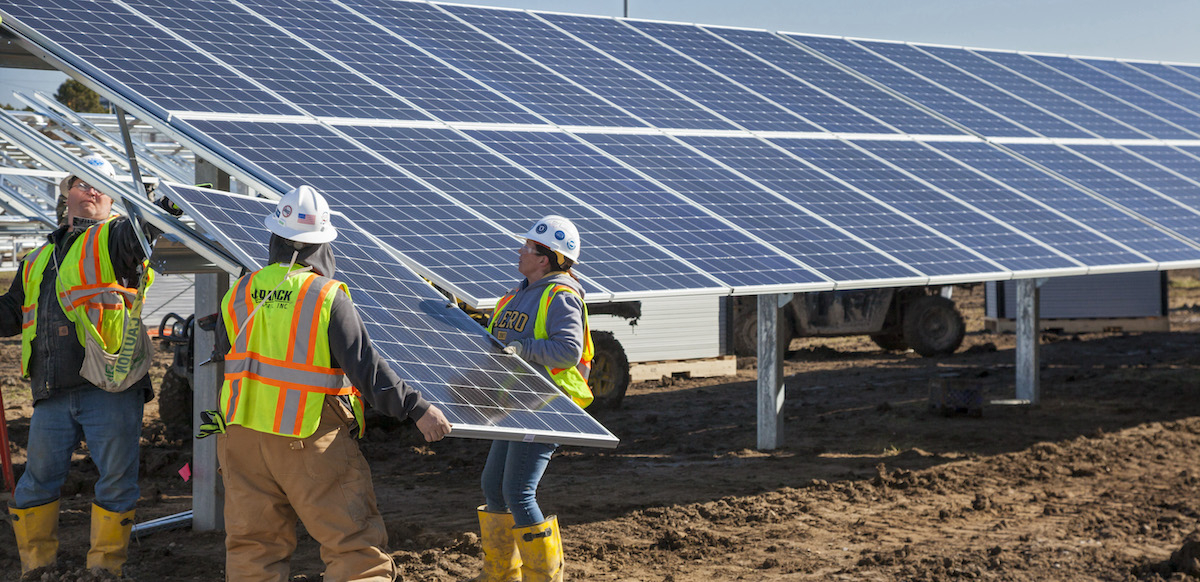
California’s solar power plants now rival the scale of any in the world. What stands out most is how they were built: under union contracts.
Across the U.S., nearly 90 percent of solar workers had no union last year. In California, the situation was different—at least on paper. The vast majority of its solar power plants have been wrenched in place by unionized construction workers.
But at first these were union jobs practically in name only, as thousands of unionized solar construction workers toiled on the underside of a two-tier system. Their wages, training, and job security lagged far behind their union siblings. Many questioned if they were members at all.
“As a probationary, pay was $15 an hour or a little less,” said Pablo Perez, an Ironworker on major solar plants near Fresno. “I was one of 100 guys they brought in. When the job was over, you were done.”
GREEN CONCESSIONS
Over the last few decades, many building trades leaders signed on to lower-tier contracts to get a foothold in residential and clean energy construction jobsites.
Around 2010, while other unions were still shut out of California’s growing solar power plants, the Electrical Workers (IBEW) began winning contracts—but at a cost. Temporary, lower-paid “construction wiremen” would fill about two-thirds of electrical jobs. Longer-term union members and apprentices split the rest.
Officers argued the repetitive nature of solar construction—often repeating the same 10 tasks of wiring and setting panels, for acres—didn’t require broadly trained, highly paid electricians.
Officials in the building trades often try direct outreach to persuade project developers to hire union, pitching them on safety, quality work, and fewer delays. But local Ironworker leader Don Savory in Fresno initially found it tough to convince solar developers to hire unionized contracting companies.
“When solar started coming, there were a few of them built non-union, paying $12 to $14 an hour,” he said. “At our package, $60 an hour [for wages and benefits], we weren’t getting traction.”
So as solar construction picked up faster, Savory proposed labor agreements that matched the IBEW’s tier ratios: five probationary Ironworkers for each fully trained “journeyworker” and apprentice.
Even compared to apprentices only two years into working iron, “probies” would get one-third less pay, and nearly none of the benefits. Instead of the union hiring hall that lined up a next job for apprentices, probationary workers finished their month or two of solar work with no guarantees to stay working union.
UNIONIZING A BOOM
The San Joaquin Valley, surrounding Fresno, is where Ironworker solar tiers started and ended. A few fields over is where the United Farm Workers struggled under vigilante gunfire.
In 2000, Fresno’s conservative city council passed the nation’s first ban on municipal Project Labor Agreements, a common deal used to unionize public work.
Meanwhile California’s state laws started pushing utility companies to shift to renewable energy: 20 percent clean by 2017, 50 percent by 2030, and 100 percent by 2045. Those mandates became a model for 27 other states, though the targets are usually less ambitious.
But California’s renewable laws lacked any explicit labor standards, let alone guaranteed union contracts.
Building trades unions made a stick out of the state’s environmental permit law. Like they had recently done to win concessions from gas power plant owners, unions threatened solar developers with lawsuits and mobilization to block permits until they signed a deal to unionize.
Just as important was a big carrot: unions could train thousands of new workers in the skills needed to build solar farms fast enough, even in remote corners of the state. Their apprenticeships, hiring halls, and mentorship gave them an edge over non-union outfits, which struggled to keep up with the demand.
As Ironworkers lined up their first few years of solar contracts, some local leaders pushed to get other unions included. Instead of competing over turf on each site, five trades agreed that stable, inclusive terms would mean steadier work all around.
By 2015, Electricians, Ironworkers, Laborers, Millwrights and Operating Engineers worked out a “five-craft agreement.” Their combined pressure made union labor the standard for all but one solar plant developer in California.
PROBATIONARY PROBLEMS
Ironworker officers pledged that the solar two-tier would be temporary. Still, “the guys were hissing and booing” when Savory introduced the tiers deal at a local meeting in 2013. “I said, ‘This’ll get a foot in the door, then it’s up to you guys to make it better.’”
Unlike some other trades with appointed officers, Ironworkers elect their local leaders from the ranks. In the “rodbusters” union, a culture of rowdy local meetings and contested elections often checks those who win.
On the job, the new tier drew gripes. According to one local officer, probationary workers were largely “hired off the street, or somebody’s cousin,” without the selective interviews and job experience that picked apprentices. Probies only got brief training in the field.
Contractors “just kind of threw us out there, sink or swim,” said Darrell Lewis, a former probationary-tier Ironworker. “If it wasn’t for some of the older guys, it would’ve been hard to learn on the job like we had to. The older apprentices watched out for us.”
Longtime Ironworkers complained that worksites with a majority of quick, temporary hires were undercutting the union culture of quality and safety. Savory said solar foremen—union members who coordinate and train others on site—told him the new system was creating “organized chaos, basically. It was like herding cats.”
That chaos was especially risky for probationary workers, given their limited training, weak health coverage, and the scorching conditions.
“I wasn’t used to the heat,” Lewis said. “It was summertime when I started, and it was 107 degrees out there. A few guys actually dropped off the job.” In nearby Southern California, summers are getting so hot that a few solar contractors have recently shifted to building at night.
Probies who stuck around wanted a full union apprenticeship, to get pay and security to match the tough work. They often found solidarity from older members on their solar sites. “All the guys who were already in were giving us as much advice as they could about how to get into the union,” said Perez. “It’s a real brotherhood, and that’s not a word I’d use lightly.”
Perez, Lewis, and scores of other probies were accepted within a few years into the Ironworkers apprenticeship program. Nearly all have stuck with the trade, and a few have become foremen.
TRIMMING OUT TIERS
Member pushback and jobsite frustrations nudged union leaders to make good on their promise. In 2015, Savory proposed a new Project Labor Agreement that would replace all probationary solar Ironworkers with full members or apprentices.
Some contractors griped that they’d be on the hook for higher wages. Pointing to the chaos when untrained workers did the work, Savory’s response was simple: “‘You’ll get more done.’ And they do.”
The proposal to abolish tiers came right as other unions were locking in their sides of the five-craft agreement that would unionize the rest of solar construction work. Although the IBEW kept its lower solar tier, Ironworkers say the Laborers, Millwrights, and Operating Engineers never introduced one.
Instead of a race to the bottom, the cross-trade push prodded contractors around Fresno to accept the Ironworkers’ landmark no-tiers deal: one apprentice to one journeyworker, and no more probationary positions.
Major solar Ironworker locals in Southern California soon demanded the same, and contractors gave in fast. Ironworkers membership has grown 70 percent in the eight years since.
Last October, IBEW, Laborers and Operating Engineers announced a national “three craft agreement,” outlining the jobs each trade will claim in union solar contracts, for every state but California.
Whether and how that agreement becomes a contract—including if Ironworkers fit in—will depend first on forcing solar developers to unionize. In California, unionizing solar jobs took creative, cross-trade pressure on contractors.
But to make solar jobs as good as those before them, like Fresno’s rodbusters showed, it took solidarity on the job and democracy in the hall.
ZNetwork is funded solely through the generosity of its readers.
Donate




