


On a cool, clear April morning just past 8 a.m., the sprawling corporate campus of the world’s second largest asset manager was suddenly roused from its suburban Philadelphia calm.
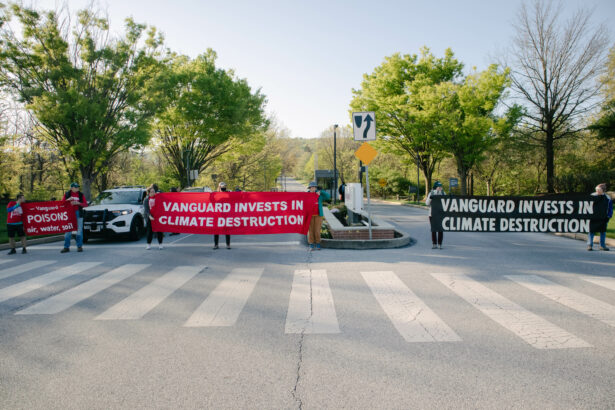
While about 20 activists broke into song, unfurled banners, stepped into the road and began blockading Vanguard’s entrances, around 80 more stood by in support. The ensuing commotion snarled traffic around the borough of Malvern, eventually slowing the flow of rush hour on Route 202 as drivers craned their necks toward a fleet of beaming police cars. Before most Vanguard employees had fired off their first email of the day, 16 people — aged 22 to 84 — were zip-tied at the wrists and hauled off to Chester County Prison.
The activists represented a broad coalition of grassroots organizations that had come to Malvern to stage an intervention over Vanguard’s $300 billion investments in fossil fuels. And while it wasn’t the first or even the largest of such interventions at the firm’s 115-acre campus, the April 19 action was arguably the most elaborate, with four teams operating in parallel across four sites.
Vanguard S.O.S., the organizing effort behind this action, is a global divestment campaign whose Philadelphia branch has been agitating in Vanguard’s backyard since May 2021. As a longtime volunteer with Extinction Rebellion Philadelphia and Earth Quaker Action Team — two of roughly 15 local partner groups — I’ve been involved in the campaign from the beginning. Our coalition has used a diversity of tactics from banner drops to rallies to a Quaker worship service outside the home of Vanguard CEO Tim Buckley. But this latest action represented a breakthrough in terms of our capacity for disruption.
During previous episodes of civil disobedience at Vanguard’s offices, we learned that security would rather contain and conceal our demonstrations than issue arrests, since a hawkish response would only increase our visibility and make them look bad. This time, we wanted to create a disturbance that would be more difficult to dismiss. So we devised a plan to interrupt the asset manager’s daily operations by blocking all four of its campus entrances at once.
Once in the planning stage, it quickly became clear that such a dispersed, multi-pronged disruption would require more activists trained in specialized roles. Each blockaded entrance needed a number of key positions — action lead, police liaison, photographer, song lead, media liaison and spiritual anchor — to help carry out the group’s objectives and support those risking arrest. So, to prepare volunteers for taking on new roles in April, we convened a small “core team” — me and four others — that set about designing a series of three protests that would double as training sessions.
Each of those comparatively low-risk actions allowed campaign supporters to practice new skills and observe others with more knowledge and experience. On-the-ground training was preceded by a virtual info session explaining the roles of action lead and police liaison. A reading group also met to discuss case studies in nonviolent resistance and draw inspiration from previous struggles. In short, the core team’s work was all about melding theory and practice, while also fostering the kind of camaraderie that sustains strong social movements.
“I think one of the most critical parts of success is a deepening of trust between people,” said Earth Quaker Action Team campaign organizer Lina Blount, who served on the core team. “The fact that folks could show up multiple times at these smaller actions, get to know each other well, debrief together and build some rapport also increased people’s ability to make decisions together on [the day of the big action].”


Combining theoretical and experiential learning
The core team held its first training protest in late February. About 15 demonstrators gathered at the perimeter of Vanguard’s campus to stage a satirical news broadcast as employees arrived for work. Set in a not-too-distant future ravaged by climate chaos, and anchored by fictional correspondent Terri Fied, our decidedly low-fi production involved three actors, a portable PA system and a handmade sign evoking a chyron. The topic of the report: a lawsuit filed by Vanguard stakeholders accusing the company of breaching fiduciary duty by failing to account for the social and ecological impacts of its investments.
We didn’t intend to risk arrest that day, but we tested Vanguard’s leniency — and asserted our collective resolve — when we stepped into the street for a group picture. That moment created an opportunity for my police-liaison-in-training, Rick Cole, to interact with Vanguard security. The back-and-forth that followed was typical of the role: Security told us we were obstructing private property and warned they were prepared to call in township police. We replied that we’d pass along the message to our action lead, who was the designated decision maker for the group, and report back. After a brief discussion with the action lead, we assured security that everyone would be out of the street soon.
A skilled police liaison creates a buffer between activists and law enforcement, allowing the group to limit their potential for coercion and maintain clear expectations between both camps. “It helps to create the right atmosphere,” Cole said, “so protesters can do their job.”
For Cole, one major takeaway from the training program was the significance of “the connection between the action lead and police liaison. They have to be on the same page. The action lead needs to know what the police response is or will be” in order to effectively — and safely — maneuver the group. In early March, our second core team protest brought us to the headquarters of Comcast, whose employee retirement plan is managed by Vanguard. We staked out a spot on a busy midday street corner with a bright red banner urging Vanguard to “Stop Investing in Climate Destruction.”
Our appearance in Center City Philadelphia drew a heavy-handed response from police, who outnumbered our group of 20 and roped off the plaza outside the media conglomerate’s 60-floor skyscraper. As Comcast employees flowed in and out of the building during their lunch breaks, we sang songs, delivered speeches and handed out flyers inviting them to support our campaign. The bloated police presence drew more attention to our rally, and the makeshift security checkpoints made it easier for us to identify and engage Comcast workers as they passed through. Reactions ranged from enthusiasm to indifference to outright scorn.
Zoë Johnston stepped into the role of spiritual anchor for the first time at Comcast, leading the group in grounding exercises before and after the demonstration. During the hour we spent on the street corner, she was prepared to offer interpersonal support and attend to the spectrum of emotions protesters can experience in such a charged environment.
“With spiritual anchor, I think the ‘anchor’ part is the essential piece,” said Johnston, a member of the Unitarian Universalist Young Adult Divestment Caucus. “Even for low-risk actions, being in the presence of police and in the presence of people who aren’t on the same page as you and trying to convince them to care about the climate is a deeply emotional experience, and it feels very intense in the moment. Spiritual anchors give a deeper grounding to that moment and remind us to return to the spiritual aspect of this work.”
The core team came back to Vanguard’s campus in late March for our final training protest. This time, we gathered near a different employee entrance — under a different police jurisdiction — to expose trainees to new conditions. Extinction Rebellion organizer Frank Fortino shadowed another volunteer in the role of action lead during the rally, which featured a series of call-and-response chants rebutting Vanguard’s talking points around environmental stewardship. Fortino briefed and debriefed the group and made spur-of-the-moment decisions about the placement of lawn signs conveying our messaging.
“Learning in that more relaxed atmosphere was very helpful,” said Fortino, who went on to serve as one of four action leads during the April escalation, where he was arrested.
The combination of theoretical and experiential learning offered in the core team’s training program reinforced, for him, “the basic pillars of what it means to be an action lead: communication, identifying the other roles, being able to adjust on the fly and make decisions.” Fortino built “terrific relationships” with other organizers in the process and ultimately felt “more confident to perform the role going forward.”
Refining the approach
This year’s April escalation marked the end of one campaign phase and the beginning of another. In the coming months, we’ll work with Vanguard investors to start collectively moving their money, and we’ll encourage industry professionals to speak out against the company’s practices and sign public pledges refusing any potential employment. True to our coalition’s theory of change, we’ll complement those tactics with a healthy dose of nonviolent civil resistance.
One of the many virtues of a sustained, long-term campaign — as opposed to one-off protests — is the potential for organizers to constantly refine their approach, and the April action left us with a trove of information and lessons to draw on moving forward.
In early May, coalition members reconvened to try to piece together exactly what happened that day across each of the four occupied entrances. Breakout groups met for discussion by action site, by role and then in randomized pairs. We took stock of what we noticed, when things happened, how we felt and what we learned.
There were practical takeaways about the value of pre-action bathroom access and the photographic merits of a tautly-held banner. There were notes on the consequences of making action details public and observations about the difficulty of coordinating across multiple locations. We learned that police respond quickly and decisively when facing a heightened level of disruption and that they will probe arrestees about our tactics with an air of affable curiosity. Our combined debrief documents eventually spanned eight pages.
In addition to those insights, many came away from the action with a stronger sense of conviction about their own skills and our collective power — the kind of conviction that can only be gained through experience, training and collaboration. As the debrief concluded with reflections on how each of us “stretched” in a personal capacity, one thing seemed obvious: The longer Vanguard avoids us, the more our movement will continue to grow. Until our demands are met, we’ll keep finding new ways to apply pressure. And each time we do we’ll become harder to ignore.
ZNetwork is funded solely through the generosity of its readers.
Donate




