Source: Tribune

Photo by mark reinstein/Shutterstock.com

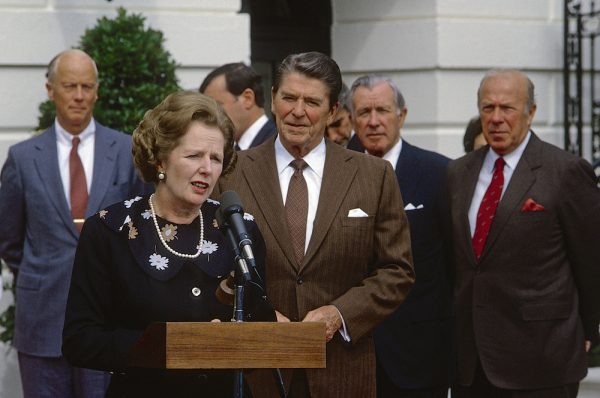
Margaret Thatcher, when introducing a swathe of neoliberal ‘reforms’ that would transform the British state for decades to come, famously stated: ‘[e]conomics are the method: the object is to change the soul’. While many will be familiar with the macroeconomic policies introduced by successive neoliberal governments over the years—from public spending cuts, to privatisation, to central bank independence—how these policy changes have influenced the way in which we relate to the world is perhaps less obvious.The intellectual foundations of the neoliberal turn could be found in the failures of Keynesian economic policy from the 1970s onwards, most obviously the breakdown between employment and inflation that had guided the state’s macroeconomic policy for most of the post-war period. With inflation spiralling out of control in the 1970s, the problem, argued monetarists, was that the public sector and its allies in the labour movement were out of control.As Geoff Mann argues in this brilliant essay, the theoretical revolution that took place within macroeconomics centred upon the idea of ‘rational expectations’. If everyone expected taxes to rise because the government was spending too much money, they’d put aside savings to pay for them, sucking as much demand out of the economy as higher government spending added to it. The unions, the argument went, anticipating higher inflation, would continue to demand too much from their employers creating a self-fulfilling cycle of rising prices.

What was required was a kind of ‘shock therapy’ to dramatically reset expectations and encourage people to adjust to a new normal in which the state was smaller, the unions were less powerful and individuals were expected to be responsible for their own wellbeing.

As should be clear from the language used to describe the problem, there was also a moral critique lurking beneath the surface of the neoliberal theory. The state had grown too large on the back of constant Keynesian counter-cyclical spending and was now skewing market outcomes in favour of profligate scroungers rather than hard-working savers. People needed to learn to rely on themselves, rather than the state or, implicitly, each other: the method was economics, the object was to change the soul.

In other words, the neoliberal turn generated a profound shift in the dominant understanding of the relationship between the individual and the collective. ‘Society’—to the extent that it even existed—came to be seen as a totalitarian mass, epitomised by Star Trek’s Borg, often referred to as ‘The Collective’, against which the rugged individuals of The Enterprise battled constantly.

Rather than understanding ourselves as individuals who were reliant upon and responsible for one another, the individual came to be seen as an isolated particle, floating freely in space – occasionally bumping up against other particles but really never becoming embedded in a community, a class, or a society.

This profound shift in the way we understand ourselves and the world was reinforced by the material changes that were introduced in the neoliberal era. Forms of social insurance, into which everyone contributed and most withdrew, were disassembled and replaced with individual insurance pots – from one’s savings account, to one’s private pension, to one’s home. ‘Asset based welfare’, in which one was expected to accumulate assets that could be liquidated in the event of unemployment or illness, is the dominant form of insurance that exists today.

Equally, the shift from public to private spending, and from government to household debt, has also reinforced the narrative of self-reliance over collective responsibility. Consumption is a deeply individualised activity that reinforces our sense of difference from, and superiority or inferiority to, one another – even if our tastes and preferences are profoundly shaped by wider society.

And the experience of indebtedness can be highly isolating – while one can band together with other workers to bargain with a boss, you can’t bargain with your bank (unless you’re extremely wealthy). A debtor is more likely to feel personal shame and anxiety about their situation than they are righteous indignation about the kind of society that would produce a class of people who can’t afford to make ends meet.

The pandemic hit a society that had become more isolated and individualised than ever. In the decade that followed the financial crisis, when it became very obvious that capitalism was rigged in favour of those at the very top, the neoliberal narrative of individual responsibility was brutally reinforced through the ideology of austerity: it is everyone’s personal responsibility to repay their debts (except, of course, the bankers themselves).

The entire edifice of the welfare state was ripped to pieces. The forms of collective insurance that remained—from unemployment to disability support—were dismantled and replaced with utterly degrading forms of ‘workfare’ designed to encourage ‘individual responsibility’. Meanwhile, the rich benefitted from more state support—in the form of bank bailouts and money creation directed towards the financial sector—than ever before.

When Covid-19 hit the UK, it hit a large mass of individuals who had become profoundly isolated from one another. The realisation that we were, in fact, all connected encouraged a revival of mutual aid and collective solidarity, as well as a groundswell of public support for those putting their lives on the line to protect everyone else.

But it wasn’t long before neoliberal logic reasserted itself. The government decided that the best way to deflect blame from its appalling handling of the pandemic (itself the result of the destruction of state capacity which was the legacy of several decades of neoliberal rule) was to shift it onto individuals. And it worked.

The public is now more likely to blame themselves for the spread of the virus than they are the state, which threw money at outsourcing giants that failed utterly to implement an effective system of testing and tracing; which paid people to go to restaurants when it was quite clear the virus was not under control; and which re-opened schools without the capacity to manage the process.

Many on the left look at the polling and wonder how people don’t blame Boris Johnson’s government for what is going on. The individuals who live on this island are described as self-sabotaging drones who are unaware of their own interests. In fact, the unimpeded spread of neoliberal ideology has created a world in which we have no one to blame but ourselves – because we cannot imagine anything beyond ourselves.

Grace Blakeley is a staff writer at Tribune and the host of our weekly podcast A World to Win.

Grace Blakeley is a staff writer at Tribune, and the author of Stolen: How to Save the World from Financialisation.


ZNetwork is funded solely through the generosity of its readers.

Donate
Donate
Leave A Reply

Subscribe

All the latest from Z, directly to your inbox.

Institute for Social and Cultural Communications, Inc. is a 501(c)3 non-profit.

Our EIN# is #22-2959506. Your donation is tax-deductible to the extent allowable by law.

We do not accept funding from advertising or corporate sponsors.  We rely on donors like you to do our work.

ZNetwork: Left News, Analysis, Vision & Strategy

Subscribe

All the latest from Z, directly to your inbox.

THE WIND CRIES FREEDOM

The Wind Cries Freedom, the new book from Z co-founder Michael Albert, is a sweeping oral history of a future American revolution.

Through thirty interconnected chapters, it draws out the strategies, failures, turning points, and hard-won wisdom of a movement that called itself the Revolutionary Participatory Society. These are not the polished memoirs of politicians: they are the unfiltered accounts of people who organized in neighborhoods, hospitals, universities, stadiums, courthouses, and places of worship, and kept a shared vision alive through cynicism and exhaustion.

The result is speculative political fiction that reads like history: messy, human, and quietly hopeful in the way that only real experience and long thought can produce.

Get your copy and peruse more features on the book’s website below.

“Read it, argue with it, but don’t look away. The future it recalls is one we must still fight to deserve.”

Yanis Varoufakis

“The most unusual and intriguing combination of prophecy, manifesto, and movement building manual that I have ever encountered.”

Bill Fletcher Junior

“This work fills a huge gap in our social movement literature.”

Cynthia Peters

You've just read your article on Z this month.

DOES Z'S SURVIVAL MATTER?

You keep coming back for a reason: serious political analysis, movement reporting, and debate beyond the priorities of corporate media. Today, Z is in a precarious financial position. If Z is part of how you understand the world, help keep it going. The readers who give monthly are the reason this work survives between fundraisers.

Z is in a precarious financial position. If it’s part of how you understand the world, help keep it going.

Number of donors705
Our goal1,000

Sustainers at $9/month or more receive the digital Z Magazine.

Already a sustainer? Click here and we won’t ask again. Thank you!

Your reading count is stored only in your browser and is never sent to us.

Sound is muted by default.  Tap 🔊 for the full experience

CRITICAL ACTION

Critical Action is a longtime friend of Z and a music and storytelling project grounded in liberation, solidarity, and resistance to authoritarian power. Through music, narrative, and multimedia, the project engages the same political realities and movement traditions that guide and motivate Z’s work.

If this project resonates with you, you can learn more about it and find ways to support the work using the link below.

Z is in the most precarious financial position in its history.

Z is a place to think beyond the limits of the present.

For decades, Z has brought together political analysis, movement reporting, debate, and visions of a different future from writers and activists around the world. That work is more than journalism. It is movement infrastructure: movements need places to develop ideas, test arguments, learn from experience, and imagine what comes next.

In the first two days of this fundraiser, 19 donors and 8 new monthly sustainers stepped up. Help us reach 1,000 donors who keep Z independent, for everyone.

For decades, Z has published the analysis, debate, and visions movements need, free of paywalls, ads, and billionaire owners. If that work should continue, Z needs your support now.

Number of donors705
Our goal1,000

Sustainers at $9/month or more receive the digital Z Magazine.

Subscribe

Join the Z Community – receive event invites, announcements, a Weekly Digest, and opportunities to engage.

Exit mobile version

