

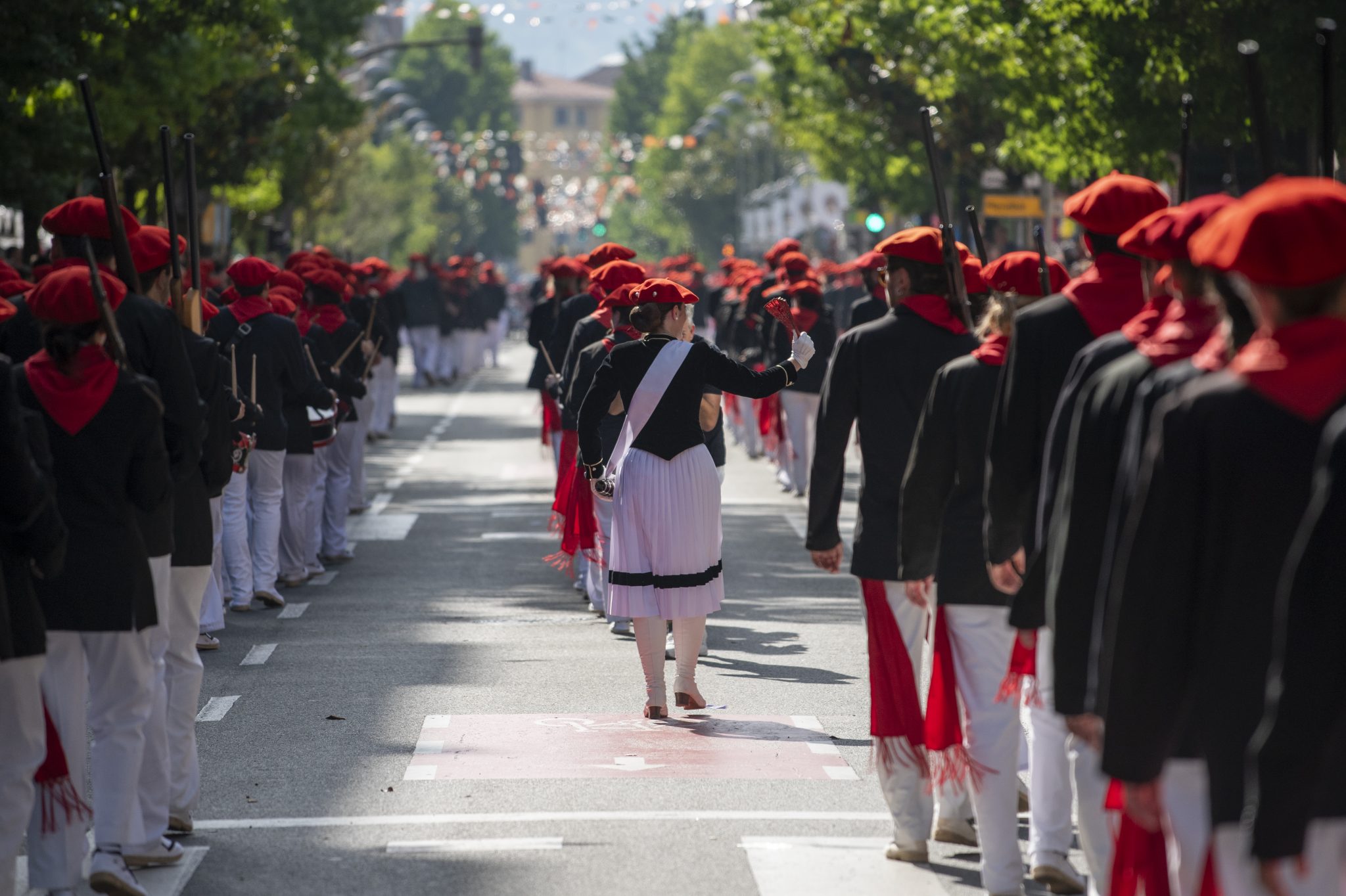
The origins of the Basque issue took shape after the Spanish Civil War. Following roughly three years of conflict between the Republicans and Nationalists, the fascist leader Franco established a dictatorship that lasted from 1939 until his death in 1975, during which various communities in Spain were subjected to repression. One of the most visibly targeted groups was the Basque community, which was distinct from Spaniards in cultural and social terms.
During Franco’s rule, the Basques’ historical, cultural, and social rights -as well as their autonomous status- were suppressed, and the Basque language was banned in public life. It could only be taught illegally in underground schools known as Ikastolas. Under these policies of repression and assimilation, the Basque people’s demand for independence gradually evolved into an organized movement. A group of university students founded the organization Euskadi Ta Askatasuna (ETA, meaning “Basque Homeland and Freedom”) in 1959.
Starting in 1968, ETA launched an armed struggle targeting the Spanish military and civil bureaucracy to achieve Basque independence. After Franco’s death, Spain entered a phase called the “Transition to Democracy.” In 1978, King Juan Carlos began seeking democratic solutions to the Basque problem. Autonomy packages were prepared within the Spanish state, and the Basque Parliament was established. However, states of emergency and ongoing clashes continued to shape the region’s political climate.
At that time, the most controversial branch of the Basque independence struggle, which took form through various political movements, was Herri Batasuna. Founded in 1978, the party adopted a socialist and pro-independence platform. Accused of being ETA’s political wing, it faced several lawsuits and changed its name to Batasuna in 2001, receiving around 15% of the vote in local elections. In 2003, however, the Spanish government banned it for alleged links to ETA.
On October 20, 2011, ETA formally declared an end to its armed campaign and announced its complete dissolution in 2018. Batasuna’s legal successor, Sortu, continued political activity as part of the left-wing alliance EH Bildu alongside other parties. Under the leadership of Arnaldo Otegi, EH Bildu is now represented by five members in the Spanish Parliament and 21 of the 75 seats in the Basque Autonomous Parliament, making it the second-largest party there. We spoke with Oihana Etxebarrieta, one of EH Bildu’s MPs, about the post-2011 process, the party’s policies, and the current political situation of the Basque people.
On 20 October 2011, ETA announced the end of its struggle for Basque independence. What has happened since then? What developments have there been? Have there been any changes in political and social discourse?
Basque society has changed significantly over the past 15 years. The majority of society has chosen to live together in peace and coexistence, choosing to understand and respect those who think differently. There are still some sectors that do not accept the end of ETA and try to hinder peace and coexistence. Fortunately, they are a minority. Still, there is a long road ahead. Many authorities and political parties have not admitted their responsibilities in the Basque conflict. We, on the other hand, advocate for recognition and reparation for all victims.
The new democratic scenario that opened after the end of ETA has brought changes in the Basque Country. We can say that the Basque Country is something of a political anomaly. While fascism is gaining ground in Spain and Europe, it has almost no presence in the Basque Country—neither on the streets nor in the institutions. There is a progressive and sovereignist majority here, and our task is to work for the will and needs of that majority.
Overall, the armed conflict phase has been closed in the Basque Country. That is, Basque society considers that phase to be over. In the Spanish state, however, they do not want to close it, as it still brings them political and electoral benefits.
How do Basque society and politics view the 2011 decision and the dissolution of ETA in 2018 today?
Basque society saw ETA’s dissolution as necessary, as it opened up a new democratic scenario in the Basque Country, and received the decision positively and with hope. That is still the prevailing view today. In fact, there is also a belief that the decision came too late.
It was a time of great hope, but fewer changes took place than expected. The Spanish and French governments did nothing in response to ETA’s dissolution and simply carried on as if nothing had happened. They showed no goodwill, and that attitude led to frustration and anger in Basque society.
What has become of the demands of ETA and the Basque resistance movement? Which ones are still relevant today?
We work for freedom and equality in the Basque Country. That has always been our guiding principle. The context in which ETA existed and today’s situation are very different, and understanding that is essential to understanding what happened and why.
Society is also evolving and has grown tired of politicians still using ETA as an excuse nearly 15 years after the ceasefire. Basque society wants to move forward. Through democratic means, we will continue working to offer a better future and way of life for our society and our nation.
What political demands does Basque society unanimously make of the Spanish state and government?
Firstly, the majority of Basque society today agrees on the need to respect the rights of Basque prisoners. In other words, the Basque Country is demanding that prisoners be treated with full rights, which is still not happening. The majority of society wants the consequences of armed conflict to finally end.
Secondly, Basque society wants greater sovereignty. It is not satisfied with the current level of autonomy. Data shows that most of society supports the right to decide our own future, and that is very significant. Our country is one of the most ancient countries in Europe. We have our own lenguage, culture and history and these have the right to be respected and protected.
Lastly, the majority of Basque society is progressive. That is, it demands social policies from the Spanish government in Madrid: strengthening public services, addressing historical memory, expanding social and political rights… These are key demands of Basque society, and those are what we are working to achieve.
What are EH Bildu’s parliamentarians in Madrid doing for the rights of the Basques? Where are the differences between the Basque Regional Parliament and the Spanish Parliament?
EH Bildu realized long ago that we must also influence and work in Madrid to defend the interests of Basque society and the Basque Country. Today, we do that work in both social and national spheres. We understand that on social issues, there are opportunities for collaboration with other progressive forces in Madrid. On national issues, we also cooperate with representatives from other stateless nations. This strategy has carried benefits in recent years, and thanks to our work in Madrid, the reality for Basques has improved.
In addition, inthe Basque Country, we have two parliaments: in Gasteiz and in Iruñea. Both of these are ultimately dependent on the government and parliament in Madrid. We do not have enough powers or sovereignty. We are unprotected, and at any moment, the central government could take control of our parliaments. That’s why gaining more sovereignty is so important for Basque society.
What is the Basque Regional Parliament doing for the rights of the Basques? What are the government and the opposition doing?
At the moment, one of the most important policies is that which focuses on protecting Basque linguistic rights. There have been many court rulings against the Basque language, and we want to create a legislative framework that shields and protects our language from legal and fascist attacks. In addition, we have an agenda marked by collaboration between different parties to create a new status that recognises our nation. Finally, the social agenda is marked by the demand for new policies that enforce the rights to housing, public healthcare, etc.
Where does EH Bildu stand in this new process in the Basque Country? How strongly is it represented in parliament and in society?
It’s true that EH Bildu is a relatively new party, but it has managed to represent a broad political base in just a few years. EH Bildu has connected with many sectors of society: young people, leftists, pro-independence supporters, feminists, environmentalists… This has happened for two main reasons: first, because of the political project it represents, and second, because of its way of doing politics.
EH Bildu works for a Basque republic where its people can live in freedom and equality. On the road to that goal, we are fighting for stronger social policies, more rights, and recognition of our territory—both in the Basque Country’s institutions and in Spain. And we do all of this with honesty and consistency—without lies or false promises. Society is starting to realize that we are not like the other parties, and this is reflected in our electoral growth.
At the moment, we hold 27 out of 75 seats in the Basque Autonomous Parliament, 9 out of 50 in the Navarre Parliament, and 6 out of 350 in the Spanish Congress. In addition, we are the party governing the most municipalities in the Basque Country. There is no other party in the Basque Country with greater overall electoral support.
Unfortunately, our social and electoral support is not properly reflected in institutional power. That’s the challenge we face now: gaining more institutional power in the highest chambers.
A well-known but somewhat forgotten issue is the situation of political prisoners. How many are there and what is their situation?
The situation of Basque political prisoners has significantly improved in recent years. From being held hundreds or thousands of kilometers away from home, they are now in prisons within the Basque Country.
Currently, there are 116 political prisoners. That is still a high number. Of them, 110 are men and 6 are women. 112 are held in prisons in the Basque Country, and 4 are in France. In addition, there are 3 deportees and 15 exiles, and bringing them back to the Basque Country should be a priority.
Even though the situation has improved, Basque political prisoners still suffer exceptional measures. If ordinary prison laws were applied to them, there would be fewer prisoners, and they would be in better conditions.
The situation of Basque political prisioners has to be a shared responsability. Spanish and French governments and Basque institutions should work in order to fix this issue.
Basque society has been essential in achieving all the progress made in recent years. The majority of society now supports the defense of Basque prisoners’ rights.
The Kurdish freedom movement is also engaged in a peace process with the Turkish state. Its goal is the recognition of the rights and freedoms of the Kurds. The process is still ongoing. Where are the parallels and where are the differences?
I believe there are indeed parallels. The peace process in the Basque Country was not a bilateral one. That is, the Spanish and French states did not seek an agreement with ETA. So far, Turkey has also not shown a willingness to pursue a peace agreement, even though it has positively acknowledged the Kurdish decision. I think that’s a significant parallel.
Another issue is the consequences of armed conflict. We will have to see what stance Turkey takes in the peace process—what it does about prisoners, about victims, and so on. The Spanish and French states showed no political will to resolve the situation, and to this day, we continue to suffer the consequences of the armed conflict.
What role do Basque women play in politics and society? What is the women’s movement like in the Basque Country, and are there any links to the Kurdish women’s movement?
The feminist movement in the Basque Country has done tremendous work in denouncing the patriarchal capitalist system. They organised a General Feminist Strike together with the Basque trade union majority, denouncing the fact that even today, care work still falls on women, both in the family sphere and in precarious employment. Thanks to this invisibility and precariousness of care work, which sustains life, capital can continue to accumulate power in the hands of a few. Likewise, the fight against gender-based violence remains a key area of work. From the EH Bildu feminism secretariat, we support and are committed to these same policies and to working together with the feminist movement. And, of course, the struggle of Kurdish women has been and continues to be an example that we recognise and support.
Who is Oihana Etxebarrieta?
Oihana Etxebarrieta was born in 1987 in Hondarribia and lives in Bilbao. She studied journalism and has been one of the representatives of the Basque feminist movement since her youth. Since 2016, she has served as a Member of the Basque Parliament and is responsible for EH Bildu’s Feminist Secretariat.
ZNetwork is funded solely through the generosity of its readers.
Donate




