

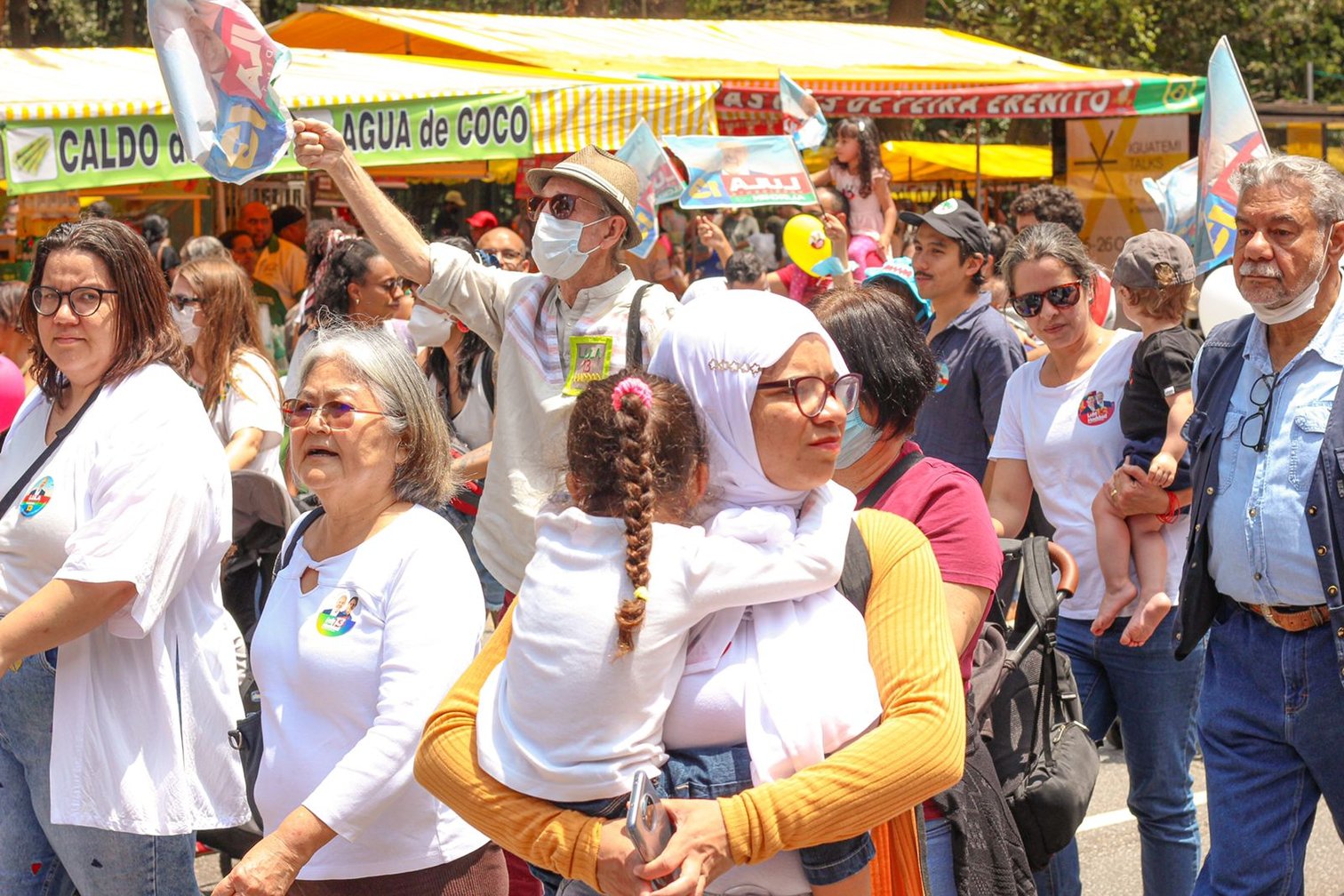
From São Paulo in the southeast to Salvador in the northeast, Brazil’s mothers have been forging a new position in the nation’s politics. In between the two rounds of presidential elections last month, they showed that a mother’s place is on the streets, protesting against the politics of hate and intolerance with their babies and children.
As incumbent right-wing president Jair Bolsonaro’s motorcade swept through the streets of Brazilian cities, the Movimento das Carrinhatas, as it became known, swapped the motorcycle outriders for baby strollers pushed by mothers and caregivers. The protests occupied the streets of cities across the country – Rio de Janeiro, São Paulo, Belo Horizonte, Salvador, Brasília and Juiz de Fora.
The movement began in São Paulo, where mothers came together on WhatsApp after the first round of voting on 2 October. They were worried about the possibility of Bolsonaro winning re-election, after he performed much better than pollsters predicted in the first round. The mothers organised, taking to the streets in defence of democracy and in support of Bolsonaro’s challenger, former President Luís Inácio Lula da Silva.
Their actions inspired mothers in other parts of the country, including five state capitals. Thousands of women, along with their children, mobilised in a unique experiment in repurposing existing digital communities. The virtual networks that offered support to women as they moved through pregnancy and into the worry, sleeplessness and exhaustion of new motherhood had been the mainstay of many. This space – where information on crying, breastfeeding, illnesses and remedies was shared – was transformed into a digital community for political innovation.

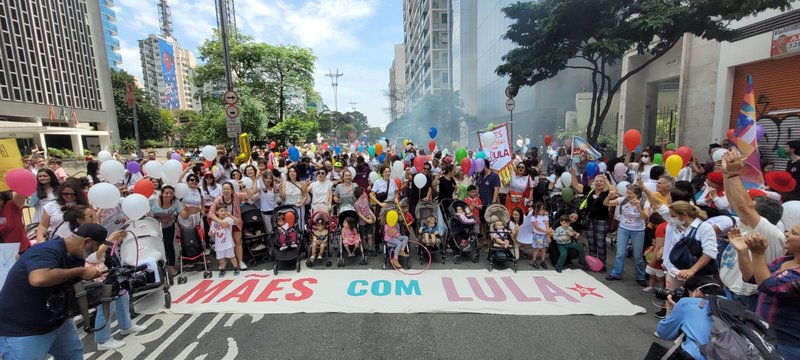
In the name of their children and for the cause of public health, quality education and an end to violence and deforestation, mothers of diverse backgrounds took to the streets against Bolsonaro, who has openly made misogynist statements, violated human rights and dismantled environmental protections during his four years in power.
The Movimento das Carrinhatas inspired other small, significant actions, such as the ‘Floreata’, a self-organised distribution of roses and pamphlets that would encourage conversations among mothers about the need to vote.
‘Politics is thorny and you have given up voting? Shall we talk?’ Activists carrying bunches of flowers wore T-shirts with this phrase printed on them, serving as a call for mothers and women to talk to them about politics. Research by Elas Que Decidem – an initiative by Brazilian progressive media lab Quid to encourage women to vote – has shown that women have little space to talk about politics in their homes. But when they are on their own, women are open to discussing political issues.
Inside Bolsonaro’s camp
The mothers mobilised to try and reverse the tendency among many Brazilian women to fill out a null or blank ballot in order to show their disillusionment with the country’s politicians. Elas Que Decidem estimates that in the 2018 election, nearly half of Brazil’s women did not choose a candidate for president. This matters because women make up 53% of the electorate – they have the power to implement change.
Opinion polls published throughout the 2022 campaign showed that Bolsonaro was favoured by just 20% of women, compared to an average of 50% who favoured Lula. This led Bolsonaro’s wife and first lady, Michelle, to become a key player in his campaign. In efforts to win women’s votes, Michelle participated in women-only events, using religious rhetoric and focusing especially on Evangelical church-goers, among whom she is popular. She also publicly apologised for her husband’s constant cursing on the day after the first round.
It was an uphill battle for Michelle and the rest of the Bolsonaro camp. With just weeks to go before the second round vote on 30 October, Bolsonaro was forced to apologise for implying a visit to a group of Venezuelan teenage girls, whom he described as “very pretty”, were involved in sex work.
But even before this latest scandal, Bolsonaro’s government has presided over rising food prices, hunger and unemployment, all of which have disproportionately affected women – especially Black women – as they head nearly half of all Brazilian families. During the pandemic, it was the women who managed their children’s homeschooling, even as Brazil waited for the rollout of vaccines, purposely delayed by the vaccine-sceptic Bolsonaro and his team.
‘Vote Like a Mother!’
It is 90 years since women got the vote in Brazil but even now, it is not always easy for them to have their say. During the recent campaign, there were instances of women being harassed for declaring their intention to vote against Bolsonaro, with verified incidents of husbands, fathers and male bosses coercing, blackmailing or threatening women. Many women chose silence to keep the peace. This is when the mothers decided to remind men that Brazil has a secret ballot, which is protected by law. The activists invited elected officials, artists and influencers who are also mothers to share videos using the hashtag #OVotoÉSeu (the vote is yours). On the eve of polling day, they occupied one of São Paulo’s main avenues and put up signs that said: ‘Vote Like a Mother!’
It was a different approach to the usual Brazilian election campaign. Instead of big events or expensive and impersonal communication materials, the mothers organised decentralised and horizontally managed activities that stimulated cooperation among people who did not know each other. Their motto was dialogue and the materials were made available to anyone to replicate or adapt.
I know that Bolsonarism will not end, but being part of a group as beautiful as this gives me hope,
In the Whatsapp group where most of the mothers’ actions were organised, messages of emotion and gratitude flew back and forth in the final days of the election. “You helped me to survive,” someone said. “I know that Bolsonarism will not end, but being part of a group as beautiful as this gives me hope,” said another. “It was very good to have your support this month, I got back on my feet,” said a message. And then: “Thank you women, even without knowing you this group gave me a lot of strength!”
An idea originally developed in São Paulo achieved results nationally, with the mothers opening up a space for a different way of doing politics, one that demonstrated the strength of collective endeavour.
The voter numbers that are starting to be released indicate a decrease in the historical trend of voter abstention: for the first time abstention was lower in the second round than in the first round according to official data from the Brazilian Superior Electoral Court. In an election in which every vote mattered, and in which one side relied on the state machine and fake news, movements like that of the mothers were likely essential for Lula’s victory. In the process, Brazil has won, as has democracy and generations to come.
ZNetwork is funded solely through the generosity of its readers.
Donate




