


Source: Davidswanson.org
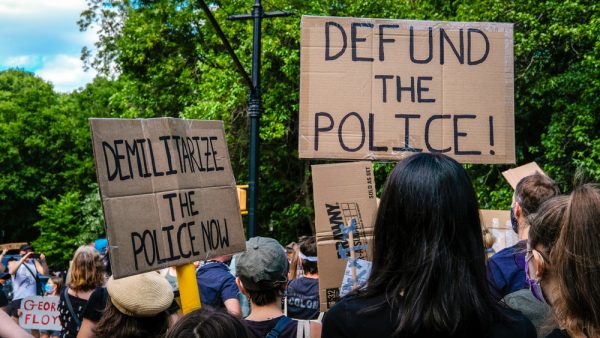

Photo by Fiora Watts/Shutterstock.com
The past month’s activism has changed a great deal. One thing it’s helped with is brushing aside the tired old argument over whether government should be big or small. In its place we have the much more useful argument over whether government should prioritize force and punishment, or focus on services and assistance.
If we want local and state governments that provide experts in de-escalating conflict, professionals to assist those with drug addictions or mental illness, and skilled experts at handling traffic or responding to various sorts of emergencies, the funding is easily and logically found. It’s sitting in the oversized budgets for armed policing and incarceration.
At the level of the federal government, an even bigger opportunity exists to move money from institutionalized deadly force to all variety of human and environmental needs. While police and prisons are a small percentage of local and state spending, the U.S. government is expected to spend, in its discretionary budget in 2021, $740 billion on the military and $660 billion on absolutely everything else: environmental protections, energy, education, transportation, diplomacy, housing, agriculture, science, disease pandemics, parks, foreign (non-weapons) aid, etc.
No other nation spends even half what the United States does on militarism. Russia spends less than 9 percent and Iran a bit over 1 percent (comparing 2019 budgets). China’s military budget is roughly on the scale of U.S. police and prison spending — nothing like U.S. military spending.
U.S. military spending has soared during the past 20 years, and the wars it has generated have proved counter-productive and extremely difficult to end. This focus seems to have done very little to protect anyone from COVID-19, from environmental disaster, from the risk of nuclear disaster, from unsafe workplaces, from all the suffering inflicted by poverty, or from the lack of comprehensive healthcare.
In both houses of Congress right now amendments to the National Defense Authorization Act are gathering support that would reduce next year’s $740 billion budget for militarism by 10 percent for the purpose of redirecting those funds to wiser purposes. Moving $74 billion would result in a budget of $666 billion for militarism and $734 billion for everything else.
Where could the money come from, specifically? Well, the Pentagon is the one department that has never passed an audit, but we do have some idea of where some of the money goes. For example, simply ending the war on Afghanistan that candidate Donald Trump promised to end four years ago would save a large percentage of that $74 billion. Or you could save almost $69 billion by eliminating the off-the-books slush fund known as the Overseas Contingency Operations account (because the word “wars” didn’t test as well in focus groups).
There’s $150 billion per year in overseas bases, many of them bitterly resented, some of them propping up brutal dictatorships. For that matter there’s the military training and funding of oppressive foreign militaries by the U.S. government. There’s also such out-of-control weapons buying that unwanted weapons are unloaded onto local police departments.
Where could the money go? It could have a major impact on the United States or the world. According to the U.S. Census Bureau, as of 2016, it would take $69.4 billion per year to lift all U.S. families with children up to the poverty line. According to the United Nations, $30 billion per year could end starvation on earth, and about $11 billion could provide the world, including the United States, with clean drinking water.
Does knowing those figures, even if they’re slightly or wildly off, throw any doubt on the idea that spending $740 billion on weapons and troops is a security measure? Some 95% of suicide terrorist attacks are directed against foreign military occupations, while 0% are motivated by anger over the provision of food or clean water. Are there perhaps things a country can do to protect itself that don’t involve weapons?
Moving money from militarism to other investments can be economically beneficial, and certainly all necessary steps to assist people in the transition would cost a small fraction of the money involved.
David Swanson is an author, speaker, Executive Director of World BEYOND War, and Campaign Coordinator of RootsAction.org.


David Swanson is an author, activist, journalist, and radio host. He is executive director of World BEYOND War and campaign coordinator for RootsAction.org. Swanson’s books include War Is A Lie and When the World Outlawed War. He blogs at DavidSwanson.org and WarIsACrime.org. He hosts Talk World Radio. He is a Nobel Peace Prize Nominee.
ZNetwork is funded solely through the generosity of its readers.
Donate




