

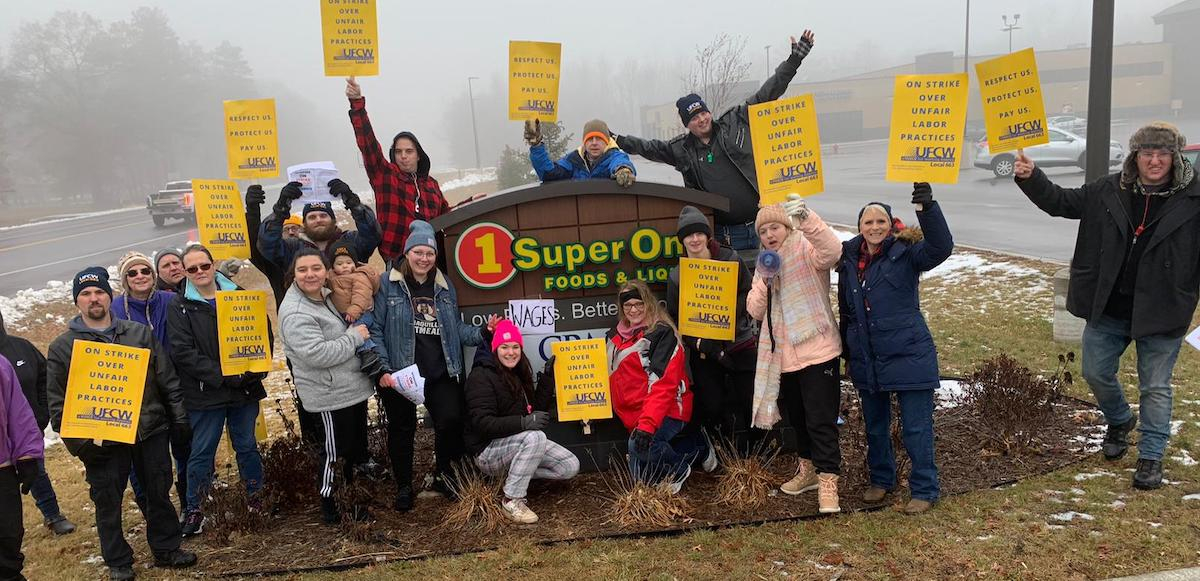
It wasn’t such a merry Christmas for grocery store management in central Minnesota. Five hundred grocery workers in the Brainerd Lakes area walked out on an unfair labor practice strike, deserting five stores between December 22 and 25.
Management tried to keep the stores running, but workers said they turned into disaster zones.
Why did two Cub Foods stores, two Super Ones, and a SuperValu find themselves on Santa’s naughty list last year? Food and Commercial Workers (UFCW) Local 663 charges management with interrogation, surveillance, intimidation, and bargaining in bad faith.
Those misdeeds included infiltrating a WhatsApp group chat for workers and stationing “loss prevention” employees—who normally focus on catching shoplifters—near the store exits to intimidate workers out of participating in walkouts leading up to the strike.
The union’s top bargaining demand is a raise. Wages have been stagnant a long time, and lag behind what grocery workers are making a few hours south in the Twin Cities. Part-time wages are especially uncompetitive; turnover is high.
HEARTENING UNITY
The strike made waves in Brainerd Lakes, a metro area of 30,000.
It “really united workers at our store,” said Doug Olson, who has worked at Baxter Cub Foods for 17 years. “Men and women, part-time, full-time, people of all different political beliefs. It’s really heartening to see the unity we’ve had.”
Olson works on the clean team, sometimes called the courtesy or maintenance team. They wipe up spills, clean the bathrooms, take out the garbage, bag groceries, and shovel snow—and get paid on a lower scale than other grocery workers. The union is fighting to eliminate the separate pay scale and bring clean team workers up to par.
Management hasn’t budged since the Christmas strike, refusing to put more money on the table even after its attorney admitted it can afford the union’s proposal. But the workers may be equally stubborn. On January 18, they voted to reject management’s latest proposal by 84 percent, laying the groundwork for another potential strike.
“I believe this contract could make or break this store,” said Olson, who would like to retire from Cub one day. “Things are just going to get worse and worse otherwise. We really need to win this one.”
RAISED EXPECTATIONS
It’s the first time in recent memory that there are buttons, walkouts, and raised expectations in Brainerd.
Vigorous contract fights are the exception, rather than the rule, in the UFCW. That’s one of the chief complaints of the burgeoning UFCW reform movement anchored by Washington state’s Local 3000, the union’s largest local with 50,000 members.
Four hundred Local 3000 members at Macy’s went on a three-day strike over Thanksgiving, and they were out on strike again as this story went to press. In 2022 the local spearheaded an ambitious coordinated bargaining effort with seven other UFCW locals representing 100,000 Kroger workers in Western states.
Local 663, which represents 17,000 members across Minnesota, did not support the proposals put forward by the reform group Essential Workers for Democracy at the UFCW international convention last April, which were backed by Local 3000 and a handful of other reform-minded locals.
But the union underwent a major shift at the beginning of 2023 when its former organizing director Rena Wong became president. She was voted in by the executive board to complete the term of the previous president, who had stepped down.
Before Wong, the union had conservative leaders for decades. “The union leadership failed us,” said Olson. “They were more interested in labor peace and getting along with the owners than in helping us secure better wages and benefits. They would settle for whatever management offered them. They just rolled over, over and over again.”
A NEW STANDARD
That labor peace has now been decisively broken. Last spring, 3,000 Cub Foods workers in the Twin Cities launched a contract campaign, voting to strike 33 stores.
When they threatened to strike all the stores over Easter—one of the biggest grocery-shopping holidays—management caved. The workers won raises of $2.50-$3.50 an hour and got rid of the lower pay scale for the clean team.
This success built an appetite among stewards and members to bring the same kind of organizing and militancy to the local’s other contract fights, according to Paul Kirk-Davidoff, a steward at Seward Community Coop in Minneapolis. “A base for continued change in the union came from the contract campaign at Cub,” he said. “It convinced a lot of people.”
Workers at Lunds & Byerlys stores, and then at Kowalski’s, mounted strike threats over the summer, winning raises of up to $4 over two years. In October, workers at Seward Community Coop won even higher raises of at least $6.50 over three years, as well as the right for cashiers to sit in chairs.
The new leadership has encouraged a new spirit of activism, taking a more open approach and bringing more rank-and-file workers onto the negotiating team—whereas the role of workers in the union used to be more like “window dressing,” Olson said.
MOTION IN MEATPACKING
The energy has spread to Local 663’s fights for first contracts—workers struck last summer at four Half Price Books stores, jointly organized with Local 1189—and to its members in meatpacking, the UFCW’s other traditional core sector.
Workers at the Hormel Foods plant in Austin‚ Minnesota—the site of the bitterly fought 1985 strike which pitted then-Local P-9 against the international union itself—won a contract in October with record raises of $3-$6, as part of national negotiations across five plants. Workers at the Austin plant had voted to reject a “final offer” from the company, and hundreds marched through town in a Labor Day show of force.
The resistance at Hormel has been a bright spot for the UFCW in meatpacking, a sector where union density has fallen precipitously, once-reigning master contracts have been all but dismantled, and the workforce, largely immigrants and workers of color, is notoriously exploited.
Case in point: coming up next is Local 663’s contract fight with the chicken processor Tony Downs Foods, in Madelia, southwest Minnesota. The employer was fined $300,000 last year for employing children as young as 13 to operate meat grinders, forklifts, and ovens.
ZNetwork is funded solely through the generosity of its readers.
Donate




