


Good morning to the Israeli left. After an eternally long hibernation, we are starting to hear the sounds of its awakening. Only when the wind is once again blowing in its direction – and not because of anything it did – does the extra-parliamentary left dare to come out of the closet where it locked itself up more than four years ago.
Perhaps one should welcome these signs of awakening, but it is impossible not to hold it accountable for its lengthy, disgraceful and cowardly silence that abandoned the street to the right and the settlers. For more than four years Israel has been doing anything it wanted in the occupied areas, practically without any domestic criticism. It killed and demolished, uprooted and brutalized, and practically nobody protested. The world saw what was going on and shouted about it. But not us. When Israel desperately needed an alternative view, a clear sound of protest, practically nothing was heard, not a peep, except from a few small and brave organizations.
So it is difficult to forgive those who were silent, looked away and wrapped themselves in indifference, thus depicting Israel as monolithically supporting the government. The rustling noises that are beginning to be heard from the Zionist left are too late to clear it of its responsibility: With its silence until now it became a partner to all the government did during those damnable years. With the evaporation of the Labor Party and the fear and impotence that gripped the other bodies of the Zionist left, the only active element in society was the settlers. Thus the government managed to continue its brutal policies and the settlers nurtured their enterprise without disruption.
Now, under cover of a prime minister from the right, the left suddenly has remembered that it also has something to say, as a weak, pale echo of Ariel Sharon. The first to speak up, as usual, were the writers of the avant-garde, at the head of the camp. In a properly stylish advertisement a few days ago, Amos Oz, A.B. Yehoshua, David Grossman, Meir Shalev, Agi Mishol and a few other elite writers called out for “a change in consciousness and feeling.”
What change? What consciousness? They also called for a renewal of the political negotiations, a very daring move after the Sharm el-Sheikh summit, and proposed the government recognize the suffering of the Palestinian people, in exchange, of course, for their recognition of our suffering.
A group of filmmakers and musicians joined in that call, but with one difference. At least in the advertisement from Daniel Barenboim, Pinhas Zuckerman and Zubin Mehta, there is at least an admission that the occupation is the direct source of the suffering of the Palestinian people and there is a clear call in their ad for an end to it; the authors weren’t ready to go that far.
It’s hard to believe: After nearly 38 years of occupation and four years of intifada, the leading writers of the peace camp are still dividing the responsibility for what is happening symmetrically between the two sides: “In our eyes, each of the sides bears some of the responsibility for the injustice, the suffering and the tragic situation in which the two nations are trapped,” they wrote with self-righteousness.
That “we’re all guilty” approach is no less outrageous than the silence that went on and on and on. How does one break the silence of the peace camp? Attribute the same measure of responsibility to the occupier and occupied, the powerful and the weak. Call both the soldiers at the checkpoints and their subjects, whose lives are beneath the soldiers’ feet, “to change consciousness and feeling” even before the checkpoint is lifted; preach to the assassin and the assassinated to fall into each other’s arms; draw parallels between a nation whose economic, cultural, social and emotional lives were completely destroyed and a nation in which the vast majority of people can go on with their lives as if nothing has happened; a people that has been imprisoned and humiliated, versus a free people in their own sovereign state.
Even without counting casualties – three times as many on the Palestinian side – there is no room for comparison, not of the extent of the suffering nor of the measure of responsibility. Can’t the writers see the decisive weight of responsibility that lies on the occupier’s side for the creation of the injustice, or did they not summon up the courage to admit as much, lest it anger the readers?
Immediately after the authors awoke, Peace Now came out of its faint. In another two weeks, it has been said, it will be returning to the street and squares. “The Coalition of the Majority,” the umbrella organization of the left and the protest groups (oxymoronic titles if ever there were) is to convene a mass demonstration. Why didn’t they do it beforehand, in the dark years of assassinations and demolitions when the need was far more critical? The explanations and excuses are ridiculous: the desire to maintain as broad a common denominator as possible and the fear of failure.
But the silence was the greatest failure of all. It is impossible not to ask now where everyone was for the 346 children that Israel killed. What prevented them from protesting when 112 wanted men were assassinated without trial and another 521 innocent passersby were killed at the same time? The demolition of half of Rafah, the uprooting of olive trees in the West Bank, the erection of the wall, the apartheid roads for Jews only, the imprisonment of an entire nation behind checkpoints for years – none of it awakened most of the artists or the “coalition of the majority.” They were silent. They were afraid. They were complicit.
The alternative voices, the voices of the protest movements and authors, have a vital role in society that goes far beyond merely what they say. They are supposed to pave the way and protect the pluralistic and democratic character of the state. But after four and a half years in which society spoke in one uniform voice, the disgraceful silence on the left, the camp that only awakens under the patronage of the prime minister, shows it is a cowardly, frightened camp.

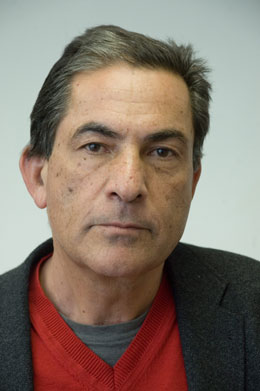
Gideon Levy is a Haaretz columnist and a member of the newspaper's editorial board. Levy joined Haaretz in 1982, and spent four years as the newspaper's deputy editor. He is the author of the weekly Twilight Zone feature, which covers the Israeli occupation in the West Bank and Gaza over the last 25 years, as well as the writer of political editorials for the newspaper. Levy was the recipient of the Euro-Med Journalist Prize for 2008; the Leipzig Freedom Prize in 2001; the Israeli Journalists’ Union Prize in 1997; and The Association of Human Rights in Israel Award for 1996. His new book, The Punishment of Gaza, has just been published by Verso Publishing House in London and New York.
ZNetwork is funded solely through the generosity of its readers.
Donate




