

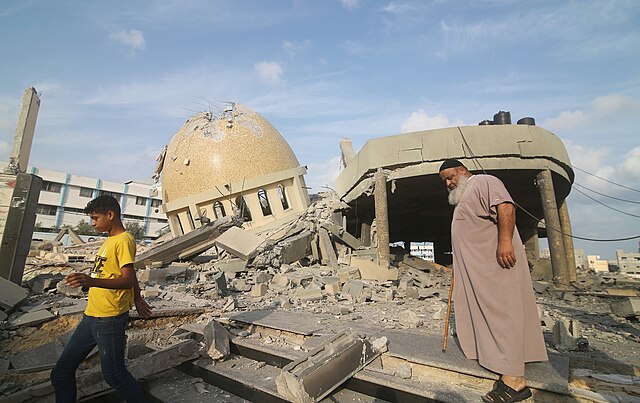
The bombs may have eased, but Palestinian children are still dying. This time, not by Israeli airstrikes, but from cold, and collapsing damaged structures. Israel have violated the ceasefire agreement by obstructing entry of vital services for children, and essential shelters to protect civilians whose homes were destroyed by two years of genocide. A war crime by other means: slower, less visible, but more excruciating death delivered through deprivation, and exposure.
In recent weeks, heavy rains have inundated Gaza’s tent camps, flooding makeshift shelters and causing damaged buildings to collapse on families inside. Adequate shelter is unavailable because Israel has blocked its entry at the Rafah crossing. At least 16 Palestinians, including infants, have died as a direct result of these storms. Amnesty International rightly described this as an “utterly preventable tragedy.” It was not bad weather that killed these children, but Israel’s violation of the ceasefire terms.
After more than two months of ceasefire noncompliance, Israel has killed and injured more than 1400 Palestinians, and continues to severely restrict aid and critical supplies needed to repair water, and sewer infrastructure system. This persists despite an International Court of Justice advisory opinion affirming Israel’s obligations as an occupying power, and a UN General Assembly resolution demanding compliance. The reality on the ground tells a different story: UNRWA alone has shelter supplies for up to 1.3 million people waiting outside Gaza, barred from entry.
After repeated displacement, the destruction or damage of at least 92 percent of Gaza’s structures, and the designation of nearly 58 percent of the territory as no-go zones, most Palestinians are now living in dilapidated tents or taking shelters under dangling concrete slabs. Israel first weaponized food to break Palestinian resistance; now it has turned nature into a new weapon of war.
Amnesty investigators documented buildings collapsing in Jabalia, al-Rimal, Sheikh Radwan, and al-Shati refugee camp, crushing entire families. Mohammed Nassar lost two children, Lina and Ghazi, when their damaged five-story building crumpled under the storm. They had fled Israeli airstrikes twice. After two years of genocide, they returned to their destroyed home, believing its sagging concrete roof would be safer than a tent flooded by rain. Instead, it collapsed, crushing them beneath it. He mourned that his children had survived the bombardment only to be killed by a storm.
UNRWA had warned over a month earlier of a harsh winter, “More shelter supplies are urgently needed for the people of Gaza. UNRWA has them outside, waiting for the green light.” Those warnings fell on deaf ears, and heartless consciences.
This is what the Trump’s mediated ceasefire looks like when the blockade remains intact. Amnesty International’s conclusion was unequivocal. Israel is continuing to deliberately inflict conditions of life calculated to bring about the physical destruction of Palestinians in Gaza. Israel’s objectives remained unchanged, if bombs and destruction do not make Gaza unlivable, nature would be allowed to complete the job.
Amid an unfolding tragedy, and babies freezing to death, U.S. President Donald Trump speaks of bringing “peace” to the Middle East “for the first time in 3,000 years.” Absurd on its face, the statement is nonetheless revealing. For Trump, and for a wider political culture that has come to accept such logic, “peace” prevails so long as the victims are not Israeli Jews.
Infants freezing to death in Gaza does not upset that false “peace’ narrative. Not even the killing of American soldiers—sent to Syria on behest of the Israel-first crowd —unsettles Trump’s delusional “peace.” It is only Israeli Jewish lives that appear to count as a measure of instability. Death is rendered invisible when it is asymmetrically borne, and peace is redefined as the absence of discomfort, for Israelis only.
The same Zionist savagery is at work in the occupied West Bank. As Gaza drowns, bulldozers tear through Palestinian refugee camps, and Jewish-mobs set fire to homes and olive groves across the West Bank. In Nur Shams camp, near Tulkarem, the Israeli military has issued new orders to demolish 25 more Palestinian homes. Palestinian leaders and UNRWA warn that hundreds face imminent forced displacement, 77 years after their first expulsion from their original homes in historic Palestine.
The demolition of Palestinian homes coincides with the approval of new Jewish-only colonies. Where are these refugees expected to go? Their land was stolen in 1948, and they have neither the financial means nor the ability to resettle elsewhere in Palestine. Meanwhile, the Israeli government continues to expropriate what little land remains for Jewish-only use, while systematically denying building permits to non-Jews.
In Gaza, displacement is enforced by siege; in the West Bank, by demolition and land theft, both carried out by the same malevolent power. In each case, only Palestinians pay the price under the so-called “peace.”
International humanitarian law is clear. Israel as an occupying power must ensure access to food, shelter, medical care, and essential infrastructure. “Peace” made on the graves of frozen infants will stand as an indictment, not of the weather, but of humanity. This is not peace; this is a genocide by other means.
ZNetwork is funded solely through the generosity of its readers.
Donate




