

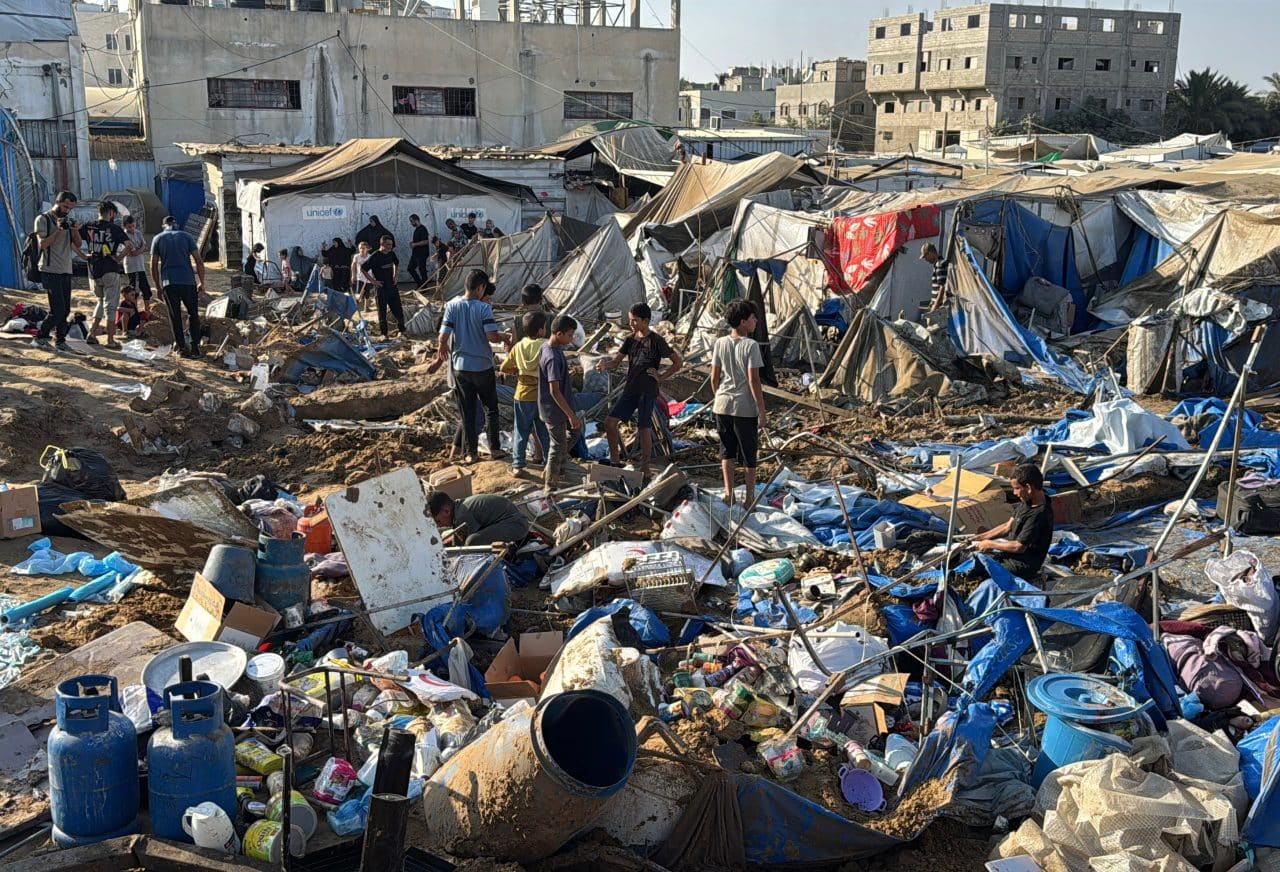
In every war, there is supposed to come a moment when the guns fall
silent and families are finally able to bury their dead.
In Gaza, that moment has still not fully arrived.
Nearly three years into the war, thousands of Palestinian families are
still waiting for the chance to recover loved ones from beneath
collapsed homes, buildings and streets. Their recovery should no
longer be treated as something that can wait for reconstruction or a
broader political settlement. Safe humanitarian access, heavy
machinery, forensic capacity and protection for recovery teams are
urgent humanitarian necessities.
Many families know almost exactly where their relatives are: beneath a
particular building, under a collapsed staircase, or behind layers of
concrete too heavy to move by hand. Across Gaza, rubble is not only
evidence of destruction. In many places, it is also a grave.
On August 4, 2026, Gaza held a mass funeral for 112 members of the
al-Hassayna and Abu Sharia extended family. Their remains had been
recovered from homes destroyed in Gaza City’s Sabra neighborhood in
November 2023. Their families had waited nearly three years to bury
them.
That funeral was more than an act of mourning. It was a warning about
what prolonged delay does to the dead — and to the living.
The longer human remains stay beneath collapsed buildings, the more
difficult identification becomes. Decomposition advances. Bones can
become separated. Personal belongings may be displaced. Forensic
evidence deteriorates. Gaza’s forensic capacity remains severely
limited.
For families, identification is not a technical detail. It is the
difference between a missing person and a known grave. It means being
able to hold a funeral, visit a burial place and begin mourning with
certainty.
The absence of formal identification can also prolong legal
uncertainty involving death registration, inheritance, guardianship
and other civil matters. A person can be gone in every human sense and
still remain unresolved on paper.
The physical obstacle is enormous.
A 2026 damage and needs assessment by the United Nations, the European
Union and the World Bank estimated that the war had generated more
than 68 million metric tons of rubble in Gaza. Some of that debris is
contaminated by unexploded ordnance, asbestos and other hazardous
materials.
Recovering the dead therefore requires far more than shovels.
It requires excavators, cranes, fuel, protective equipment, forensic
teams, DNA identification capacity, safe humanitarian access and
protection for the people carrying out the work.
Heavy machinery is not a luxury. It can mean the difference between a
body remaining beneath concrete and a family finally being able to
bury its loved one.
In July 2026, the United Nations Development Programme and the
European Union launched a €15 million initiative to support emergency
debris removal and strengthen Gaza’s capacity for the dignified
recovery and identification of human remains.
It is an important step, but the scale of the need is far greater.
The international community should insist on safe and unhindered
access to recovery sites, the immediate entry of heavy machinery, fuel
and necessary equipment, expanded forensic capacity, and protection
for civil defense, rescue, forensic and humanitarian teams.
These are not maximalist political demands.
They are minimum requirements of human dignity.
People will continue to disagree about politics and about the future
of this conflict. But there should be no disagreement over one basic
principle: the dead have a right to be recovered and buried with
dignity, and families have a right to know where their loved ones lie.
A bulldozer should not become a diplomatic bargaining chip.
A crane should not require a political breakthrough.
Reaching the body of a child should not become another battle.
Open the crossings and humanitarian routes. Allow the machinery and
forensic equipment in. Protect the teams recovering the dead. Give
families the chance to identify and bury their loved ones.
Because even after war has taken a life, it should not be allowed to
take away a name, a grave and a final goodbye.
Human dignity does not end with death.
Let Gaza bury its dead.
ZNetwork is funded solely through the generosity of its readers.
Donate




