


This bitter and not-so-subtle irony of history supplies a surreal confluence that was nearly unimaginable before now : merely to imagine the prime minister landing in Krakow, arriving at the main entrance of Auschwitz and being arrested by Polish police at the gate, under the slogan « Arbeit macht frei » (« Work sets you free ») ; merely to consider that of all the figures and countries, it is the prime minister of Israel who is prevented from attending the memorial for members of his people on account of the threat of international law hovering over his head. The German chancellor, yes ; Netanyahu, no.
Eighty years ago, when Auschwitz was liberated, it would have sounded like the most insane development imaginable. Not anymore. Eighty years ago, Jews were given a choice between two legacies : Never again, the Jews will never face a similar danger, or – Never again, no one in the world will ever face a similar danger. Israel clearly chose the former option, with a fatal addition : After Auschwitz, Jews are permitted to do anything.
Israel has implemented this doctrine in the past year as it never has before. A prime minister who dodged a ceremony in Auschwitz is perhaps the grossest illustration of this. The fact that of all the places in the world, Auschwitz is the first that Netanyahu fears going to, shouts symbolism as well as historical justice.
Other heads of state will attend the ceremony, but not Netanyahu. He is wanted by the tribunal – which was established in the wake of what happened at Auschwitz – on suspicion of war crimes that, with alarming speed, increasingly resemble the crimes of Auschwitz.
The distance between Auschwitz and Gaza, with a stopover in The Hague, is still enormous, but it can no longer be argued that the comparison is preposterous.
After reading Yaniv Kubovich’s nightmare report on what is taking place on the corridor of death in Netzarim, one realizes that this distance is shrinking by the day.
It has always been taboo to compare anything to the Holocaust, and rightly so. There has never been anything like it. The worst crimes of the occupation pale in comparison to the crimes of Auschwitz.
Moreover, this comparison always left Israel white as snow and its accusers as antisemites : After all, there are no death camps in Gaza, so every accusation can easily be rebuffed. There are no death camps, therefore the IDF is the most moral army in the world. There will never be death camps in Gaza, and nevertheless the comparisons are beginning to cry out from beneath the rubble and the mass graves.
When Palestinians in Gaza know that where packs of stray dogs prowl, there are human corpses eaten by the dogs, Holocaust memories begin to surface.
When in occupied Gaza there is an imaginary line of death, and anyone who crosses it is doomed to death, even a hungry or disabled child, the memory of the Holocaust begins to whisper.
And when ethnic cleansing is carried out in northern Gaza, followed by clear signs of genocide throughout the Strip, the memory of the Holocaust is already roaring.
October 7, 2023 is increasingly emerging as a fateful turning point for Israel, much more than it seems at present, similar only to its previous calamity, the 1967 war, which was also not diagnosed in time. In the Six-Day War, Israel lost its humility, and on October 7 it lost its humanity. In both cases, there is irreversible damage.
Meanwhile, we must consider the historical occasion and absorb its significance : a ceremony commemorating the 80th anniversary of the liberation of Auschwitz, world leaders march in silence, the last living survivors march alongside them, and the place of the prime minister of the state that rose from the ashes of the Holocaust is vacant.
It is vacant because his state has become a pariah, and because he is wanted by the most respected court that tries war criminals. It bears raising our heads for a moment from the Hanni Bleiweiss scandal and the Feldstein affair : Netanyahu will not be at Auschwitz, because he is wanted for war crimes.

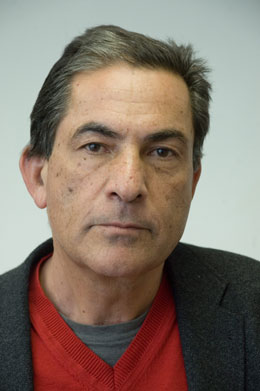
Gideon Levy is a Haaretz columnist and a member of the newspaper's editorial board. Levy joined Haaretz in 1982, and spent four years as the newspaper's deputy editor. He is the author of the weekly Twilight Zone feature, which covers the Israeli occupation in the West Bank and Gaza over the last 25 years, as well as the writer of political editorials for the newspaper. Levy was the recipient of the Euro-Med Journalist Prize for 2008; the Leipzig Freedom Prize in 2001; the Israeli Journalists’ Union Prize in 1997; and The Association of Human Rights in Israel Award for 1996. His new book, The Punishment of Gaza, has just been published by Verso Publishing House in London and New York.
ZNetwork is funded solely through the generosity of its readers.
Donate




