


Peter Hallward: I’d like to start by asking you about some of your basic philosophical principles, starting with your understanding of human freedom and creativity. In the modern European tradition I’m most familiar with, freedom is a dominant philosophical theme from Descartes through Rousseau to Kant. With Kant we have an affirmation of absolute freedom from all external causation, but it remains a relatively abstract affair, a matter of ‘pure practical reason’. This sets a post-Kantian agenda: from Hegel and Marx through to the Frankfurt School and their existentialist contemporaries, the question becomes one of trying to think freedom or rather the process of emancipation in a way that has more concrete socio-historical determination or ‘actuality’. Through to the 1930s, at least, for many of the thinkers in this tradition the role of mediating agent was played, one way or another, by the proletariat conceived as a tendentially universal class.
I know you’ve approached these issues from a different perspective, but like a lot of your readers I’m curious to know more about how you see these two aspects of your work: the libertarian aspect, oriented by an uncompromising affirmation of freedom, and the social/ historical aspect, oriented by an equally uncompromising critique of capitalism, imperial- ism, propaganda and forms of domination more generally.
On the face of it, many of your long-standing priorities and principles – the accounts of freedom you find in Descartes, von Humboldt and some of the classical liberals, your critique of behaviourism, your allegiance to aspects of the anarchist and libertarian socialist traditions, and so on – seem to form an internally coherent group, one that’s consistent across the whole sweep of your work. Is that how you yourself see it? Did your main ideas fall gradually into place over time, or were there quite specific debates or encounters that served to crystallize things?
Noam Chomsky Well, I was interested in anarchist ideas right back through my childhood, but I only learned about the deeper Romantic and rationalist tradition in the 1960s, after I’d pretty much settled most of my own ideas on the topic. I’d always been interested in the anarchist tradition itself, I’d investigated it, I’d thought it had been somewhat misinterpreted, but I can’t say that what lay behind the anarchist tradition in many ways was a direct influence – it was more like a discovery of historical origins for ideas I’d already been defending for some time.
The critique of behaviourism began very early, as soon as I found out about it. I was a graduate student at Harvard in the early 1950s, and radical behaviourism was orthodox and ubiquitous. There were a couple of us, graduate students, who just didn’t believe any of it. We were very critical of behaviourism, particularly with respect to the way it was used in the study of language, of course, but also in psychology and the social sciences, and in American philosophy more generally.
Ph Partly as a critique of social engineering?
NC That too, but it was mainly a critique of its scientific pretensions. It was worthless as an explanation of language acquisition, for instance, and it missed some of the more important work that was happening in biology at the time. So we looked at materials that not many people were reading in those years – European work in ethology, comparative psychology, people like Nikolaas Tinbergen and Konrad Lorenz, who offered a very different way of understanding behaviour and the cognitive systems at work in behaviour.
Later I wrote criticisms of the social and political implications of behaviourism, and right around that time, say around 1960, I was beginning to learn about the earlier tradition in the philosophy of language and mind, the tradition that includes Descartes and von Humboldt.
It was almost totally ignored here: when I started working on it I couldn’t even get hold of the basic documents in the United States; I had to go to the British Museum to find things like translations of the Port Royal grammar, and I found that standard translations, like of Leibniz, say, were sometimes very inaccurate.

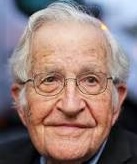
Noam Chomsky (born on December 7, 1928, in Philadelphia, Pennsylvania) is an American linguist, philosopher, cognitive scientist, historical essayist, social critic, and political activist. Sometimes called "the father of modern linguistics", Chomsky is also a major figure in analytic philosophy and one of the founders of the field of cognitive science. He is a Laureate Professor of Linguistics at the University of Arizona and an Institute Professor Emeritus at the Massachusetts Institute of Technology (MIT), and is the author of more than 150 books. He has written and lectured widely on linguistics, philosophy, intellectual history, contemporary issues, and particularly international affairs and U.S. foreign policy. Chomsky has been a writer for Z projects since their earliest inception, and is a tireless supporter of our operations.
ZNetwork is funded solely through the generosity of its readers.
Donate




