

During the COVID-19 pandemic and its associated economic downturn, many people couldn’t pay their transportation costs, and often didn’t. In New York City in 2021, some 21 percent of bus riders did not pay the fare, a figure that grew to 48 percent in 2024. Some local governments, including New York City, responded with reduced or free fare programs. From 2023 to 2024, New York’s Metropolitan Transit Authority (MTA) ran a zero-fare bus pilot that served around 43,000 riders. The pilot, championed by then-assembly member Zohran Mamdani, offered free trips on one bus in each borough.
To expand this small pilot to universal zero-fare buses throughout New York City is a tall task, with a total 2024 bus ridership of 409 million and 6,300 buses. As mayor-elect Mamdani and his administration look to grow zero-fare buses in New York, they have a stellar example just a few hours south of New York, in Maryland.
The largest free bus program in Maryland by ridership is in Montgomery County, a suburb north of Washington, D.C.
Montgomery County first made its “Ride On” buses free to all riders under 18 in 2019. Then on June 29, 2025, it made all of its buses fare-free for all passengers. The system has a fleet of nearly 400 buses, 80 routes, and provided 19.2 million rides in the 2025 fiscal year. In the three months since free fares were instituted, ridership has increased by 5.4 percent. Phil McLaughlin, General Manager of Transit Services for Montgomery County Department of Transportation (MCDOT), said an estimated 1 percent to 2 percent of that ridership increase came from instituting zero fares.
One reason Montgomery Country’s City Council adopted the zero-fare program was financial. Montgomery County reduced fares during the pandemic from $2 to $1 and saw lower fare revenues (dropping from $10 million to roughly $1.6 million) overall. When faced with the need to upgrade its fare collection systems to tap-to-pay in order to align its fare boxes with Washington D.C.’s Metro system, it became clear that replacing the fare boxes would cost more than they would recoup: The cost was estimated at $22 million and would take approximately eight years to begin turning a profit. In addition, it cost the county $557,000 annually to collect fares. Montgomery County was faced with either paying police to enforce fares or going fare-free. County Executive Marc Elrich proposed a fully fare-free bus system in his 2026 fiscal year proposed operating budget, and the county council adopted it soon after.
Montgomery County Councilmember Evan Glass, chair of the Council’s Transportation & Environment Committee, told Truthout that fare-free buses are “bringing real impacts for Montgomery County residents” and the increased ridership shows that “cost barriers make a real difference. In a county with a median income of $115,000, compared to $35,000 for the average bus rider, fare-free transit is fundamentally about equity.”
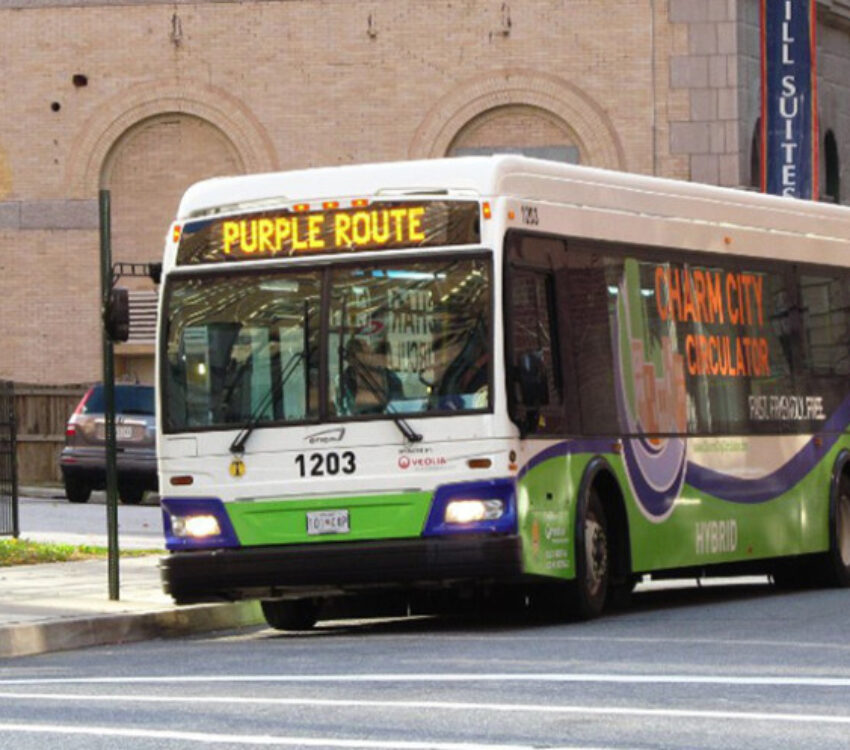
The oldest free bus program in Maryland is likely Baltimore’s Charm City Circulator (CCC), first established in 2010 by then-mayor Sheila Dixon and funded through state transportation department grants. In 2024, the CCC provided 1.43 million rides, according to the Baltimore City Department of Transportation. The CCC has over 100 stops along five routes, with buses arriving every 13-20 minutes, and operates on an $8 million budget. Its impact has been overwhelmingly positive: a 2022 rider survey showed that over 40 percent of people who use the CCC would have used single-occupancy vehicles to make their trips, if not for this free service, thus reducing overall traffic congestion and vehicle emissions.
These programs, while crucial, still need to be built upon. Previously, local residents have pointed out that the bus service has a history of disproportionately serving majority-white neighborhoods and tourist mainstays, and has connected primarily to the city’s largest predominantly white institutions such as Johns Hopkins and the University of Maryland, while not offering the same level of service to majority-Black neighborhoods or Baltimore’s historically Black colleges and universities, such as Morgan State University or Coppin State. More public investment in the city-wide transit programs can help bridge the gap. In one promising improvement, Baltimore mayor Brendan Scott recently announced an expansion of the CCC to three East Baltimore neighborhoods beginning on December 7. The Baltimore City Department of Transportation told Truthout that the expansion is aimed at “improving equity of city services” and that it will add fast, free transit options to “communities that have relatively low vehicle ownership.”
Dr. Lawrence Brown, a research scientist in the Center for Urban Health Equity at Morgan State University, told Truthout that while “there is still work to be done,” the changes to the CCC since 2020 — including the Cherry Hill line addition in 2024 (which serves a neighborhood that is 90 percent Black and historically redlined) — “represents a change in the right direction.” Dr. Brown elaborated that “The Green line changes are definitely an improvement from an equity perspective as it extends into historically redlined central East Baltimore,” but “the Brooklyn/Curtis Bay community is still being left out although it also has tremendous transit needs.”
In an interview, Minister Glenn Isaac Smith, co-founder and president of the Baltimore Transit Equity Coalition, told Truthout, “We had long advocated for the extension of the circulator” including its expansion into Cherry Hill, and called the November changes “a welcome addition.” He continued, “The East Baltimore extension will service people who need transportation and a lot of times cannot afford it, especially if they are on a fixed income and need to travel to doctor’s appointments, or need to travel to buy groceries since it’s a food desert.”
West of Baltimore, the more rural but quickly-growing Frederick County made all of its mass transit free at the start of the COVID-19 pandemic and never went back. Transit Services of Frederick County, which includes buses and a paratransit service called Transit Plus, served a little shy of 1 million riders in fiscal year 2025 [928,650 riders], a record ridership for the county (up from over 540,000 trips in FY2022). It operates on a $9.3 million budget and has six lines and a fleet of 48 buses, four of which are all-electric and powered by a solar array at the Frederick County landfill, according to an emailed statement from Mary Dennis, Communications Manager for Transit Services of Frederick County. Its buses also serve many of the local food banks in Frederick, a fact advertised on Frederick Transit’s homepage.
Frederick resident and Transit Plus rider Jose Gabriel Coronado Flores, who uses a wheelchair, told Truthout that “I’m glad price is no longer a concern.” Coronado Flores pointed out that Transit Plus’ scheduled hours interfere with civic participation for the elderly and disabled people who rely on it, as many Frederick County government meetings happen later in the evening, when Transit Plus no longer schedules trips. This “keeps out many disabled people from participating in the processes which have to do with them,” Coronado Flores said.
Christian Benford, a candidate for Frederick County Council, told Truthout, “It is fantastic to have a program that provides alternative travel, reduces carbon emissions, and is at no-cost to residents.” Benford also pointed out improvements could be made to accessibility in the county overall, adding, “Frederick, as a whole, is not very walkable. So, while there are stops at key locations, it still requires crossing dangerous intersections or moving on uneven or poorly maintained public infrastructure.”
Like New York, Maryland faced reduced fare collections on buses in the state during the pandemic. Rather than increasing enforcement, Montgomery County and Frederick County, implemented temporary reduced or zero-fare measures. Seeing the financial and public benefits, both counties went fully zero-fare permanently. Zero-fare buses address a key equity gap noted in a 2024 report by Montgomery County called “Ride On Reimagined,” which found that 27 percent of Montgomery County residents in Maryland make less than $20,000 a year, showing the need for free public transit to connect residents to jobs and education. Maryland’s zero-fare bus programs provide an important model to the incoming Mamdani administration and others who want increased equity in their cities.
More can and should be done in Maryland, as these advancements in buses are coming amid a $2.1 billion statewide shortfall in public transit funding, leading to the elimination of many new road and transit projects. In Baltimore, a light rail extension called the Red Line was cancelled in 2015, and “set transportation in Baltimore back ten years,” said Smith. Maryland Gov. Wes Moore has made getting the Red Line built one of his platform promises, and Smith said, “We look forward to further expansions into the east-west corridor” of Baltimore.
Like in New York, there is much coordination that needs to take place between state, city, and county governing bodies to make public transit deliver better for all its residents. But Benford, at least, sees opportunity in what’s left to be done: “This is a great instance to foster better partnership between the county and city councils to engage with constituents. We may have different governing bodies but should always look for meaningful ways to work together.”
ZNetwork is funded solely through the generosity of its readers.
Donate





2 Comments
link to youtube video of “Fare-Free Transit” public domain folk song:
https://youtu.be/aiKa0hCAG4k?si=5L8aSJxECfKuJ8dA
Also, from a 2022 public domain folk song: “You can ride all buses free in Kansas City
You can ride all buses free in Olympia
You can ride all buses free in Albuquerque.” https://patch.com/massachusetts/boston/fare-free-transit-folk-song