

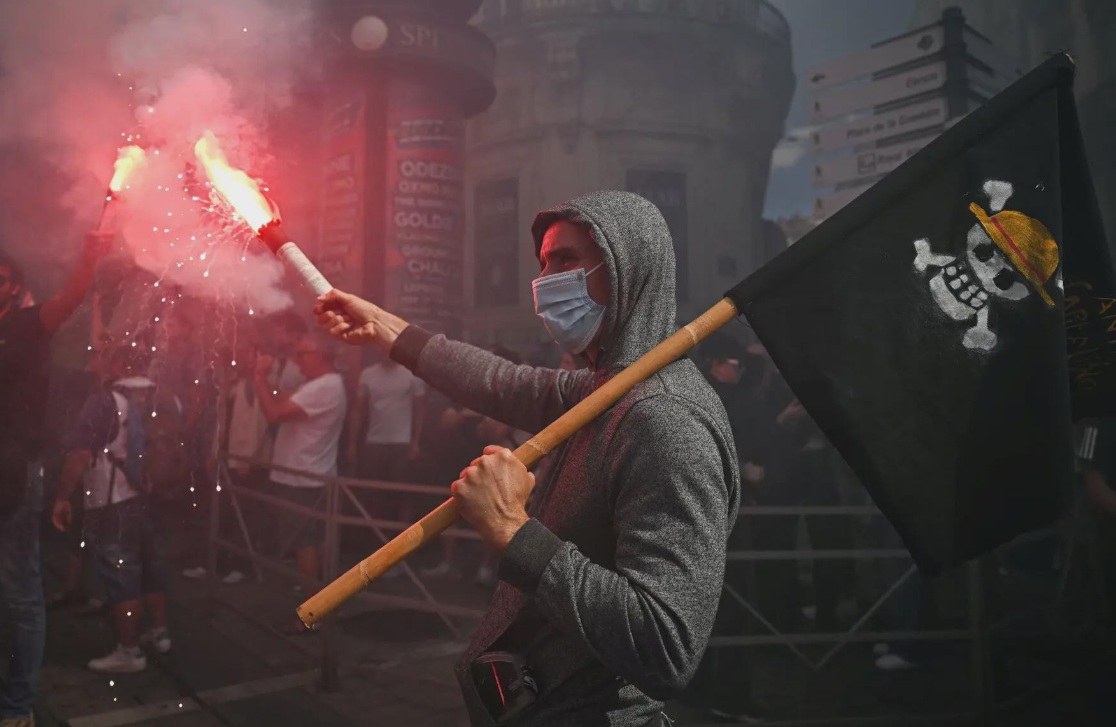
“Due to social unrest, the Musée d’Orsay is closed,” a sign might have read on Wednesday, when tourists were not able to admire the works of Courbet. The great revolutionary painter would have surely looked on with sympathy at this shutdown laden with irony, and at the movement that paralyzed Paris on Wednesday with the rallying cry of “let’s block everything.”
There were some thoughtless vandals, to be sure. But the protesters were mostly young people, very many women, many immigrants, and red banners were everywhere.
Some say the movement originated among the sovereignist right, active on social media. Although that is possible, there was little sign of them on the streets on Wednesday. The “blockaders,” as we’ll call them, employ a subversive language in which the term “nation” – in its republican, very French sense – is certainly present. But the rioters’ key word is another: “Equality.” This word was chanted insistently, wielded like a dialectical weapon, primarily against Macron’s policies of privilege – policies that the post-fascists in the National Assembly would like to support more openly than they can currently admit.
The protest is directed first and foremost against the anti-social program Macron is trying to force on the country. This includes over €40 billion euros in cuts, to be administered in the usual way: a freeze on pensions and social benefits, a halt to public sector hiring, the dismantling of public healthcare, and – perhaps uncoincidentally – the abolition of the May 8 national holiday celebrating the victory over Nazism.
Jordan Bardella and the other blackshirts in parliament would have been happy to take the bait. But for now, they must stage the old farce of being a “social” and rebellious opposition on the right. We know the kind of U-turn they will be capable of if they come to power, as the government of Giorgia Meloni in Italy has shown.
This doctrine of sacrifices is justified in the usual way: public debt is too high, and the French state is Europe’s last great spendthrift. The inefficient public apparatus must be sanitized, cleaned up, and re-disciplined. Before being forced from office, the just-resigned Prime Minister François Bayrou had even resurrected the old Thatcherite motto: “there is no alternative.”
If we look closely at the data, however, reality looks a bit different. France has a public debt of around 115 percent of GDP. That’s higher than Germany and the European average, but lower, for example, than Italy’s 135 percent. Yet France is in the crosshairs, while Italy, for the moment, is less so. Why is that?
The reason lies in a fact that has rarely made headlines but is now well-known to economists, both critical and mainstream. A country’s financial fragility depends not so much on its public debt, but on its external debt, both public and private. In other words, what matters more than the amount the state borrows from its own citizens is the amount the state and private sector borrow from foreign creditors, often to finance imports higher than exports. In short, financial fragility isn’t simply a problem of a spendthrift public sector; it is a larger problem of a national capitalist system that is less competitive than its rivals.
From this perspective, France’s external debt exposure is over 20% of its GDP. Italy, on the other hand, no longer has this problem. This is not because Italian capitalism has solved its competitiveness problem, but for the opposite reason: for years, we implemented so much austerity that our national income collapsed and, with it, our imports plummeted. The country is now a net creditor to the rest of the world – deindustrialized and impoverished, but a creditor nonetheless.
In a sense, France is now being called upon to follow the “Italian doctrine” of the harsh austerity-focused government of Mario Monti. If it does, this would mark the beginning of the definitive erosion of the last major capitalist economy competing with that of Germany – a complete Germanization of Europe, at the expense, first of all, of French workers.
Herein lies the challenge for anyone who truly wants to embrace the demands of the “blockaders.”
Before it ends up being repressed, the wind of revolt sweeping through the squares of France must be transformed into a comprehensive, alternative economic policy project – one that could also become an alternative path for today’s grim and warmongering Europe.
Technical solutions do exist, starting with a freeze on military spending and capital flight. It can work, on one condition: the center of gravity around which this new project is built must be equality, rather than the nation. This is how the post-fascists can be unmasked; this is how hegemony can be built. The “blockaders” are showing the way.
ZNetwork is funded solely through the generosity of its readers.
Donate




