

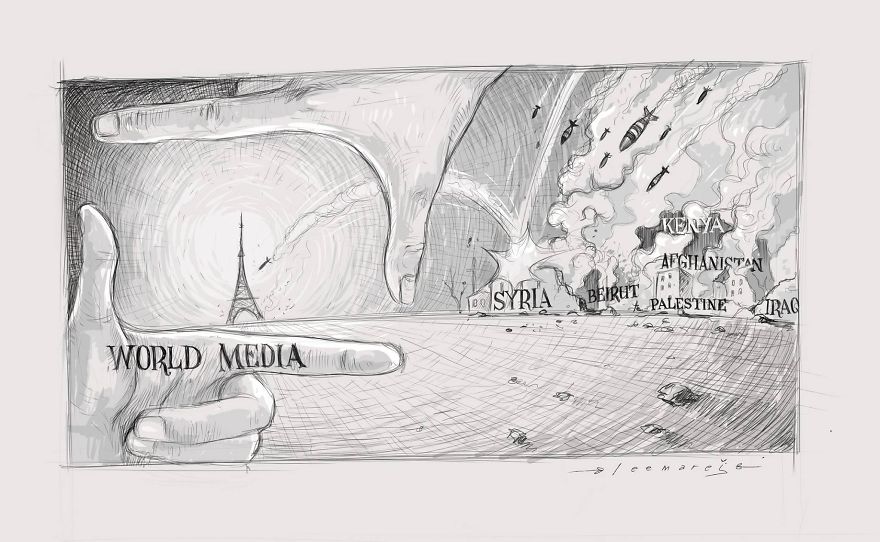
When a gunman opens fire in a crowded venue or a vehicle plows into pedestrians in Berlin, New York or London, the linguistic reflex of Western corporate media is swift and predictable. If the perpetrator bears an Arabic/Muslim name or background, the media seizes upon terms like “Islamic terrorism,” “radical extremist,” or “jihadist plot.” Faith is immediately elevated as the primary interpretation for the unlawful act.
Yet, when similar acts of mass violence, domestic bloodshed or ideologically-motivated murder are committed by individuals identifying as Christian, Jewish or other major Western traditions, the nomenclature shifts dramatically. They are routinely characterized as “lone wolves,” “troubled youth,” “mentally unstable” outcasts or victims of personal grievance. Their religious texts, affiliations or institutions are rarely, if ever, offered up as breeding grounds for terror.
This disparity is not a product of fair journalism or academic discourse. It is an institutionalized rigid double standard shaped by global politics, systemic bias and old ideas about human worth.
The root of the imbalance—the “othering” of one group over another—lies in how news rooms, classrooms and political systems have constructed and manipulated the concept of “threat.”
For decades, Western media echo chambers have operated within a worldview shaped by the post-Cold War era and accelerated exponentially by the post-9-11 “War on Terror.” Within this framework, violence committed by a Muslim is rarely viewed as a localized criminal act; instead it is reframed as symptomatic of a monolithic clash of civilizations.
When a Muslim commits a crime it is not recounted as the exceptional act of an individual. Rather, the offender’s religion is treated as a contagious ideology, an expression of a larger demographic threat. The violator is systematically linked to a global network, an ideology or a theological framework, defaming the religion and essentially censuring its more than two billion followers.
Conversely, when a white Christian, or individual from a dominant Western background commits an illegal act—whether driven by racial supremacy, anti-abortion extremism or fundamentalist Christian ideology— the media rarely, if ever, associates the individual and his/her malevolence with the broader community. Christian or Jewish perpetrators are sanitized of collective guilt. Their actions are attributed to mental illness, isolation or a personal crisis, preserving the moral innocence of the broader religious group.
At its core, the refusal to label crimes by Christians or Jews as religious terrorism stems from the privilege of individualism. Adherents of these faiths are viewed as complex individuals, because they are historically and culturally entwined with the dominant Western power structure. Muslims, on the other hand, are routinely denied this individual complexity. They are flattened into a single homogenized political identity, where every action is scrutinized through a security lens.
Empirical evidence consistently refutes the assumptions that underpin such biased reporting. Statistical analyses of domestic and international terrorism reveal a stark contradiction in media framing.
Studies examining ideological violence in Western nations have consistently revealed that non-Muslim actors—far-right extremists and white supremacists—
are the major source of terrorism and violent events.
Research by organizations like The Institute for Social Policy and Understanding (ISPU) and academic content analyses indicates that violent acts committed by offenders perceived to be Muslim receive substantially more media coverage—frequently, hundreds of times more—than identical acts committed by non-Muslims.
The media skews reality when it amplifies attacks by Muslims, while minimizing or compartmentalizing violence by others. This self-reinforcing negative cycle feeds public anxiety, weaponizes Islamophobia and directly influences domestic and foreign policy. It serves to normalize atrocities against Muslims and to justify surveillance, discriminatory legislation and military interventions and wars in Muslim-majority nations.
The selective application of the word “terrorism” is a powerful ideological tool. In labeling crimes selectively, the media and political establishment dictate who belongs to the “civilized in-group” and who is marked as a member of the threatening “unruly out-group.”
Until the language of crime and terror is stripped of its double standards and racialized biases, media coverage of violence will remain less an exercise in objective truth and more an instrument of cultural and political control.
Dr. Behnam is a political scientist who specializes in comparative politics with a focus on West Asia. His “Cultural Foundations of Iranian Politics,” published by University of Utah Press, and still in print, was recognized by Choice as Outstanding Academic Book for 1987–1988.
ZNetwork is funded solely through the generosity of its readers.
Donate




