Source: The Conversation

There’s more to Antarctic ice than meets the eye. Sea ice is not a uniform crust overlying the salty Southern Ocean.

Our new research is the first to review the many crucial roles of “landfast” sea ice around Antarctica. Landfast ice is frozen seawater that is fastened to the coast. It acts like a belt around the Antarctic coast, regulating the flow of ice shelves and glaciers into the sea. And it’s crucial habitat for Weddell seals and emperor penguins.

Satellites can easily estimate the horizontal extent of sea ice, but determining the type of ice is far more difficult. Our deeper analysis of satellite images reveals landfast sea ice extent declined to a record low of just 123,200 square km in March 2022. That’s well below the normal March range of 168,600-295,200 square km.
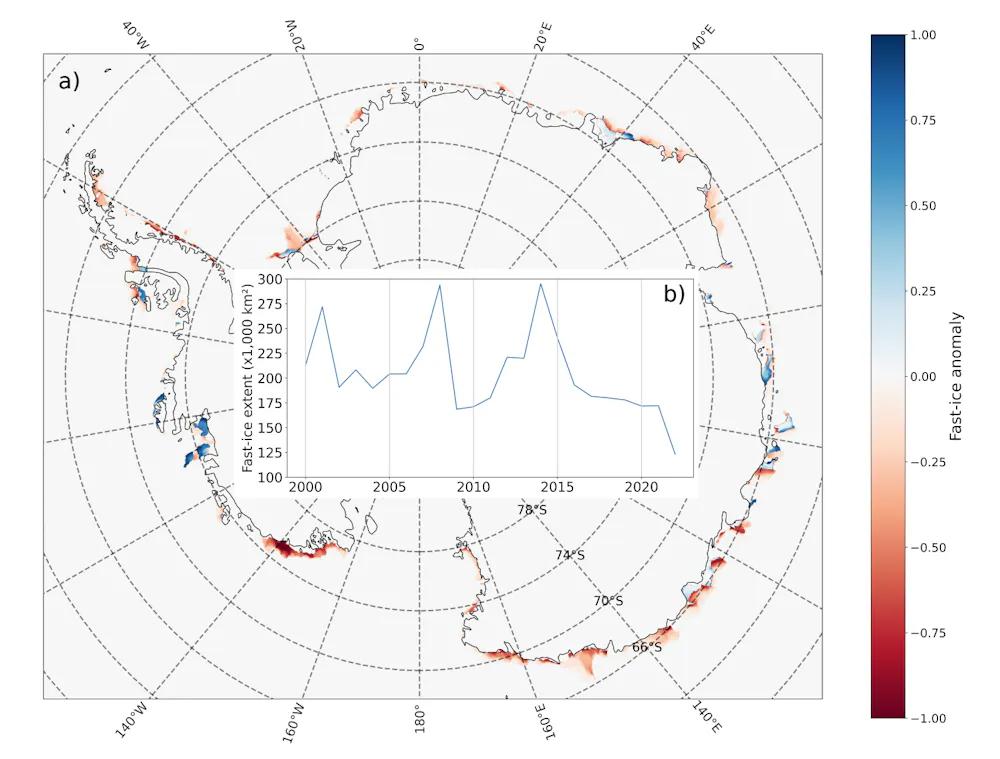
Distribution of anomalies in Antarctic fast-ice extent in early-mid March 2022. Red shading indicates negative anomalies, with a value of -1.0 indicating a lack of fast ice in 2022, in a region that has had early-mid March fast-ice cover every year from 2000 to 2021. Inset (b) is a time series of early-mid March fast-ice extent from 2000 to 2022. (Source: Reviews of Geophysics, CC BY-NC)

Much of the ice lost in 2022 had been present since 2000, when high-quality records began. If this trend persists, the consequences for the climate and for Southern Ocean ecosystems could be catastrophic.

Getting a grip on landfast ice

Antarctic sea ice drives the circulation of the world’s oceans. The “overturning” circulation begins in Antarctica when very salty, dense brine (created as the ice forms) sinks to the bottom of the ocean. This “bottom water” spreads away from Antarctica to reach the northern hemisphere.

This crucial circulation is projected to slow due to glacial melt, because the input of more buoyant fresh water dilutes the denser brine. This raises the spectre of a further slowing or worse, total shut down of deep ocean currents as in the disaster movie, “The Day After Tomorrow”. We know concentrated regions of sea ice formation tend to occur next to landfast ice, so the changes we are seeing are likely to further reduce this deep ocean circulation.

Global climate models are not particularly skilful at reproducing the recent history of Antarctic sea ice, giving limited confidence in our ability to predict its future. There are many reasons for this, but one of the main ones is an overly simplistic representation of the sea ice.

Landfast sea ice is not represented in any global climate model. These models treat all sea ice as if it’s able to drift, whereas in reality up to 15% of ice should be held still by being anchored to land or grounded icebergs.

This is a big problem because, as our study reveals, if we don’t properly simulate it, we are likely to get all kinds of inaccurate flow-on effects, including an incorrect amount of sea ice (and hence dense water) produced by our models?.

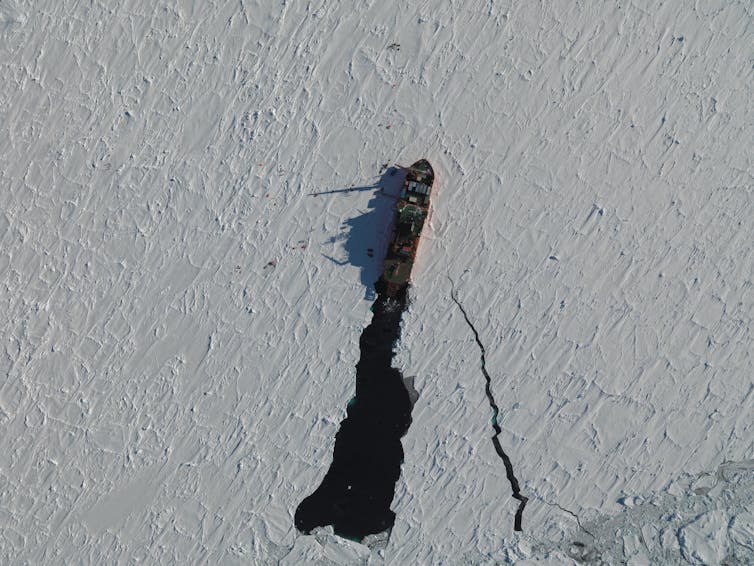
Icebreaker Aurora Australis in landfast ice. Jan Lieser

Wildlife depends on landfast ice

Landfast ice supports a unique community of algae, krill, small crustaceans called copepods, molluscs and fish. They are adapted to live within and below the ice where conditions are harsh.

These species form a complex food web around ice algae, using the ice as a nursery ground. Life within landfast ice requires wide-ranging survival strategies. Drastic changes could mean cascading effects on the entire food web.

Seals and penguins rely on this environment for resting, hunting and breeding. Emperor penguins have a unique approach to raising a family that requires stable ice, which only landfast ice can provide. Reduced ice extent, increased fragmentation and earlier breakup can lead to population declines of this iconic species.

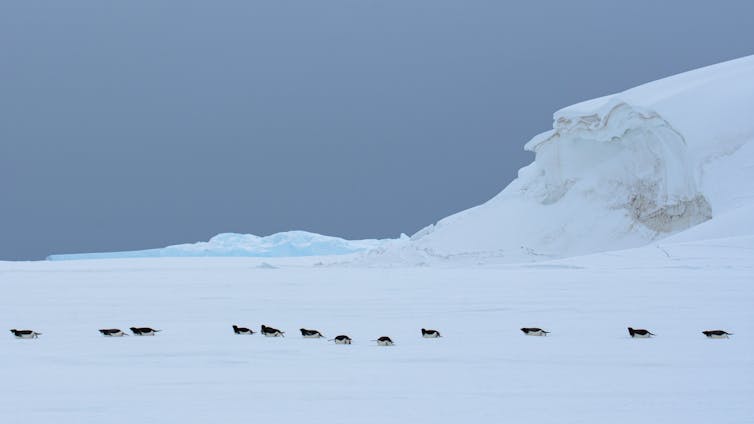
Adélie penguins toboggan on landfast ice. Pat Wongpan

Deeper knowledge is crucial for climate forecasts

Only a few areas of Antarctic landfast ice are regularly sampled. These areas are found near Antarctic research stations and are generally separated by thousands of kilometres of coast.

Additionally, scientists can often only safely collect sea ice cores from smooth ice thick enough to support people. So sampling is skewed to favour the unbroken crème brûlée-type crust over the shattered meringue of rough landfast ice.

To better understand rough landfast ice and a slew of other poorly understood ice types, we need repeat ice core measurements along with more detailed satellite studies. We also need the capability to model each ice type accurately.

Our research has ensured landfast ice is earmarked for inclusion in the next iteration of our national climate model, which aims to better simulate the interactions between sea ice of all types and the Southern Ocean. Without this ability, we are missing a key ingredient in the recipe of Australia’s climate future.


This article was originally published by The Conversation; please consider supporting the original publication, and read the original version at the link above.

ZNetwork is funded solely through the generosity of its readers.

Donate
Donate
Leave A Reply

Subscribe

All the latest from Z, directly to your inbox.

Institute for Social and Cultural Communications, Inc. is a 501(c)3 non-profit.

Our EIN# is #22-2959506. Your donation is tax-deductible to the extent allowable by law.

We do not accept funding from advertising or corporate sponsors.  We rely on donors like you to do our work.

ZNetwork: Left News, Analysis, Vision & Strategy

Subscribe

All the latest from Z, directly to your inbox.

THE WIND CRIES FREEDOM

The Wind Cries Freedom, the new book from Z co-founder Michael Albert, is a sweeping oral history of a future American revolution.

Through thirty interconnected chapters, it draws out the strategies, failures, turning points, and hard-won wisdom of a movement that called itself the Revolutionary Participatory Society. These are not the polished memoirs of politicians: they are the unfiltered accounts of people who organized in neighborhoods, hospitals, universities, stadiums, courthouses, and places of worship, and kept a shared vision alive through cynicism and exhaustion.

The result is speculative political fiction that reads like history: messy, human, and quietly hopeful in the way that only real experience and long thought can produce.

Get your copy and peruse more features on the book’s website below.

“Read it, argue with it, but don’t look away. The future it recalls is one we must still fight to deserve.”

Yanis Varoufakis

“The most unusual and intriguing combination of prophecy, manifesto, and movement building manual that I have ever encountered.”

Bill Fletcher Junior

“This work fills a huge gap in our social movement literature.”

Cynthia Peters

You've just read your article on Z this month.

DOES Z'S SURVIVAL MATTER?

You keep coming back for a reason: serious political analysis, movement reporting, and debate beyond the priorities of corporate media. Today, Z is in a precarious financial position. If Z is part of how you understand the world, help keep it going. The readers who give monthly are the reason this work survives between fundraisers.

Z is in a precarious financial position. If it’s part of how you understand the world, help keep it going.

Number of donors715
Our goal1,000

Sustainers at $9/month or more receive the digital Z Magazine.

Already a sustainer? Click here and we won’t ask again. Thank you!

Your reading count is stored only in your browser and is never sent to us.

Sound is muted by default.  Tap 🔊 for the full experience

CRITICAL ACTION

Critical Action is a longtime friend of Z and a music and storytelling project grounded in liberation, solidarity, and resistance to authoritarian power. Through music, narrative, and multimedia, the project engages the same political realities and movement traditions that guide and motivate Z’s work.

If this project resonates with you, you can learn more about it and find ways to support the work using the link below.

Z is in the most precarious financial position in its history.

Z is a place to think beyond the limits of the present.

For decades, Z has brought together political analysis, movement reporting, debate, and visions of a different future from writers and activists around the world. That work is more than journalism. It is movement infrastructure: movements need places to develop ideas, test arguments, learn from experience, and imagine what comes next.

In the first two days of this fundraiser, 19 donors and 8 new monthly sustainers stepped up. Help us reach 1,000 donors who keep Z independent, for everyone.

For decades, Z has published the analysis, debate, and visions movements need, free of paywalls, ads, and billionaire owners. If that work should continue, Z needs your support now.

Number of donors715
Our goal1,000

Sustainers at $9/month or more receive the digital Z Magazine.

Subscribe

Join the Z Community – receive event invites, announcements, a Weekly Digest, and opportunities to engage.

Exit mobile version