



Tosha Alberty (Center) being evicted from her home in Oakland, California. (Photo: David Bacon)

Oakland – At eight in the morning on Monday, ten Alameda County sheriffs arrived in their patrol cars in front of the tan house on the corner of Tenth and Willow in west Oakland, the oldest African-American neighborhood in the city and one of the oldest on the west coast. The renovated home is surrounded by an iron fence, and the sheriffs poured through its open gate and up the stairs.
Tosha Alberty had just left for work for her job as a transportation services coordinator for Alameda County. Her children were still at home, though. Sheriffs told her adopted son Christian, a nine-year-old with autism still in his undershorts, to get dressed. Alberty’s daughter Sharquita rushed to collect the bottles and diapers she needed to take care of her nine-month-old baby Zmylan. All of them were then hustled out of the front door, down the steep steps, through the gate in the iron railings and onto the sidewalk.
Sheriffs had threatened to evict the family before, an action stymied when a local locksmith, seeing that he was about to shut the family out of their home, had refused to cooperate. This time, however, a more compliant locksmith drilled out the door locks so the family couldn’t get back in. Other workmen nailed sheets of plywood over every window to keep the Albertys out. And a new brass and steel padlock was fastened to the gate.

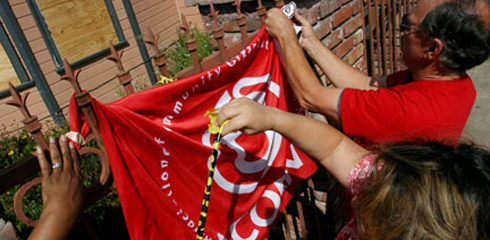
Tosha Alberty and her husband James, a cancer survivor, had lived in the home with four children and two grandchildren for four years. Tosha had grown up in the same neighborhood, and had been house hunting for a long time when she found the place in 2005. Although she was unemployed at the time, her mother had died and left her a little money. She talked with a real estate broker, who pushed her into a nonconforming loan with no down payment with First Franklin Mortgage Services.
“I thought my loan was for $520,000, and that I’d be paying $2,800 a month,” she recalls. “But I discovered that it was for $550,000, and the payment was much more.” Alberty got a union job with the county, though, where her husband was also working. They barely made the payments. But then the monthly installments ballooned to close to $5,000. “I knew I couldn’t do that,” she says. “But when I tried to renegotiate them, they said that since I’d been paying before, they wouldn’t help me. So, I stopped paying.” The loan went into default.
First Franklin, which moved from making normal mortgages to nonconforming loans back in 1994, boasts on its web site that “First Franklin makes it easy for mortgage brokers to find flexible, hassle-free home loan solutions.” The lender was bought by Merrill Lynch in 2006. Merrill Lynch closed in last year’s meltdown, and was bought for $50 billion by Bank of America. Last week, Bank of America reported second-quarter profits of $2.4 billion, it’s second straight profitable quarter since the mortgage crises started, despite losses from bad loans. No wonder. The bank received $45 billion in bailout money from the Troubled Asset Relief Program.
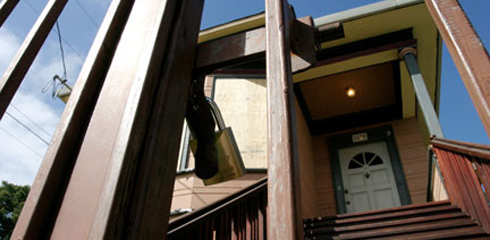
None of that money is going to the Albertys, though, despite promises that the bailout would enable the renegotiation of loans, and keep people in their homes. Bank of America, however, did spend $2.3 million in 2008 on lobbying Congress, and another $1.5 million this year. The bank wants flexibility on how it spends that TARP money, with fewer restrictions on huge bonuses for executives, on fees for credit card holders and even on home mortgage lending to other Oakland residents.
When First Franklin’s “hassle-free solution” became her eviction, Alberty joined ACORN’s Home Defender campaign. Twice in May, the sheriffs came to put the family out, and twice they met a resolute group determined to keep the Albertys from being dumped on the sidewalk. That’s undoubtedly why they swooped down without warning on July 20, just after Tosha had left for work.
ACORN Home Defender Martha Daniels, who herself had been threatened with a foreclosure eviction, held an impromptu press conference that afternoon in front of the padlocked iron gate. She vowed, “We will find a way to put Tosha and her family back into this house. There is no justice here.” Representatives of city council members and a county supervisor announced their support.
As Tasha Alberty leaned on her brother and cried, though, her father Charles wondered, “There’s something wrong with this country. My daughter just needed a house for her family. What was she supposed to do?”


David Bacon is a photojournalist, author, political activist, and union organizer who has focused on labor issues, particularly those related to immigrant labor. He has written several books and numerous articles on the subject and has held photographic exhibitions. He became interested in labor issues from an early age and he was involved in organizing efforts for the United Farm Workers, the United Electrical Workers, the International Ladies' Garment Workers' Union, the Molders' Union and others.
ZNetwork is funded solely through the generosity of its readers.
Donate




