

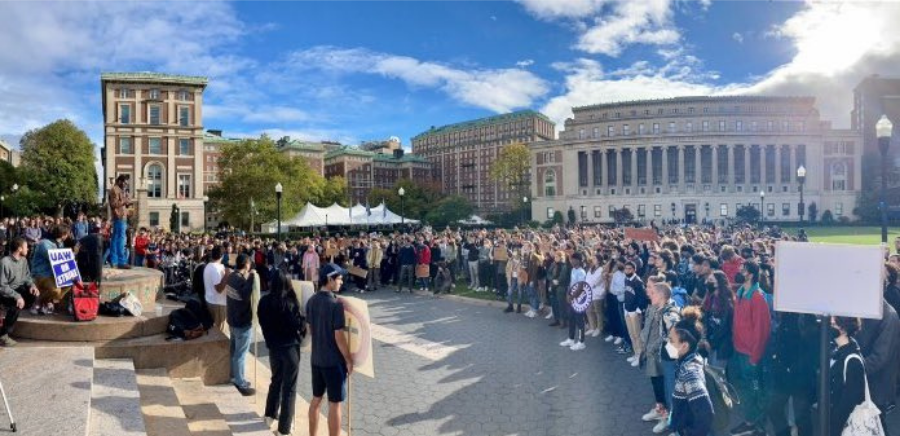
In 2019, the National Labor Relations Board proposed shrinking the definition of “employee” to exclude college students working for their university in connection with their studies. In their eyes, the relationship between a private university and a student worker engaged in teaching or research was primarily educational, not financial.
If accepted, the rule would have severely limited student workers’ right to unionize. But in early 2021, President Joe Biden’s NLRB suddenly withdrew the proposal, citing limited resources. The agency would instead focus on the “adjudication of cases currently in progress.” Biden had been sworn in less than two months before, appointing a former union leader, Marty Walsh, as labor secretary.
Now, public approval of labor unions is at the highest level since 1965, with 71 percent of Americans in favor of organized labor. Along with more progressive appointees in the NLRB, the national coverage of the union drives at Amazon and Starbucks has further solidified the idea that unions are still both relevant and potent.
This union resurgence is also finding expression in American higher education. The fight to organize private university employees has historically focused on graduate workers, but now undergraduate workers are increasingly seeking out the benefits of collective bargaining. It wasn’t until 2016 at Grinnell College that undergraduate students at private institutions gained the right to collectively bargain, when a union of student dining workers was voluntarily recognized by the school.
In those six years, unionizing efforts have had mixed success thanks largely to the constraints imposed on organizing by the Trump-era NLRB. Since Biden became president, undergraduate student workers have fought for union recognition at Kenyon College, Hamilton College, and Dartmouth. This year, after Dartmouth decided not to formally recognize the union, students had to go through an election process with the NLRB. But the vote passed unanimously, making them the fifth undergraduate union in the country. That same month, student workers at Wesleyan also won voluntary recognition from their university. And just this week, undergraduate resident assistants at Barnard College filed for union recognition
For undergraduate students, the financial pressure of going to college has never been worse. The cost of attendance at private colleges has risen aggressively, with tuition and fees around 20 percent higher than a decade ago. In 2018, 43 percent of full-time students were employed, with poorer students disproportionately working the most. Higher wages won by unionization can alleviate the pressure faced by rising tuition costs, and Dartmouth student dining workers formed the union specifically to fight against wage stagnation and overworking during the pandemic.
“There is quite a common idea and misconception that students at private, liberal-arts schools are wealthy and that they should feel lucky. For so many students it is not true, because many students use those jobs they get in school to put themselves through school,” said Emma Kang, a student worker at Kenyon College involved with the Kenyon Student Worker Organizing Committee.
“I feel like it is important to have job stability—to have a say in how the college is treating us.” In 2020, Kenyon’s administration declined to recognize the union. KSWOC filed for an election with the NLRB nearly a year ago; today students are still awaiting their union election date.
Many students that receive federal financial aid at private liberal arts institutions are expected to take a work-study job to cover expenses. For Grinnell students, the package is around nine hours of work per week for around $9 an hour. But the UGSDW has pushed for an increase to $15 an hour, cutting the working time to six hours per week. Students started an expansion campaign to cover all student workers on campus in 2017, which was thwarted by the progressive college and Trump’s NLRB.
In March, under Biden, the UGSDW at Grinnell College once again asked the university to recognize the first “wall-to-wall” union that any undergraduate student employee could join, getting their employer to agree to a neutrality agreement promising not to interfere with the election. “We were able to go to the college administration this time, because both of us knew they will rule in our favor. There was no point in the college fighting our desire to unionize,” said Gutman. UGSDW won their election 327-6.
Since forming the union, the student dining workers have secured significant wage increases and just-cause employment. Now, the focus will be “working with every student worker on campus” to “win higher wages, anti-harassment and anti-discrimination protections on the job, and paid leave.”
Student labor organizers are hoping to maintain this unprecedented momentum. “People felt like they did not have the right to complain or want more from their jobs,” said Ian Scott, part of the Organizing Committee SWC Dartmouth. “That was a challenge to overcome at the beginning. It was something that was only broken because of the pandemic.”
Now, with a more pro-union government and with an NLRB that votes in favor of organized labor, private colleges cannot hide from student workers’ desires for collective representation, even while pouring money into union-busting law firms. And there is still more the agency could do for students. In April, general counsel for the NLRB Jennifer Abruzzo recommended bringing back the Joy Silk doctrine, which would allow the NLRB to recognize a union if the majority of workers sign authorization cards, preventing the delay tactics commonly utilized by universities. If the rule is revived, it would instantly make it easier for students to unionize their workplace.
“Every student worker deserves the protections and the voice that comes with a union. Grinnell cannot function without student work,” said Keir Hichens, then-president of UGSDW in a statement in March. “[I]t’s past time for every student worker to have a say in their workplace’s policies.”
ZNetwork is funded solely through the generosity of its readers.
Donate




