


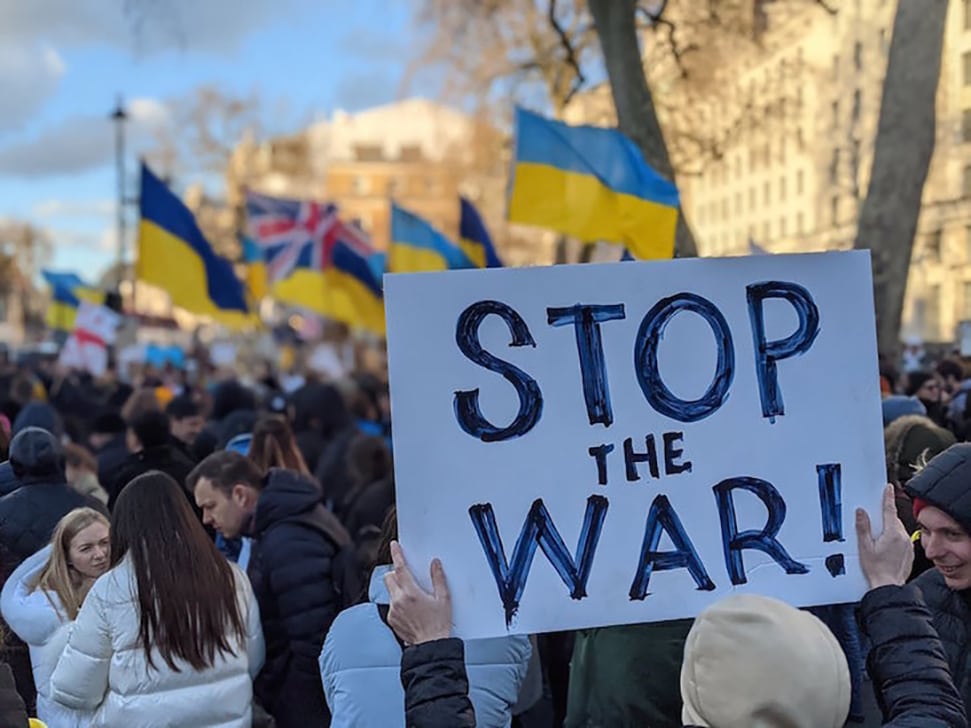
Faced with the invasion of Ukraine by the regime of Vladimir Putin, the antiwar movement has seen the development of very contrasting positions. They all have in common that they all claim peace, a word behind which very diverse, even opposing attitudes can be placed.
There are, on the one hand, calls for an unconditional ceasefire, which suggest, or even openly assert, that NATO states should force the Ukrainians to stop fighting by ceasing to provide them with the means for their defense. This position, though it may emanates in some cases from authentic pacifism and from a real concern to spare human lives, is highly problematic nevertheless because it does not define the conditions of the desired ceasefire. In the tradition of the antiwar movement, any call for a cessation of fighting in the event of an invasion of one country by another must be accompanied by the demand for the withdrawal of the invaders, failing which it can legitimately be suspected of wanting to ratify the acquisition of territory by force.
On the other side are antiwar activists for whom opposition to the Russian invasion and support for the right of Ukrainians to fight for the liberation of their territory is the priority consideration. While this starting point is certainly more legitimate because it takes the side of the victims of aggression, it can nevertheless end up setting the bar for peace too high. In some cases, there is even no question of a ceasefire: peace is defined as having as a necessary condition the withdrawal of Russian troops from all parts of internationally recognized Ukrainian territory, which include not only the entire Donbas, but also Crimea annexed in 2014.
Whatever the intention behind such a position, it risks being confused with that of Ukrainian ultranationalist hardliners. It also risks finding itself at odds with the majorities of public opinion in Europe and North America which, while sympathizing with the Ukrainians’ fight for self-defense, cannot identify with a hardline stance likely to considerably increase the risks of a general conflagration, including a nuclear war, in addition to its crushing cost in times of acute global economic crisis.
How then to define a democratic anti-imperialist antiwar position, both truly pacifist and concerned with peoples’ rights? Such a position should be inspired by the same parameters that have determined the antiwar position in the face of previous wars of invasion in contemporary history, while taking into account, of course, the present situation on the ground.
In the face of the ongoing war of invasion in Ukraine, a democratic antiwar and anti-imperialist position should include the following demands:
- Ceasefire with the withdrawal of Russian troops to their positions of February 23, 2022.
- Reaffirmation of the principle of the inadmissibility of the acquisition of territory by force.
- Negotiations under the aegis of the UN for a lasting peaceful solution based on peoples’ right to self-determination: deployment of blue helmets in all the disputed territories, both in Donbas and in Crimea, and organization by the UN of free and democratic referendums including the vote of refugees and displaced persons from these territories.
The Ukrainian left should also determine its position on the terms for ending the war, as it cannot adhere unconditionally to the view of Ukraine’s government. That said, unless there is a political upheaval in Russia which would radically change the situation, the withdrawal of Russian troops even just from the territories conquered since February 24 is itself a very difficult objective to achieve: it presupposes a major amplification of the Ukrainian counter-offensive, with quantitatively and qualitatively increased support from NATO countries, and an increase in the economic pressure exerted by these same countries on Russia.
This objective could be achieved much more quickly and at much less human and material cost if China, the only state with a decisive influence on Moscow’s position, joined in this effort, which corresponds to the principles of international law that it continues to invoke: sovereignty and territorial integrity of states, peaceful resolution of conflicts. The antiwar movement should exert pressure on China to do so, while criticizing belligerent attitudes towards Beijing, especially those of Washington and London, which do a disservice to this purpose as well as to the cause of world peace.
ZNetwork is funded solely through the generosity of its readers.
Donate

