

Treating dirty waste water solves one environmental problem but creates another by releasing large amounts of climate emissions. As microorganisms break down sewage, they release carbon dioxide, methane and nitrous oxide – three potent greenhouse gases.
Our new research found a surprisingly simple way to cut greenhouse gas emissions from open wastewater treatment lagoons: growing plants on buoyant rafts.
Water treatment companies have made progress in reducing emissions from their operations, including switching to renewable energy. But the greenhouse gases produced by the biological and chemical processes used to treat wastewater – particularly in open treatment ponds – are harder to tackle.
The first, full-scale trial of its kind worldwide, our project on Phillip Island in Victoria showed reductions in greenhouse gases by nearly a third over two years.
The climate problem hiding in wastewater
During wastewater treatment, organic matter and nutrients are broken down and removed by microorganisms, cleaning the water. But these microbial processes can produce powerful greenhouse gases, including carbon dioxide, methane and nitrous oxide.
Methane and nitrous oxide pack a much greater climate punch than carbon dioxide. Over a 100-year period, methane is about 27 times more powerful at trapping heat than carbon dioxide, while nitrous oxide is about 273 times more powerful.
Globally, wastewater treatment is estimated to account for around 7% of human-caused methane emissions and 10% of nitrous oxide emissions. Wastewater treatment companies currently have relatively few options for reducing these emissions, particularly from open wastewater lagoons.
Putting plants on the water
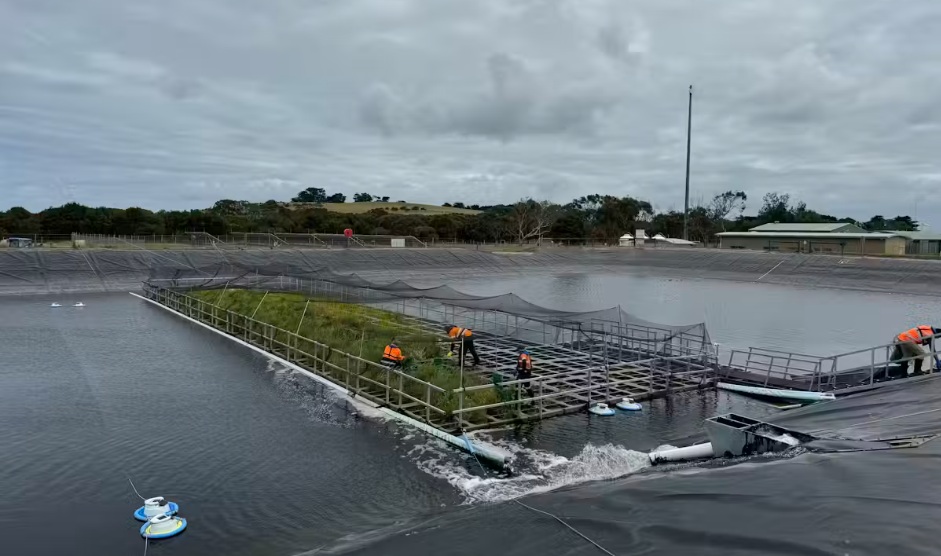
Floating wetlands are buoyant platforms planted with native wetland species, such as rushes, reeds and sedges. The plant roots hang down into the wastewater, creating a large surface area where roots, microorganisms and water can interact. The plants can absorb nutrients and pollutants, while microbial communities living on the roots can consume organic matter.
Floating wetlands are already being used to improve water quality in wastewater treatment lagoons, storm water ponds and other polluted water bodies around the world. One advantage is they can be installed on existing ponds and lagoons, without additional land or major changes to treatment infrastructure.
To investigate if they could also reduce climate emissions, we installed a floating wetland the size of nearly two tennis courts (330 m2) in an operating wastewater lagoon on Phillip Island, off the Victorian coast.
The lagoon contained two parallel channels. We installed the wetland in one, and planted it with three Australian native plant species: common reed (Phragmites australis), jointed rush (Baumea articulata) and marsh club rush (Bolboschoenus caldwellii). We used the other channel as a control, allowing us to compare them.
For two years, we continuously measured carbon dioxide, methane and nitrous oxide emissions at the start and the end of each channel. We also measured water quality and nutrient concentrations each month.
A drop in emissions
The results were striking. Overall, greenhouse gas emissions from the channel containing the floating wetland were 22-31% lower than emissions from the control channel. Methane emissions fell by 32-66%, while carbon dioxide and nitrous oxide emissions were reduced by 24-36% and 18%, respectively.
Importantly, the reduction in emissions occurred within four to seven months of installing the floating wetland. We expected this drop in emissions to be linked to the plants removing nutrients from the wastewater, because nutrient removal can reduce the microbial processes that produce greenhouse gases.
However, we could not detect substantial reductions in nutrient concentrations until about 12 months into the study. This suggests that nutrient removal alone cannot fully explain why greenhouse gas emissions began to fall so early. There is still much we don’t know about exactly how floating wetlands reduce greenhouse gas emissions.
What does this mean for wastewater emissions?
Floating wetlands may be a promising way to decrease wastewater emissions. But there are still important questions.
Our experiment was confined to two channels within a large wastewater lagoon, rather than measuring emissions across the entire lagoon. Accordingly, the emission reduction potential across the entire lagoon remains to be tested.
We also conducted our study at a single site. Further studies are needed to test whether these results hold across different wastewater systems and lagoon settings.
There are practical questions too. The floating wetland used in our trial relied in part on plastic-based materials. Other floating wetland designs using natural or biodegradable materials may offer a reduced environmental footprint.
Nevertheless, our results provide encouraging evidence that a relatively simple intervention can reduce greenhouse gas emissions from open wastewater lagoons.
We would like to thank Dr Kavindra Paranage, Dr John Award, Dr Divina Navarro, Dr Chris Walker, Meg Humphrys, Mark Dishon, Zoe Geyer, Ilse Hall, Tamika Johnston, Melinda Glew and Johanna Randall for their contributions to and support of the project.
ZNetwork is funded solely through the generosity of its readers.
Donate
