


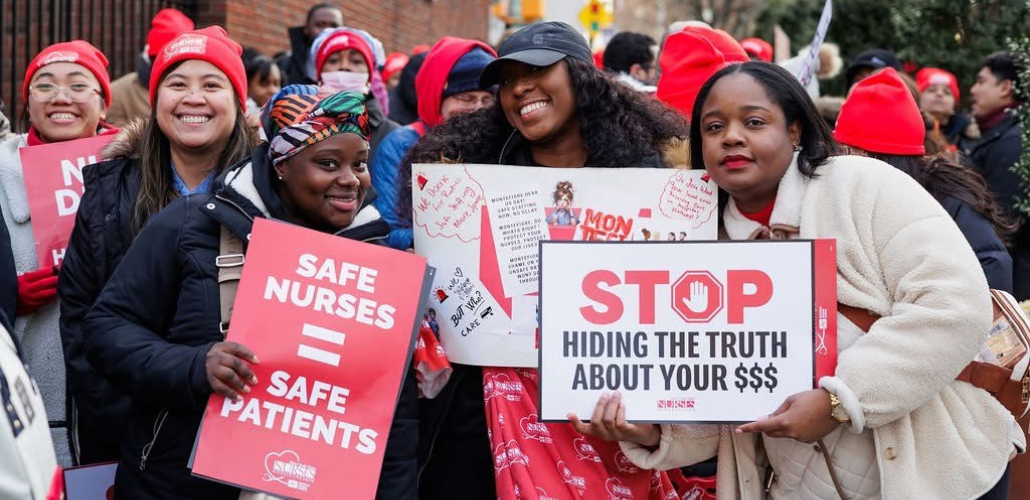
Fifteen thousand nurses across 10 campuses in New York City’s three biggest hospital systems are on an open-ended strike. It’s the city’s largest nurse strike in decades.
Picket lines stretched for blocks at Mount Sinai, Montefiore, and New York Presbyterian hospitals on January 12, thronged with nurses plus Teamsters, hotel workers, and university staff showing solidarity.
At New York-Presbyterian, nurses in red hats blew whistles and waved clappers. The union’s printed signs read: “If nurses are outside, something is wrong inside!” Others scrawled on cardboard were more whimsical: “So bad even introverts are here!”
Solidarity was everywhere. When one nurse saw another without any red gear, she handed over her own union scarf: “You’re lucky! Everyone wants one of these.”
At the Mount Sinai picket line in Manhattan, union bus drivers and firefighters honked along Madison Avenue. Some nurses piled into their own cars for a spontaneous caravan that circled the block honking, revving engines, and waving clappers out windows in a festive cacophony. Even the cops standing akimbo cracked smiles. Music from saxophone and horns jazzed the crowd.
At Montefiore in the Bronx, hundreds of nurses rallied and played the song “No Scrubs” by R&B group TLC and chanted, “No contract, no scrubs!”
“Every single member here told us what they needed, we took it to the boss and the boss didn’t take it seriously,” bargaining committee member Rhonda Middleton-Roches, a nurse who works across a number of community clinics, said at a New York Presbyterian picket. “We need the safe staffing. We need to feel safe in the workplace. We need our benefits so we can take care of our patients.
“This right here is us saying we need what we need to take care of this community.”
ROLLING BACK STAFFING GAINS
Three years ago, nurses bargained together at 12 hospitals but only ended up striking at two of the city’s big three hospital systems, Montefiore and Mount Sinai; 7,000 nurses walked out for three cold days in January 2023.
Those strikers won aggressive safe-staffing language, some of the best in the country. It allowed nurses to bring staffing-ratio violations directly to arbitration, and an arbitrator could assign monetary penalties to the hospitals for not having enough nurses working on each shift.
The money would go to the nurses who had worked short-staffed. In 2024, Mount Sinai paid out $2 million in fines. Nurses at the East Harlem campus, for instance, took the hospital to arbitration over thin staffing. “We won $500,000 on our unit to split among all nurses that worked severely understaffed shifts,” said Meghan Higgins, a nurse in the step-down unit (post-surgery or post-ICU).
Facing these penalties, both companies have reportedly hired hundreds of nurses since the last contract.
Now, “we’re trying to keep that language so that we don’t go back to the way things were,” Higgins said. “And Sinai is trying to get rid of that language and instead just pay us extra for shifts that were short.” She said the hospital is proposing $2 extra per understaffed shift.
Nurses say management is also proposing language changes that would make these arbitrations a more tedious process. Without arbitration, there’s no recourse to stop the hospitals from running units chronically short-staffed. The last contract allowed the union to demand that hospital management post vacancies.
“Before the last contract, I had seven patients, a seven-to-one ratio, and if they take out the wording for those ratios, it’s going to go back to that,” said Sunny Fatima, an oncology nurse at the Mount Sinai campus in East Harlem. “All I did was pass meds. I didn’t really get to take care of my patients. Even when I gave chemo, it wasn’t maintaining safe standards. And I’m really worried about my patients.”
To add insult to injury, Higgins said, the hospital has implemented better patient-nurse ratios for travel nurses who fill the gaps, because that’s what it takes to recruit them. “Oh, so this can be done,” she says, “have better ratios for travel nurses, make manageable assignments for travel nurses, but when we work day to day with assignments that are very difficult, we don’t always have safe ratios.”
‘HERE’S A PEBBLE’
This time around, nurses say hospital administrators have dug in—demanding concessions on the nurses’ own health care and refusing to hear out union proposals. Management has been calling “huddles” to discuss the negotiations at work, and denouncing the nurses in the media.
Higgins, who has been attending bargaining sessions at Mount Sinai, called management’s attitude disrespectful: “‘Here’s a pebble, here’s a little grain of salt,’ not addressing any of our major sticking points.”
But nurses have been coordinating across hospitals, with particularly strong collaboration among the “Big 3,” joining citywide calls and planning in conjunction with contract action teams.
Nurses are pushing back with their own media and social media campaigns. A video circulated of Presbyterian nurses fed up after waiting two hours for management to meet with them.
Some nurses involved in contract campaign actions have been disciplined with warnings, suspensions, and even fired from Mount Sinai on trumped-up charges. Mount Sinai has hired 1,200 travel nurses to serve as scabs.
CUTTING HEALTH BENEFITS
Besides nurse-patient ratios, the major sticking points are health care benefits, workplace violence, and the implementation of artificial intelligence. The nurses’ contracts expired on December 31. Four other hospitals have already settled with the nurses, and three more made enough progress that nurses rescinded their strike notices.
Nurses at Mount Sinai and other hospitals won an 18 percent raise over three years in 2023. But this time Mount Sinai is instead proposing a lump sum of $4,500 per nurse, per year of a three-year contract—and that sum is supposed to include not only the raise but also the cost of health care benefits, as well as the additional compensation for serving as a charge nurse (a non-management shift coordinator) or preceptor (training nursing students).
“So basically what it shakes down to is a 1 percent wage increase per year, and we’re not accepting that,” says Mount Sinai nurse Higgins.
Nurses point out that these hospitals are investing in A.I. and scab nurses. Why can’t that go to health care and wages? Nurses earn above $100,000 a year, but the head of New York Presbyterian, Dr. Steven Corwin, received more than $26 million in compensation in 2024, public records show. When top executives are raking in millions, it shows that the employers can afford a fair contract, especially when it comes to health care benefits.
“The battle we have is their management wants to cut our health care,” said Roy Permaul, a surgical and transplant ICU nurse on the picket line in East Harlem. “We have a health care crisis in this country, and it doesn’t make sense to work in a hospital where we cannot even see providers in the hospital that we work for.”
As of January 1, Mount Sinai stopped offering Anthem health plans to its nurses to cut costs. Now nurses can no longer go to Mount Sinai doctors because they’re not accepting their insurance.
Rafael Soto, a dialysis nurse at Mount Sinai for 11 years, says this has thrown his life into disarray. His daughter sees a specialist for multiple sclerosis. “She’s been sick for seven years now,” he said on the picket line, “and she sees a neurologist here, and she’s not even able to see her neurologist. It’s something that’s not curable, but it’s something that you need to treat so it doesn’t get any worse.”
That’s the reason why he’s fighting for a fair deal. “Now she has to try to find a different doctor.” On top of that, “they want us to pay for our own insurance and find a different provider before we even start negotiating.”
VIOLENCE AND A.I.
Safety is another top concern. Higgins was working last November when a gunman entered Mount Sinai’s campus in East Harlem. The nurses weren’t notified about the active shooter incident. Police killed the person. “There was so much shade around the whole incident,” she said. “Our manager never talked about it.”
To protect themselves and their patients, the nurses are asking for increased security. To enter the hospital people must wear a badge, but nurses say the enforcement is too lax. They want bag checks and walk-through metal detectors.
One more concern is the irresponsible use of A.I. “Nursing is an essentially human activity,” said Jarrett Murphy, a night shift nurse in the pediatric emergency room at the Mount Sinai picket line. As Mount Sinai management makes big investments in A.I. technology, Murphy said nurses should maintain control over clinical decision-making and patient assessment, advocating for contract clauses that ensure ongoing nurse involvement in A.I. evaluation and prevent A.I. from replacing human care.
“A.I. has a role in supporting clinical decision making by helping us gather information and present options,” he said. “We don’t want A.I. making decisions. We don’t want A.I. limiting our ability to assess patients and make clinical choices.”
“The reason we’re respected as much as we are valued is because of the human touch we give to care,” Murphy said, “combining clinical skill with being able to assist people as people and process things the way only humans can. That can’t be replaced by technology, but we’re definitely deeply afraid that some bean counter will think that it can.”
‘IT’S A DISASTER’
New York’s politicians are weighing in. “These executives are not having difficulty making ends meet,” Mayor Zohran Mamdani said alongside striking nurses at New York Presbyterian in Manhattan, a red scarf draped around his neck. “The CEO of Montefiore made more than $16 million last year. The CEO of NewYork-Presbyterian made $26 million. But too many nurses can’t make ends meet.”
To maintain continuity of services, the city’s emergency management department helps coordinate any response to service disruptions which impact public safety or access to essential services. “New York City will do everything in our power to ensure the sick and injured can receive high-quality care, while refusing to abandon those who have time and again refused to abandon us,” said Mamdani.
Ahead of the strike, Governor Kathy Hochul declared an “ imminent disaster,” warning that the strike “could jeopardize the lives of thousands of New Yorkers and patients.”
“It’s a disaster for us,” said Permaul, holding a blowhorn. “If management is able to come to the table and negotiate with us, we’ll gladly go back inside and work. We don’t want to be outside. It’s cold and we’re losing money. So yeah, we want to go back inside and work. But we have to do what’s right for our patients and what’s right for us.”


Luis Feliz Leon is a staff writer and organizer with Labor Notes.
ZNetwork is funded solely through the generosity of its readers.
Donate




