


The second round of elections in Argentina will take place on Sunday, November 19th, amidst currency devaluation and growing indebtedness. Ultra-right politician Javier Milei and his rightwing ally Patricia Bullrich, who was defeated in the first round will face Sergio Massa. Massa is a member of the ruling Peronist party and for the last year, he has been Argentina’s Minister of Economy.
In this article, Verónica Gago and Luci Cavallero take up the arguments they initially published a few days after the first round of elections. Here, they add significant context to their reflections about these heady days, highlighting the visibility of and the debate around feminist politicization and the impact it has had on the vote by women and sexual and gender dissidences —Editors’ note
Javier Milei is Argentina’s local representative in the planetary saga of the far-right in politics, becoming a favourite of Tucker Carlson, Donald Trump’s preferred journalist, and having a love-in with Brazil’s Bolsonaro family.
But there are two distinct elements with which the Argentine chapter of the transnational ultra-right have to content. On the one hand is the importance of a highly mobilized and massive feminist movement, which is active inside and outside social and political organizations as well as in the streets and at the ballot boxes. And on the other is an economic crisis marked by debt and inflation.
These two key aspects of Argentine reality have altered the way the extreme right is expressed. They also play a role in explaining the—at least temporary—relief of having stopped La Libertad Avanza, Milei’s coalition, in the first round of general elections after his surprise win in the open primaries on August 13.
Let us return to the unique elements we mentioned above. It is in this context that what we call feminist politicization is occurring. Feminist politicization is a way to make the crisis in patriarchal models of relating to one another visible, and to connect it with deepening economic trouble that has led to income devaluation and the heavy burden of informal work, or work that is formal but underpaid.
We have to consider economic desperation and everyday precariousness together with feminist politicization when analyzing Massa’s comeback, which was both forceful and which responded to the context. To do so, we must understand the articulation between the everyday economy and the multiple ways in which the feminist movement has been mobilizing.
Feminist politicization has been central in dismantling the binary between politics and economics (and the suggestion that one or the other explains Milei’s triumph in August and his defeat in October) as well as in suggesting micro-political interpretations of mass phenomena. In recent years, feminist politicization has worked to turn awareness of everyday phenomena and ways of sustaining life in contexts of violence into political analysis and articulation with the capacity to intervene.
This has allowed for the composition of memories that have altered the narrative of Argentina’s democratic transition, weaving together events and moments long forgotten on the shelves of historical marginality. This year, Argentina celebrates 40 years of having recovered democracy after the popular defeat of the dictatorship, making the possibility of the political triumph of dictatorship deniers all the more disturbing.
During her campaign, Milei’s vice-presidential candidate Victoria Villarruel denied state terrorism, whitewashed genocide, and demanded the restoration of compulsory military service. In doing so, she has attacked the popular consensus of human rights struggles, led by the Mothers and Grandmothers of the Plaza de Mayo (who mobilize for those disappeared during the dictatorship), whose ongoing resistance is a moral north star in Argentina.
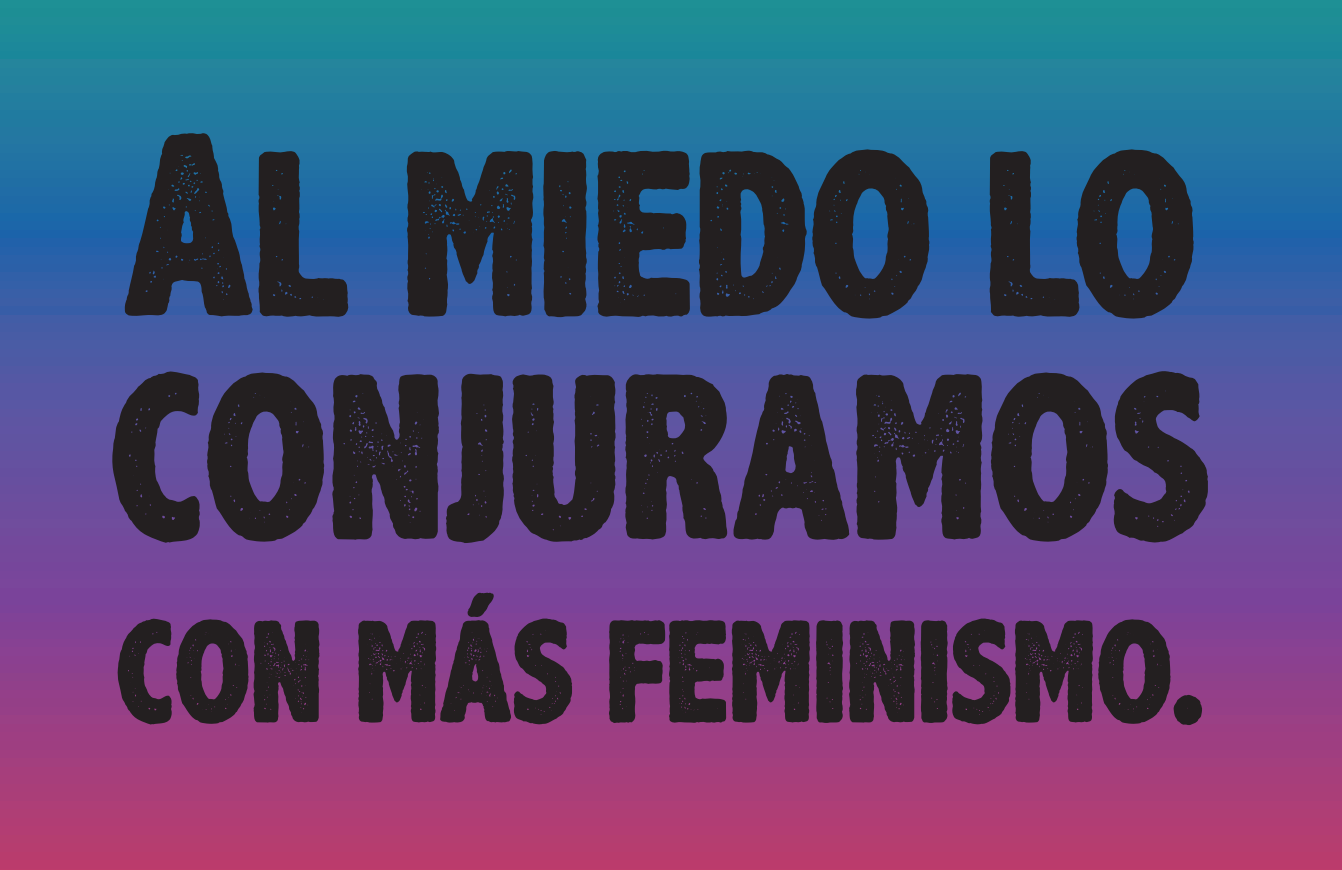

“We cure fear with more feminism.” Detail of a poster prepared for September 28th, the Global Day of Action for Safe and Legal Abortion, in Argentina. Design: Sol Gey @Solgey.
We propose to “constellate” a series of points which, from our perspective, have played a fundamental role in Massa’s comeback at the polls. The ultra right thought, with premature triumphalism, it would win in the first round. One of the keys to understanding this moment is that beginning on August 14th, the political confrontation began to take place in the media, in our homes, and in the streets.
We are part of the Ni Una Menos Collective, which joined with the Mujeres Que No Fueron Tapa (MQNFT) feminist art collective to create the visual campaign that illustrates this article. Using slogans that dispute the meaning of the concept of freedom, we produced collective texts connecting it to concrete aspects of everyday life.
Freedom means that thanks to comprehensive sexual education, many children and adolescents have been encouraged to denounce abuse. Freedom means being able to retire after working inside the home because of the recognition that care work is work.
We are interested in deepening our understanding of how this profound political activation took place, and how it became, especially through the vote of women and LGBTQI people, an emergency brake against the danger of collective destruction. Milei and Villarruel, as well as Rodrigo Marra, who is running for head of government in Buenos Aires, and legislator Lilia Lemoine are extreme examples of this danger.
Three feminist proposals against the ultra-right
How best can we understand the process of activation that rallied votes, took the streets and burst into the public conversation?
The first example came in response to their proposal to allow people to carry weapons and their response to femicides. Milei’s speaks of a war in which its everyone for himself, that’s how he has channeled public concern about safety into his political campaign. But his proposal that children go to school with guns, which he expected to ignite like gunpowder, was instead rejected by mothers, generating a great deal of blowback against him.
The proposal for citizens to take up arms also raised alarm bells with regard to femicides. A study by Aldana Romano and Julian Alfie from Institute for Comparative Studies in Criminal and Social Sciences (INECIP), found 97 percent of registered gun users are male, and one in four femicides are committed with firearms.
Milei has gone so far as to deny the existence of femicides, which he did in the second round of the debate. This ignited a deep concern among women, who since 2015 have taken up this issue as a central tenet of their organizing.
The response to Milei’s position came from mothers and women across social classes, too many of whom have borne witness to the terrible impacts of femicides. This is an example of how the politicization of domestic violence led to results at the ballot box.
The second example is around responsibility for paternity and child support. Lemoine proposed a bill that would “notify” fathers once a woman was pregnant in order to give them the option of acknowledging paternity. This too generated outrage in many quarters.
What delicate reflex was activated here? How was it trained by a feminist politicization composed of situated militancy in organizations, discussions and assemblies but also through public policies?
The process of politicizing motherhood is rooted in the activism of many collectives struggling against non-compliance with child support, which is a de facto way of rejecting paternity. It is also rooted in the struggle against the extreme indebtedness, which is felt especially sharply by those who work without pay at the same time as they hold low-paying jobs.
Women go into debt in order to live and to support their families, because of which they become impoverished and are far too busy. The Ministry of Women, Gender Policies and Sexual Diversity of the Province of Buenos Aires presented an initial measurement that showed shocking data, including that almost seven out of 10 fathers fail to pay child support, or do so in an irregular manner.
A “Parenting Index,” which measures the cost of care work, has recently begun to be included in studies by the National Institute of Statistics and Census as a social and legal tool to show how and why poverty is feminized.
This vocabulary comes out of feminist struggle, and has made the moral regime and the gender mandates that oblige women into precariousness more explicit. Questioning why motherhood is penalized with poverty is one way of creating another idea of freedom: the freedom to be a mother without being poor. This is a rejection of patriarchal freedom, which instead proposes fathers shirk responsibility for raising and supporting their children.
The third example is connected to care. Milei has denied the gendered wage gap in several public statements. This gendered gap is also evident when it comes to renting a house, getting a job, running a small restaurant, or taking care of sick family members.
During the pandemic, the amount of care work took on dramatic proportions. This impacted so-called essential work, but also a range of duties the feminist movement had been drawing attention to for years, allowing for the creation of a new kind of common sense around care work.
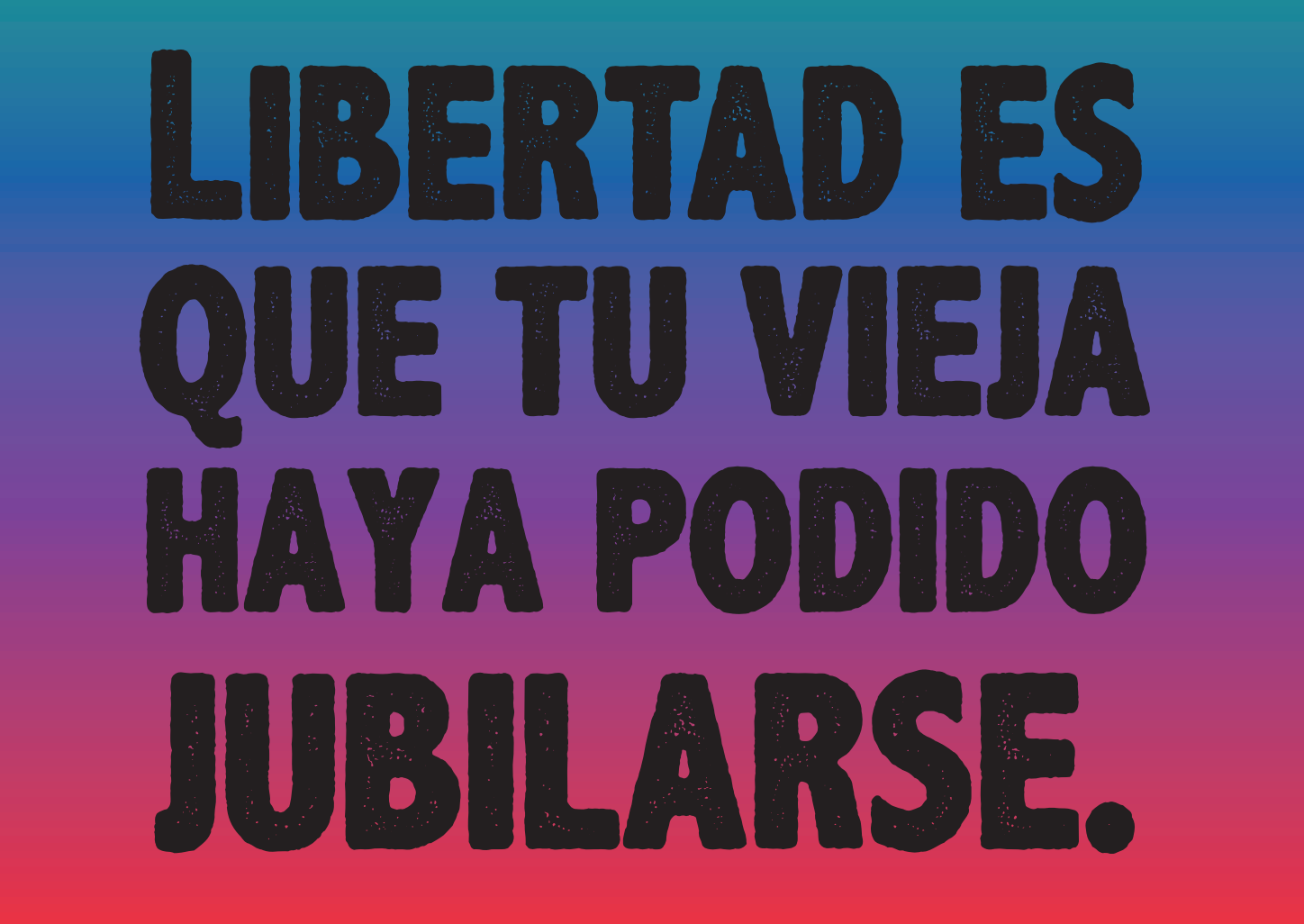

“Freedom is that your old lady could retire.” Detail of a poster prepared for September 28th, the Global Day of Action for Safe and Legal Abortion, in Argentina. Design: Sol Gey @Solgey.
A focus on microeconomics
We wanted to focus on these examples, which some intellectuals consider microeconomic and refer to as being doors inside of a house. But those doors are no longer closed. The micro is a mode of capillarity that allows us to examine and explain phenomena experienced by millions.
Because when the economy in the home—which is where inflation is most keenly felt—is ignored as a sphere of politicization and social conflict, too much is overlooked.
Of course, it is easier to blame feminism for the frustration of young men facing a hostile future. It is easier to blame feminism for the resentment of masculinities that are barely able to provide, and to accuse feminism of trivializing sexual and reproductive rights, as if they were extravagant luxuries.
Feminism has a political capital that is consistently made invisible. And yet within it is the possibility of activating forms of knowledge that can be translated into concrete struggle.
The images and phrases of collective and democratic freedom, including those reproduced here, are one example of that. These images compete with the financial terrorism of the currency run and the reactionary utopia of armed men.
This past Saturday, over 1.5 million people attended the 32nd annual Pride March in Buenos Aires. Their slogan was: “¡Ni un ajuste más, ni un derecho menos!” (No more structural adjustment, all rights for all).
Milei didn’t win the first round. His numbers were much lower than in the primaries, and this is due to the reasons we signal above. In the week after the general elections, the alliance celebrated between Milei and former President Mauricio Macri—who took out debt with the International Monetary Fund in 2018—rearranged the far right coalition.
Current predictions for the second round of voting are basically a coin toss: the numbers could go either way. For our part, we’ll remain active in streets, homes and classrooms as we work to prevent the ultra-neoliberal, negationist and fascist forces from winning on November 19.
ZNetwork is funded solely through the generosity of its readers.
Donate




