


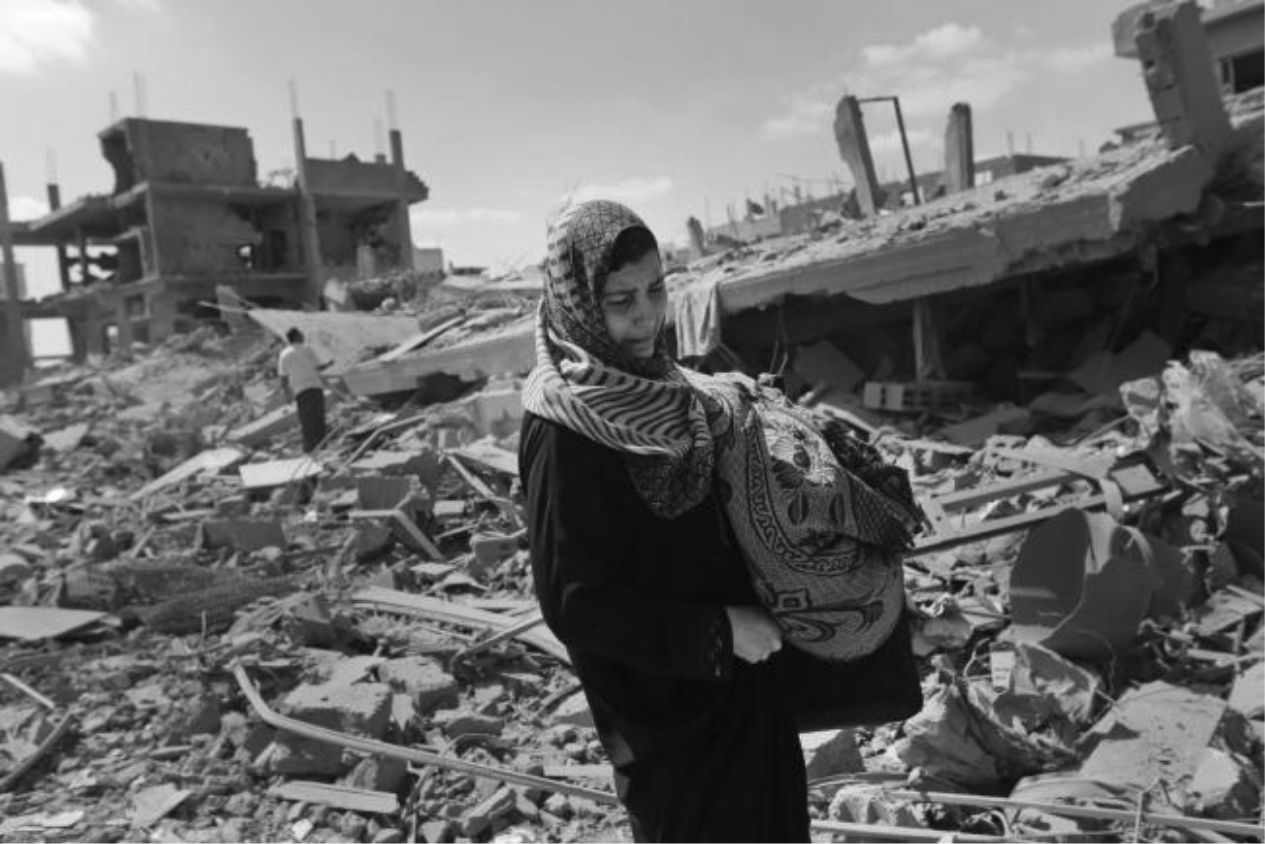
Though Israel’s past wars on Gaza have often been justified by Tel Aviv as a response to Palestinian rockets or, generally, as acts of self-defense, the truth is different. Historically, Israel’s relationship with Gaza has been defined by Tel Aviv’s need to create distractions from its own fractious politics, to flex its muscles against its regional enemies and to test its new weapons technology.
Though the Occupied West Bank – in fact, other Arab countries, too – has been used as a testing ground for Israel’s war machine, no other place has allowed Israel to sustain its weapon experimentation for as long as Gaza, making Israel, as of 2022, the world’s tenth largest weapons exporter.
There is a reason why Gaza is ideal for such grand, albeit tragic experiments.
Gaza is a perfect place for gathering information once new weapons have been deployed and used on the battlefield. The Strip is home to two million Palestinians who live squalid lives with virtually no clean water and little food, all of them confined within 365 km² (approx. 181 mi²). In fact, due to Israel’s so-called safety belts, much of Gaza’s arable lands which border Israel are off limits. Farmers are often shot by Israeli snipers, almost at the same frequency as Gaza’s fishermen are also targeted, should they dare venture beyond the three nautical miles allocated to them by the Israeli navy.
“The Lab”, an Israeli award-winning documentary released in 2013, discussed in painful detail how Israel has turned millions of Palestinians into actual human laboratories for testing new weapons. Gaza, even before, but especially since then, has been the main testing ground for these weapons.
Gaza has been ‘the lab’ for Israeli political experimentations as well.
When, from December 2008 to January 2009, then-Israel’s Acting Prime Minister Tzipi Livni decided to, in her own words, “go wild” by unleashing one of the deadliest wars on Gaza, the Israeli politician was hoping that her military adventure would help solidify support for her party at the Knesset.
Livni, at the time, was the head of Kadima, which was established in 2005 by former leader of the Likud, Ariel Sharon. As Sharon’s successor, Livni wanted to prove her own worth as a strong politician capable of teaching Palestinians a lesson.
Though her experiment then won her some support in the February 2009 elections, it backfired badly following the November 2012 war, where Kadima was nearly destroyed in the January 2013 elections. Eventually, Kadima vanished altogether from Israel’s political map.
This was not the first, nor the last time that Israeli politicians have attempted to use Gaza as a way to distract from their own political woes, or to demonstrate, through killing Palestinians, their qualifications as protectors of Israel.
Yet, no one has perfected the use of violence to score political points as much as Israel’s current Prime Minister Benjamin Netanyahu. Returning as the head of Israel’s most extremist government in history, Netanyahu is keen to stay in power, especially since his rightwing coalition has more comfortable support margins in the Knesset than any of Israel’s five governments in the last three years.
With a rightwing, pro-war constituency that is far more interested in illegal settlement expansion and ‘security’ than economic growth or socio-economic equality, Netanyahu should, at least technically, be in a stronger position to launch another war on Gaza. But why is he hesitating?
On February 1, a Palestinian group fired a rocket toward southern Israel, prompting an Israeli response that was intentionally limited.
According to Palestinian groups in the besieged Strip, the rocket was fired as part of the ongoing armed rebellion by West Bank Palestinians. It was meant to illustrate the political unity between Gaza, Jerusalem and the West Bank.
The West Bank is living its darkest days. 35 Palestinians were killed by the Israeli army in January alone, ten of whom perished in Jenin in a single Israeli raid. A Palestinian, acting alone, responded by killing seven Jewish settlers in Occupied East Jerusalem, the perfect spark of what is usually a massive Israeli response.
But that response has been confined, thus far, to the demolition of homes, arrest and torture of the attacker’s family members, military sieges on various Palestinian towns and hundreds of individual assaults by Jewish settlers on Palestinians.
An all-out Israeli war, especially in Gaza, has not yet actualized. But why?
First, the political risks of attacking Gaza through a long war, for now, outweigh the benefits. Though Netanyahu’s coalition is relatively secure, the expectations of the Prime Minister’s extremist allies are very high. A war with an indecisive outcome could be considered a victory for Palestinians, a notion that could alone break down the coalition. Though Netanyahu could launch war as a last resort, he has no need for such a risky option at the moment.
Second, the Palestinian Resistance is stronger than ever. On January 26, Hamas declared that it has used surface-to-air missiles to repel an Israeli air raid on Gaza. Though the Gaza group’s military arsenal is largely rudimentary, much of it homemade, it is far more advanced and sophisticated compared to weapons used during Israel’s so-called “Operation Cast Lead” in 2008.
Finally, Israel’s munition reserve must be at its lowest point in a long time. Now that the US, Israel’s largest weapons supplier, has tapped into its strategic weapons reserve – due to the Russia-Ukraine war – Washington will not be able to replenish the Israeli arsenal with constant supplies of munition the same way the Obama Administration did during the 2014 war. Even more alarming for the Israeli military, the New York Times revealed in January that “the Pentagon is tapping into a vast but little-known stockpile of American ammunition in Israel to help meet Ukraine’s dire need for artillery shells …”.
Though Israeli wars on Gaza are much riskier nowadays compared to the past, a cornered and embattled Netanyahu can still resort to such a scenario if he feels that his leadership is in peril. Indeed, the Israeli leader did so in May 2021. Even then, he still could not save himself or his government from a humiliating defeat.


Ramzy Baroud is a US-Palestinian journalist, media consultant, an author, internationally-syndicated columnist, Editor of Palestine Chronicle (1999-present), former Managing Editor of London-based Middle East Eye, former Editor-in-Chief of The Brunei Times and former Deputy Managing Editor of Al Jazeera online. Baroud’s work has been published in hundreds of newspapers and journals worldwide, and is the author of six books and a contributor to many others. Baroud is also a regular guest on many television and radio programs including RT, Al Jazeera, CNN International, BBC, ABC Australia, National Public Radio, Press TV, TRT, and many other stations. Baroud was inducted as an Honorary Member into the Pi Sigma Alpha National Political Science Honor Society, NU OMEGA Chapter of Oakland University, Feb 18, 2020.
ZNetwork is funded solely through the generosity of its readers.
Donate




