

The other day I went on Extinction Rebellion’s (XR) website and signed myself up. I had been thinking about this for a while – UK based XR operates with a loosely affiliated, decentralized, global model, and I knew that there is a group in nearby Franklin County, Massachusetts. I am simply attempting to bring my personal commitment in line with my rhetoric. I admire XR, but not without reservations. People familiar with my writing know that I view the issue of climate as an ongoing confrontation between corporate intentions and organized activism. I have repeatedly raised a few points:
1) Without massive resistance and civil disobedience we are politically and environmentally doomed.
2) Resistance is, critically, a matter of building coalitions and attaching the climate movement to other issues – worker’s rights and union building, human rights, housing, universal health care, voting rights, war and military spending, to name a few.
3) The climate movement often reflects class imbalance – many have pointed out that XR in particular, and the climate movement in general is too White, too middle class and too immersed in academic rhetoric – thereby cutting off poor and working class participation and passion.
4) Climate activism should be inherently political, anti-capitalist and based on the understanding that the political structures that have pushed us collectively to the brink of apocalypse cannot be redeployed to get us out of danger.
5) The poorest people are a wellspring of potential power that has been reduced – via the brainwashing of media and the immediacy of threats to personal survival – to the status of passive bystanders. Those that inhabit housing waitlists, or live in subsidized housing projects, or occupy Section Eight housing, are both the most vulnerable to climate related events, and an untapped progressive voting block and source for activism. Very poor people are almost never sympathetic to Trumpist fascism. As a long time (now retired) mental health outreach worker I never heard a good word about Trump from anyone living in subsidized housing, and many of my clients were White.
6) Poor people are disproportionately subjected to climate suffering, whether through catastrophic heat waves, rising food prices or floods. Where I worked, in Greenfield, Massachusetts, all three housing projects and many poor neighborhoods have been built adjacent to the Green River, which has flooded many times in recent years, and has the potential to cause terrible damage. It must be a goal of the climate movement to pursue rapprochement with those most threatened by climate instability. Poor people should not be patronized or marginalized within the climate community, but be seen as a cornerstone of a coalition.
I mentioned that I had joined XR, but that is not the whole story – XR has been criticized for lack of class and racial diversity, and for hedging on ties to larger political issues. XR has avoided the natural inclination to identify itself with any of the fundamental left wing ideological touchstones – socialism, degrowth, redistribution of wealth, etc. – and yet leftist ideology permeates XR as an often unacknowledged undercurrent. XR has promoted itself as an apolitical organization, founded solely on the common cause of climate, but this self definition fails to address the political issues that have caused the climate apocalypse in the first place – the political power and lobbying influence of corporate rulers, who keep fossil fuels, toxic chemicals and industrial agriculture locked into the eternal status of unregulated juggernauts of societal fate.
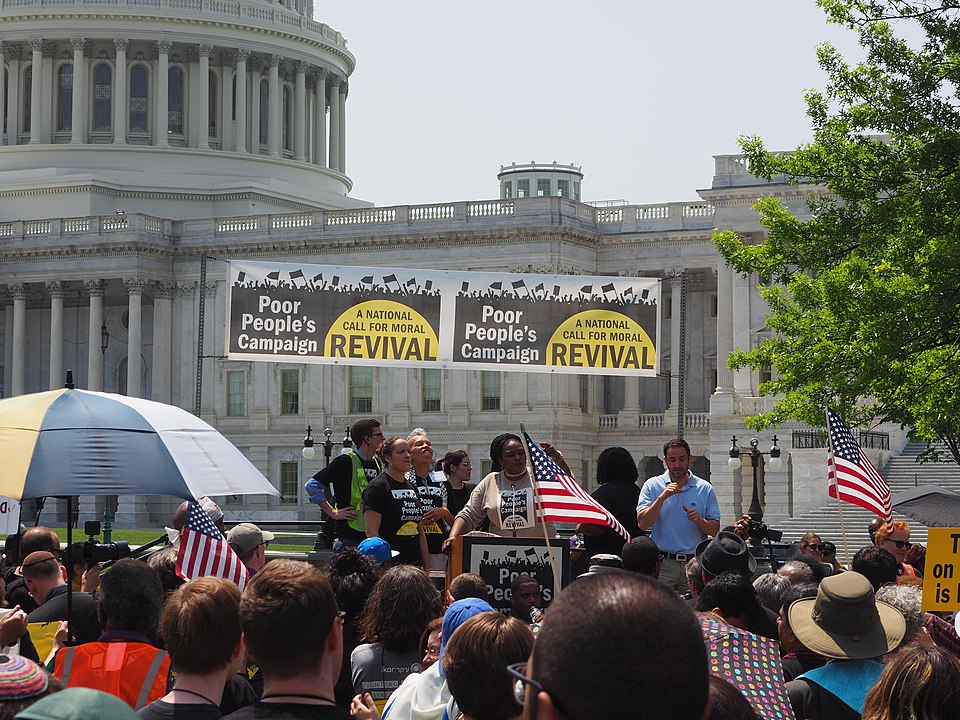
For me, XR can therefore only be an incomplete platform for activism. The Poor People’s Campaign (which has scheduled “The Mass Poor People’s and Low Wage Worker’s Assembly and Moral March on Washington D.C. and to the Polls!” for June, 29th) ticks all the boxes. The Poor People’s Campaign has issued a 17 point agenda that ties climate issues to the full social justice context that I believe XR ought to add to their well known three demands (as I more or less implied in this piece).
These points are:
- Abolishing poverty as the fourth leading cause of death in the U.S.
- A living minimum wage of at least $15 +/hour (indexed for inflation)
- Full and expanded voting rights
- No more voter suppression
- Guaranteed workers’ rights & labor rights
- Healthcare for all
- Affordable, adequate housing
- Strong social welfare and safety net programs
- An end to gun violence, profit and proliferation
- Fully protected women’s rights
- Environmental justice that secures clean air & water
- Justice for all Indigenous nations
- Fully-funded public education
- Just immigration laws
- Addressing militarism and the war economy
- Standing for peace not war; an immediate cease fire in Gaza that allows humanitarian relief, the release of all hostages, and peace with justice to be pursued; and an end to genocide, around the world
- An end to hate, division, and the extremist political agenda
The Poor People’s Campaign also aspires to mobilize 15 million poor and low wage “infrequent voters.” In my working career I found poor people to be non-voters rather than infrequent ones. The political mobilization of the poorest people (I have argued) is fundamental to the climate movement.
The 11th point – “environmental justice that secures clean air and water” – does not fully delineate and represent the issue of climate. The climate point in the Poor People’s Agenda is incomplete in much the same way that XR is incomplete because it does not place the climate crisis within the larger context of social injustice and class inequity. Perhaps XR and the Poor People’s Campaign ought to get married. It may not be a perfect marriage – few are – but, rather, a marriage of convenience. I’d rent a tux and be there enthusiastically in time for the vows.
ZNetwork is funded solely through the generosity of its readers.
Donate




