

The EU’s competitiveness and deregulation drives are accelerating and deepening, with European Commission announcements on how it can advance the short-term interests of the chemicals industry due next week. Disastrously the chemicals sector looks set to be pampered, while the public will pay – both via subsidies for industry, and weakened protections for the environment and our health. The chemicals industry looks as if it has successfully captured the Commission’s decision-making on the so-called ‘Clean Industrial Deal’.
Take action here to support a toxic-free Europe!
Introduction
As part of the frame of the ‘Clean Industrial Deal’ the European Commission is expected to shortly publish chemicals policies that will hand major wins to the industry (and its business allies). This is despite the fact that the industry has a long legacy of defending harmful chemicals and the huge pollution that they cause, has a heavy climate footprint, and a tendency for hyperbolic lobbying to weaken important regulations needed to protect health and environment.
These new policies will include the European Commission’s expected publication of a Chemicals Industry Action Plan and the first Chemicals Omnibus, both expected on 8 July 2025. Later in the year we expect a Chemicals Industry Package, and far more detail on the Commission’s approach towards both PFAS / forever chemicals and the revision of the REACH chemicals regulation. Sidenote Early warning signs indicate that these policies will reward polluters with public money, and weaken or remove rules to rein in toxic substances.
1. What do chemicals have to do with the ‘Dirty Industrial Deal’?
The chemicals industry provides its products to many other industries, and often refers to itself as the ‘industry of all industries’. This has put the European Chemicals Industry Council (CEFIC) in pole position to mobilise its own sector and other heavy industries with large pollution footprints to campaign hard against new or existing green rules and to seek public funding for its flawed approaches to the climate and pollution crises. And the Commission has been all too ready to listen and support, with industry’s agenda forming the base of the so-called Clean Industrial Deal.
February 2024’s Antwerp Declaration is a prime example of this support, when Commission President Ursula von der Leyen and then Belgian Prime Minister Alexander De Croo attended a large industry-only event – save a handful of trade unionists – in Antwerp organised by chemical lobby CEFIC and hosted by BASF, the largest chemicals company in the world. Collaborating with other intensive energy users, CEFIC took the opportunity to present its 10 point plan, and has since been rewarded with its complete adoption by the Commission.
The Antwerp Declaration led to a series of nine follow-up Antwerp Dialogues during 2024, the topics of which CEFIC consulted Commission officials on, and the dialogues’ conclusions were to be “presented to EU leaders and legislators, to help shape decision making”. All but one of the dialogues were co-hosted by CEFIC, and topics included trade, biotech, and energy. One of the criteria for holding such a dialogue was that the Commission would be present, presumably offering participants an opportunity to lobby. We do not know what specifically was said in these meetings as they were held “under Chatham House rules”.
One year later in February 2025 von der Leyen returned to Antwerp to report back to 400 industry leaders on how she had delivered on “each and every one” of the 10 points in the Antwerp Declaration as she put it, through the ‘Clean Industrial Deal’. She even offered to come back next year “to report on what we have done in between,to listen to how your reality was in between”.
This regulatory capture fits with analysis published earlier this year by Corporate Europe Observatory and LobbyControl, based on LobbyFacts data, which showed how the chemicals sector is among the biggest sectors lobbying in Brussels, with huge lobby firepower. There can be no clearer symbol of this lobby power than these two trips to Antwerp, organised by CEFIC, made by von der Leyen to meet EU business leaders. This easy lobby access to the Commission seems to be a day-to-day reality for CEFIC, with one of Brussels’ biggest lobby groups enjoying 15 high level meetings with the Commission just between April and mid-June 2025. Meanwhile, at the time of writing, von der Leyen has not met with green groups in the six years since she first became Commission President.
With the Commission’s promises in place, the chemicals industry is now expecting delivery via the upcoming announcements, starting on 8 July 2025.

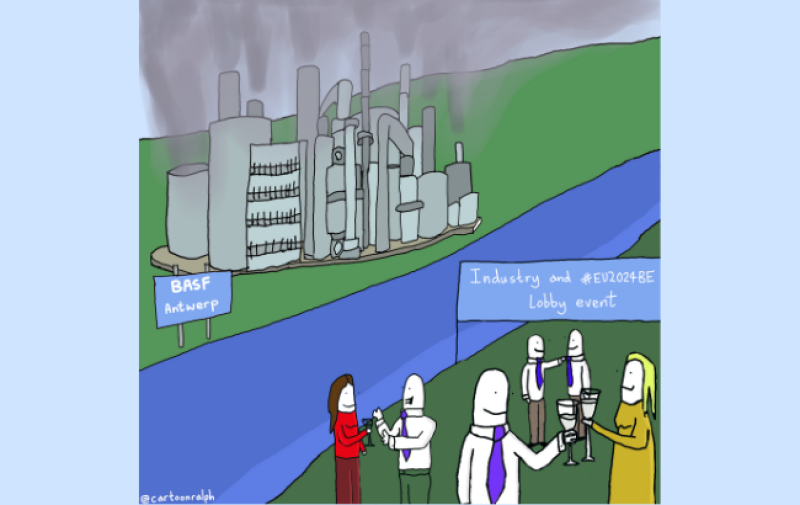
Cartoon by @CartoonRalph
2. So what does the chemical industry lobby want exactly?
Of course the chemicals industry has a long shopping list of demands relating to its core products and services (see question three below), largely to do with deregulation of the health and environmental standards on harmful chemicals.
But the chemicals industry also has a series of wider demands which it has been hammering home to EU decision-makers. This industry has been under great pressure to decarbonise, considering its heavy use of fossil fuels to both power its plants and as a basic component of most chemicals. Concerningly, its wish-list includes a number of fake solutions for decarbonisation, three of which are detailed below.
Fake decarbonisation solution 1: Hydrogen
For years European industry has been widely touting hydrogen as a clean replacement for natural gas used by industry, even though hydrogen will just maintain Europe’s fossil fuel economy. CEFIC has teamed up with some key players from the fossil fuel industry, including Eurogas and Hydrogen Europe, to lobby for a “technology neutral” hydrogen market in the EU, meaning hydrogen from all sources including fossil fuels, as well as “financial incentives” to support it. The German chemicals lobby, Verband der Chemischen Industrie (VCI), has explicitly called for the strengthening of the role of “blue hydrogen” (made from fossil gas) within the hydrogen market. This lobbying ignores the massive concerns about hydrogen, including how it perpetuates the use of fossil fuels, and the major problems associated with extracting green hydrogen made with renewables from the global south.
Fake decarbonisation solution 2: Emissions trading
The EU’s emissions trading scheme has long shown itself to be deeply problematic, enhancing polluters’ profits while failing to effectively tackle the climate crisis. Yet CEFIC says that “the EU Emissions Trading System (ETS) provides a market-based solution to drive emission reductions cost-effectively, rewarding innovation while maintaining fair competition within the global market.” Of course it would say that wouldn’t it, when some of its biggest members have profited so much from this scheme. According to a recent report by WWF and Carbon Market Watch, “steel, cement, oil refining and chemical production, are all at the top of the polluting league [and] receive enormous volumes of ETS free allowances”. In 2023 chemicals producers BASF, Yara, Solvay, and Ineos, for example, all received more free allowances than their actual emissions, providing the opportunity for windfall profits and little incentive to reduce emissions. Meanwhile the chemicals industry demands that the EU includes “innovative carbon removals” in policies, even though removals are not permanent, and could just lead to business as usual and a prolongation of the fossil fuel economy. The only way to actually get to ‘zero’ emissions is to stop burning fossil fuels.
Fake decarbonisation solution 3: Carbon capture
On carbon capture and storage and utilisation (CCS and CCU) CEFIC supports the development of both, with a demand for “establishing a supportive regulatory framework”. However, CCS and CCU are risky, costly technologies that have repeatedly failed to work, and would simply allow the chemicals industry to keep on pumping out greenhouse gas emissions. (Read more on fake decarbonisation solutions in part II of these FAQs on gas imports and energy prices, and upcoming part IV on hydrogen and carbon capture.)
Beyond these fake solutions to decarbonisation there are other problematic demands of this sector. One such demand by the plastics industry, supported in the Antwerp Declaration, and reinforced in a July 2024 lobby meeting between VCI, BASF, and the Commission, is for chemical recycling via ‘mass balance’ which on first sight would seem to fit within the narrative of the circular economy. But mass balance is better seen as a “creative accounting” tool, says the Natural Resources Defense Council. It involves heating waste plastic, adding it to virgin plastic, and then claiming that resulting products contain 100 per cent recycled plastic when they may contain no such thing. Indeed chemical recycling distracts from the need to reduce absolute levels of plastics production; undermines mechanical recycling which works well in some areas; and subverts the need to phase out certain plastic products which are not efficiently recycled with state-of-the-art technologies, or are just down-cycled.
In recent months some EU governments have called for a Critical Chemicals Act, following a proposal by the French Government. The proposed Act would list 15 or more ‘critical molecules’ which would receive special protection and financial support, but the draft list includes, for example, those substances used to produce the highly problematic PVC. Even if some uses of some of these molecules may be critical for society and without adequate alternatives, that does not mean that all uses of all of these molecules should be protected and financially supported. According to the minutes of a January 2025 Commission lobby meeting, CEFIC argued for the EU to “consider” such a step to “address the risk of strategic dependencies in the supply chain”.
Underpinning all of these demands from the chemicals industry are calls for public handouts via funding for the false solutions listed above, and relaxed state aid rules to provide subsidised energy for chemical production. (See more on this in part II of these FAQs on gas imports and energy prices.) In addition, the Antwerp Declaration called for the “public de-risking of private investment” – in other words the public helps cushion the risk for the private sector, and in exchange get… more pollution! This so-called “de-risking” can come in the form of financial guarantees, potentially with money straight out of the public purse. This agenda was perfectly delivered by the Commission’s Clean Industrial Deal announcement of February 2025, meaning that big corporations are being pampered while ordinary citizens have to pay.


Cartoon by @CartoonRalph
3. What does the chemicals sector’s deregulation agenda look like?
An absolutely key element of the chemicals industry’s lobby demands for the ‘Dirty Industrial Deal’ is deregulation ie. to roll back existing rules that help reduce pollution, and better protect people’s health, and to weaken new ones. Industry has therefore jumped on the so-called “simplification” agenda of the Commission which aims to do exactly that, and for exactly the rules that industry has been complaining about.
Industry deregulation demand 1: Chemicals Omnibus
Expected to be announced on or around the 8 July, along with the Chemicals Action Plan, is the first Chemicals Omnibus, a review of existing chemicals rules that have come under heavy industry lobbying for rollback. It is implied that a second part of a Chemicals Omnibus will follow, but the details of that have not yet been made public. The fingerprints of the chemicals lobby are likely to be heavy in these plans, given the German chemicals lobby VCI called for such an omnibus more than eight months before it was announced. At least two regulations are known to be in the scope for this first part, which have been reviewed via industry-friendly so-called ‘reality check’ processes organised by the Commission (discussed in more detail in question five), and confirmed via a recent leak of the Omnibus proposal obtained by Politico.eu:
- The Classification, Labelling and Packaging (CLP) Regulation: the revision of the CLP was identified by the European Environmental Bureau as one of the very few successes of the first von der Leyen Commission in implementing the Chemicals Strategy for Sustainability (CSS). But now elements of this revision are in jeopardy. The VCI and BusinessEurope among others have heavily criticised improved rules on the font size and advertising of harmful chemicals – which make it easier for consumers to know exactly what they are buying – and these rules are now likely to be paused, or even fully halted. As ClientEarth has argued, the Commission’s plans to revise the CLP rules put “business interests ahead of people’s health and environmental safety … cutting paperwork does not make toxic products any safer.”
- The second set of rules being targeted is the Cosmetics Products Regulation, where the Commission will now propose to make it easier to use chemicals classified as carcinogenic, mutagenic, or toxic to reproduction (CMRs) in cosmetics and personal care products. It has proposed to ban CMRs in cosmetics “only if they are classified based on skin exposure”, but not when they are found to be harmful based on evidence from ingestion or inhalation exposure. The cosmetics industry in the shape of the Fédération des Entreprises de la Beauté has welcomed the ‘reality check’ process on cosmetics, while the International Fragrance Association has been lobbying directly on CMRs in cosmetics. But as the Health and Environment Alliance has argued: “the suggestion to more easily permit known carcinogens in personal care products, such as toothpaste and mouthwash, is unacceptable”.
Industry deregulation demand 2: REACH revision
The revision of the EU’s key chemicals rules, the REACH regulation, was initially planned by the Commission as part of the Green Deal’s Chemicals Strategy for Sustainability (CSS), and it promised to introduce several important elements to improve the regulation of harmful chemicals. These included several positive proposals which would modernise REACH and make it far more effective including:
- Banning most hazardous chemicals in consumer products by extending the fast track restriction process, also known as the Generic Risk Management Approach;
- Bringing in the Mixture Assessment Factor (which would address the ‘cocktail effect’ when different substances are used together);
- Generating information on the hazards and uses of polymers.
In early April 2025, the Commission indicated that these measures were still being considered in the REACH revision albeit in a weaker form than previously promised, but even that was swiftly slammed by CEFIC. CEFIC’s pithy statement said it was “shocked” at the proposals, and accused lower ranking officials of “living in a different world” to the Commission’s political leadership and the President.
But NGOs were also left really unhappy with a core ambition of the CSS to phase out Substances of Very High Concern (SVHCs) now missing in action, while there was also a new proposal for an additional assessment step ahead of any regulatory action, which would further delay protections.
Parts of the chemicals industry have opposed steps to strengthen REACH from the start, but in recent months CEFIC has toughened its stance, with its current agenda likely to “weaken chemical protections and hinder the objectives… to improve the protection of people and the environment”, according to analysis by the European Environmental Bureau. It seems that as the Commission has emphasised its deregulation / simplification agenda this has only emboldened the chemicals industry to demand more and more. This is despite the fact that there is support from other business sectors for a comprehensive REACH revision, presumably as they can see the consumer and economic benefits of removing harmful chemicals from their supply chains.
We understand that these issues continue to be debated within the Commission and the final REACH revision proposal is still expected in quarter four of 2025.

Cartoon by @CartoonRalph
Industry deregulation demand 3: Proposed PFAS / forever chemicals restriction
As detailed by the Forever Lobbying Project (with which Corporate Europe Observatory collaborated) and our report ‘Chemical reaction’ from January 2025, the chemicals industry and its allies have been lobbying very heavily to weaken or even derail the proposed universal restriction on forever chemicals, known as PFAS. More recently industry has been lobbying to substantially weaken the restriction so that it focuses on consumer uses of PFAS, leaving many industrial uses of PFAS outside of the restriction’s scope and therefore massively under-regulated. This would be a disastrous outcome for this proposal, but the Commission has indicated that it is minded to go down this route.
As with the REACH revision, we understand that the Commission will only announce how it will provide “clarity” on PFAS as part of the Chemicals Industry Package in quarter four.


Cartoon by @CartoonRalph
Industry deregulation demand 4: Proposed export ban
As part of its Chemicals Strategy for Sustainability (CSS) the Commission pledged to address one of the most unethical trading practices in the EU, namely the export of chemicals already banned here to third countries. In 2022 the EU allowed the export of more than 120,000 tonnes of pesticides banned on European farms because of the dangers they pose to human health and nature. A petition with over 300,000 signatures has demanded that the EU stops exporting banned chemicals, while just last week 600 civil society organisations called for the ban to be implemented urgently. But the chemicals and pesticides lobbies have argued to keep this deadly trade flowing and to block the proposal to ban the export of forbidden chemicals, as exposed in our 2024 report.
It is not yet clear when the Commission will announce its intentions regarding the export ban.
Industry deregulation demand 5: Sustainable taxonomy
In early June 2025, 30 industry trade associations including CEFIC, Eurometaux, and BusinessEurope wrote to the Commission to demand that the provisions on chemicals in the sustainable taxonomy regulation be substantially weakened. Specifically there is a Commission proposal, via its first Omnibus which covered corporate sustainability issues, to delete the “do no significant harm” criteria which require companies to report and assess the use and presence of specific chemical substances. ENDS has concluded that the criteria will therefore no longer apply to “approximately 90% of substances of very high concern”.
This deregulation demand looks set to be progressed via a delegated act, due to be published by the Commission shortly.
Beyond these immediate demands for deregulation in the area of chemicals, we can additionally see that the chemicals industry has variously been lobbying to deregulate new genetically modified crops, to weaken the Corporate Sustainability and Due Diligence directive, the Industrial Emissions Directive, and a number of other rules.

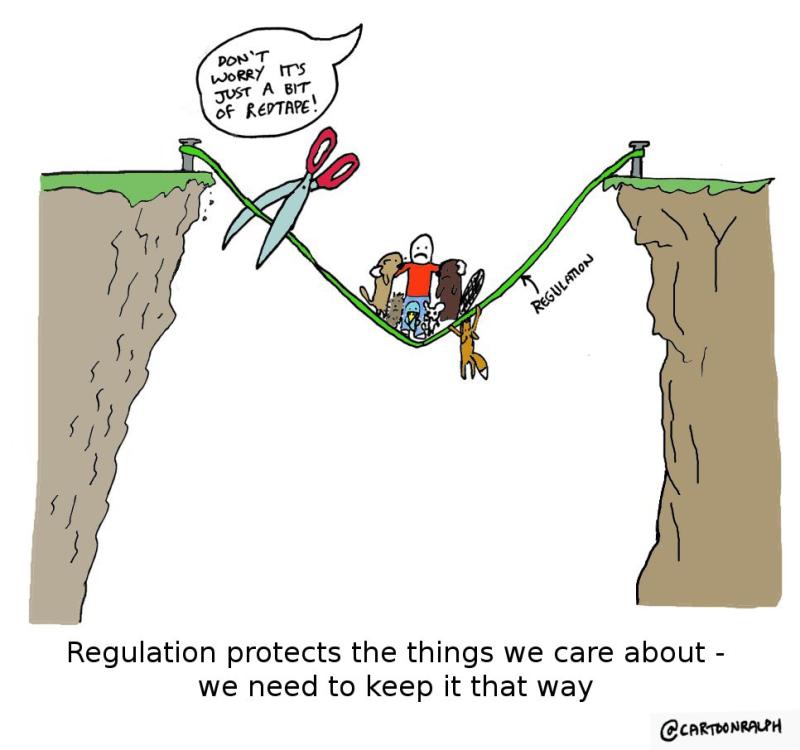
Cartoon by @CartoonRalph
4. Is the chemicals industry really struggling?
At the heart of the chemicals industry’s lobbying are arguments about high energy prices; about the so-called burden from regulation; and that it is facing intense competition from China, the US, and the Middle East where there have been recent investment in ‘crackers’ (industrial facilities which use extreme heat to break down petrochemicals into the building blocks of chemicals and plastics). By contrast, Europe’s crackers are said to be old, inefficient, and fading, while a number of plant closures have happened or are planned. However, the reasons for such closures are grounded in a changed economic environment rather than heavy regulatory burden. The plastics industry in particular, has now entered a phase where production capacity has overtaken demand growth, which entails a different set of problems than those raised by the industry.
Nevertheless a recent article by Table.Media indicated that the Commission was set to enable public handouts in one form or another, via the Chemicals Industry Action Plan. Ideas touted included subsidised industrial energy costs, while the renewal of steam crackers has also been talked up by Commission Vice-President Stéphane Séjourné. But considering that the EU chemicals industry has had several decades of substantial sales growth ‒ according to Eurostat, the EU’s trade surplus in chemicals and related products grew throughout the last 2 decades, from €55 billion in 2002 to €198 billion in 2023 ‒ providing plentiful opportunities to invest in cleaner, more efficient technology, and to reduce dependency on fossil fuels, which it has not properly taken, can the chemicals industry really justify these demands?
The NGO ChemSec has succinctly disputed the chemical industry’s narrative that it is struggling financially. It points out that after two decades of high profits the industry’s trajectory is now more in line with that of other industries; profit margins remain strong; and they are not cash-strapped if shareholder dividends are anything to go by. In September 2024 for example, BASF announced that it would allocate €12 billion in the 2025-28 period for shareholder dividends and share buybacks. It has already paid 41 per cent of its net profits back to shareholders in the 2010-23 period, a total of €39 billion, according to research by SOMO and Friends of the Earth Europe.
Meanwhile the chemicals industry is no stranger to public financial support. In the early COVID years, the European Central Bank bought bonds worth around €12.6 billion in the petrochemicals sector, while in the 2010-20 period, the European Investment Bank provided at least US$1 billion in direct financing to the petrochemicals sector.
But most importantly any discussion about the financial situation of the chemicals industry must always be contextualised by a look at the costs of chemical pollution that are imposed on the public purse. Taking just PFAS / forever chemicals, the costs of some health conditions related to PFAS exposure in Europe have been estimated at €52-84 billion per year, while the Forever Lobbying Project has estimated that environmental remediation in Europe could cost €100 billion a year in perpetuity. These figures do not cover the costs and consequences of pollution from many other harmful chemicals including the burden of disease and costs of exposure to endocrine disrupting chemicals in the EU, estimated to be €163 billion a year, or the costs to society of using pesticides.
In light of this, it is pretty shocking that the chemicals industry is going, cap in hand, to the Commission, for public funding for climate-busting or other problematic technologies, while at the same time demanding a roll-back on their health and environmental responsibilities. There is a severe risk now that the Commission will reward this industry for its past failures. It is especially worrying that the detoxification agenda, ie. industry commitments to move away from PFAS and other harmful chemicals are largely absent from the Clean Industrial Deal, and that there has been a marked decline in the Commission’s commitment towards achieving a toxic-free environment.
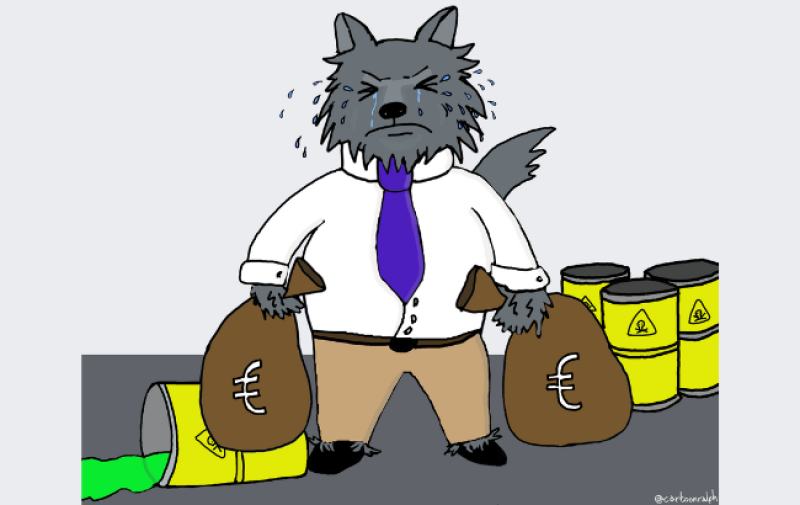
Cartoon by @CartoonRalph
5. How is all this being decided?
Outrageously the Commission is opting to push through its ‘competitiveness’ and ‘simplification’ agendas via the Clean Industrial Deal very quickly, with a heavy emphasis on securing industry input, presumably to justify its pre-determined direction of travel. This represents a rolling-back of democratic norms.
This year there have been two high-level “strategic dialogues” on chemicals, the first with Commission Vice-President Stéphane Séjourné and Environment Commissioner Jessika Roswall in late March 2025; and the second with President von der Leyen herself in May 2025. Both events were relatively small, invite-only affairs, but notable for how NGOs and trade unions were significantly outnumbered by industry voices.
Indeed it was only at the May 2025 event that von der Leyen announced that there would be a Chemicals Action Plan for the sector and a Chemicals Omnibus, giving only two months for the Commission to prepare the content of these announcements. So much for simplification and predictability. This flurry of pronouncements is being delivered in a ridiculously short space of time, without adequate scrutiny of the true impacts of what is being discussed. A case in point are the ‘reality check’ workshops on CLP and cosmetics as detailed above, which saw hundreds and hundreds of industry voices and only a handful or two of NGOs, debating biased concept notes, and taking part in flawed online polls. Follow-up written feedback had to be submitted within ten working days. As a result legislation which was agreed over a period of months and years looks set to be ripped up in a matter of weeks. And there is barely a ripple of public awareness about this process.
Moreover industry is even greedier in its demands for access to officials. The VCI has called for “the chemical and pharmaceutical industry [to] be involved in all activities to draft and shape the new chemicals industry package as well as proposals to simplify legislation and reduce administrative burdens”.
It appears that much of the drive for this reckless deregulation is coming from the top of the Commission with lower-ranking officials unaware of imminent announcements but having to then rapidly organise the deregulation processes. And while the stated beneficiaries of the Commission’s simplification agenda are supposed to be industry, AND regulatory authorities and citizens, the latter two groups appear to be all but forgotten in the rush to deliver what the chemicals industry wants, as fast as possible.


Screenshot of poll from Commission CLP “reality check” workshop, May 2025
6. Does the chemicals industry deserve support via the Chemicals Industry Action Plan and Omnibus?
It seems that the Commission is falling over itself to make announcements to please the huge chemicals industry lobby, no matter its heavy climate footprint, its legacy of producing harmful chemicals, and widespread failure to follow the existing rules. ClientEarth has pointed to a 2023 report by the EU chemicals agency which observed that 40 per cent of companies inspected failed to comply with their chemical authorisation duties under REACH, the highest rate ever observed. Infringements ranged from “the use of a chemical without authorisation to the failure to comply with the conditions attached to the authorisation”.
And what about the chemicals industry’s longstanding reputation for hyperbolic lobbying to weaken important regulations needed to protect health and environment? This lobbying is seriously problematic. Earlier this year the investigative journalism project Forever Lobbying (with which Corporate Europe Observatory collaborated) accused the plastics industry of presenting arguments to defend fluoropolymer PFAS which were “misleading, fearmongering, exaggerated, or potentially dishonest”. There are many other well-known examples of such hyperbolic industry lobbying such as that on endocrine disruptors, exporting banned toxic substances, keeping bee-killing pesticides on the market, to name just a few.
Liberally sprinkled throughout industry’s lobby demands are commitments to, and requests for support for, innovation. But is that innovation to benefit the short-term interests of the sector or innovation to benefit wider society and to secure sustainable jobs? Looking at the agenda above, the ‘innovations’ look set to focus on the former, rather than the latter.
The Commission should not reward fake solutions and demands for less regulation. And the detoxification of industry’s outputs must go hand in hand with real efforts to decarbonise the sector, and move towards zero pollution production processes. Any public support should be aimed at genuine efforts to reduce fossil fuel use, to become more energy efficient, to develop safe and sustainable replacements for today’s harmful chemicals, and crucially for a just transition for workers and communities. A real Clean Industrial Deal should reuse the worthy objectives of the Chemicals Strategy for Sustainability (CSS) and put the precautionary principle and the polluter pays principle at its heart.
But all the evidence indicates that instead we will see that the polluter gets rewarded as the chemicals industry becomes a major winner from the Commission’s ‘Dirty Industrial Deal’.
Take action here to support a toxic-free Europe!

Cartoon by @CartoonRalph
ZNetwork is funded solely through the generosity of its readers.
Donate




