

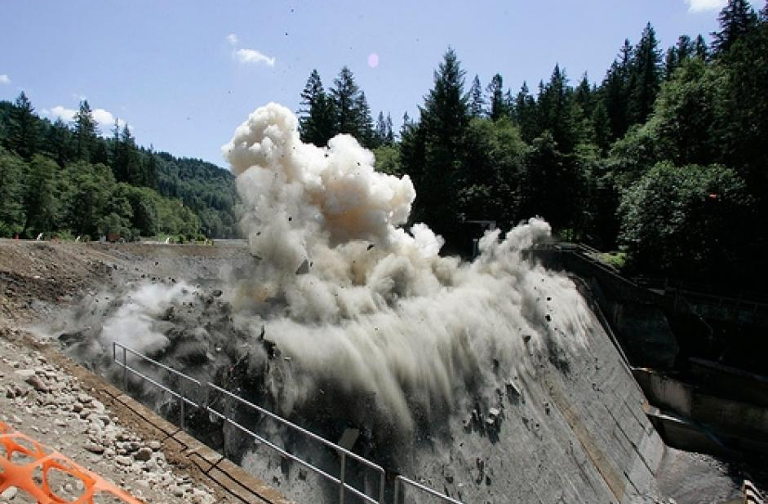
The 1999 demolition of the Edwards Dam on Maine’s Kennebec River set off a wave of dam removals across the United States. Since then some 1,200 dams have come down to help restore rivers and aquatic animals, improve water quality, and boost public safety — among other benefits.
Across the Atlantic, European nations have been busy removing thousands of river barriers, too. But until recently the efforts have gone largely unnoticed, even among experts.
Pao Fernández Garrido can attest to that.
An engineer and expert in ecosystem restoration from Spain, Fernández Garrido was finishing her master’s thesis in 2012 when she attend a dam-removal training in Massachusetts that was part of a conference on fish passage.
She was floored to learn about the United States’ widespread dam-removal efforts and returned to Europe determined to learn what was happening with dam removals on the continent — and to be a part of the action.
So did Herman Wanningen, a freshwater consultant from the Netherlands, who also attended the conference. Fernández Garrido joined him when he founded the World Fish Migration Foundation in 2014. Soon after they helped form a coalition organization called Dam Removal Europe that also includes European Rivers Network, WWF, Rewilding Europe, the Rivers Trust, Wetlands International and the Nature Conservancy.
One of the first things Fernández Garrido and her colleagues wanted to know was the extent of river fragmentation on the continent. That wasn’t easy: While the United States has an exhaustive inventory of its 90,000 dams, not every European country, they learned, had collected similar data.
At the time not much was known beyond the fact that Europe had 7,000 large dams. But as their project to map river barriers, known as AMBER, got underway, they learned the on-the-ground reality included many smaller dams and other barriers — at least 1.2 million river barriers in 36 European countries.
Fernández Garrido and her colleagues spent more than three years on research, including river surveys in 26 countries, to gather the more robust data. Their results, published in Nature in 2020, found that on average river barriers occur almost every half mile.
Two-thirds of these barriers are under seven feet tall, but small doesn’t mean insignificant. Low-head dams and smaller obstructions like weirs and sluices can still block the movement of some fish, as well as aquatic plants, invertebrates, and the flow of sediment and nutrients.
Many of the dams — around 150,000 — are also obsolete and no longer provide any beneficial functions.
The good news, though, is that they also found that 4,000 European river barriers had already come down in the previous 20 years, with France, Finland, Sweden, Spain and the United Kingdom being the most active.

These efforts, though, had largely flown under the radar.
“Nobody was talking about these, nobody,” says Fernández Garrido. “The United States is celebrating that it has removed 1,200 and nobody’s celebrating in Europe because nobody knows.”
That’s changed as they continued with their work to compile research, organize supporters across the continent, and push policymakers for action.
In 2019 the researchers delivered a report on case studies of dam removals and their benefits to the European Commission. The following year the World Fish Migration Foundation published the first-ever Living Planet Index on the global state of migratory fish. It found that migratory freshwater fish populations in Europe had dropped 93% since 1970, much higher than the already dismal global average of 76%.
The cumulative weight of those findings may have had a big impact on policy.
That same year the European Commission published its biodiversity strategy for 2030.
“For the first time ever in history, it stated that we should free at least 25,000 kilometers (15,500 miles) of river in Europe from barriers by 2030,” says Fernández Garrido.
While that was welcome news, it was still only a guideline — not legally binding.
In May 2022, however, the commission followed up with a proposal called the EU Nature Restoration Law. “In this law, they say we must start removing dams,” she says. And the proposed language calls for restoring 15,500 miles of river to a “free-flowing state by 2030.”
The European Parliament will need to ratify the law in the next couple of years. “In the meantime politicians could work to weaken it,” she says. “That’s why environmental groups are working hard to keep it strong.”
On the ground, the work to restore free-flowing rivers continues.
Last year 239 river barriers were removed in 17 European countries, including more than 100 in Spain. Finland is in the process of removing three hydroelectric dams on the Hiitolanjoki River, which will aid salmon populations. And France is home to the tallest dam removal on the continent yet, the 118-foot Vezins Dam on the Sélune River in Normandy, which was removed in 2020. Demolition began this summer on a second dam on the river, La Roche Qui Boit, which will allow the Sélune to run free for the first time in 100 years. Migratory fish populations like salmon are expected to return, and the dam removals will also reduce toxic algae that pooled in the warm waters of the reservoirs during summer.
Some of this work — and more — is showcased in a new documentary, #DamBusters, by director Francisco Campos-Lopez of Magen Entertainment. The film follows Fernández Garrido across Europe as she meets dam-removal heroes in Spain, France, Estonia, Lithuania and Finland.
“Restoring nature is probably the job of our time, our generation,” she says in the film.
But it’s a process that will also take time.
“There are some river systems, like for example in North America, where the benefits of dam removal are shocking and so amazing because that river system was only blocked for only 100 years,” she tells The Revelator. “But when you are talking about recovering our river systems in Europe that have been controlled and mismanaged for 500 years, 600 years, 1,000 years, we have to be cautious about what we expect.”
But even if ecological restoration comes more gradually, political movement has been swift.
“The progress since we started in 2016 until now — having policies proposed at the European level — it’s amazing,” Fernández Garrido says. “It’s really an achievement.”
The combination of research, policy reports, political pressure and movement-building have kickstarted a river restoration effort that shows no signs of slowing down — and could be a model for other regions.
ZNetwork is funded solely through the generosity of its readers.
Donate




