

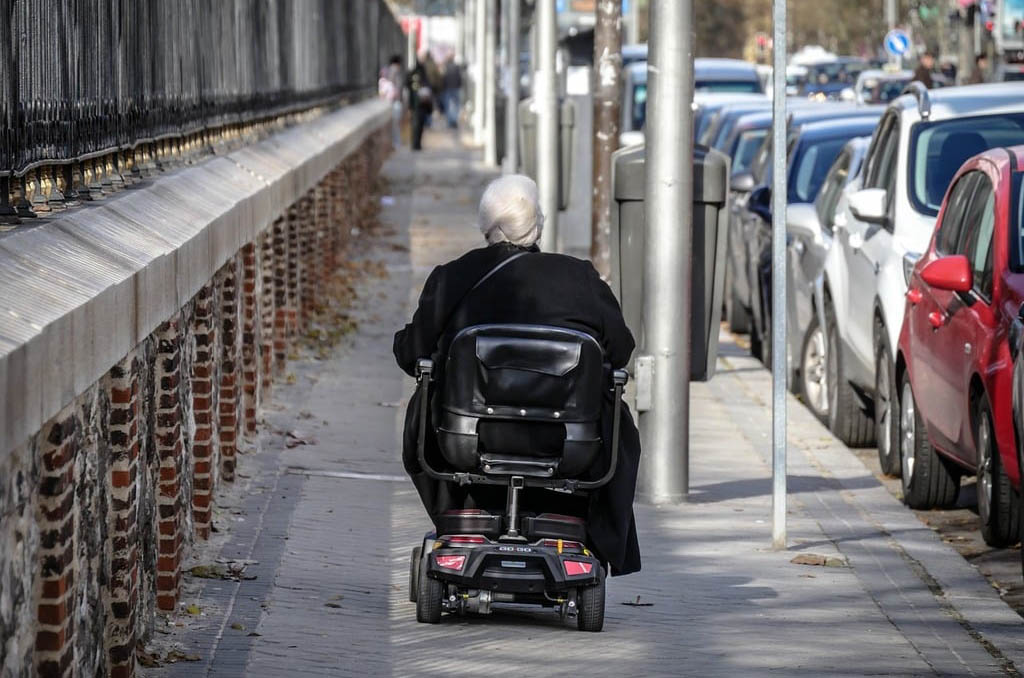
In forward-thinking municipalities across North America, elected officials and staff members can learn important lessons by taking on the Week Without Driving Challenge. As Anna Letitia Zivarts describes it, “participants have to try to get around for a week without driving. They can take transit, walk, roll, bike, or ask or pay for rides as they try to keep to their regular schedules ….”
In most municipalities, the challenge leads to a difficult but eye-opening week. That’s because in most areas getting around without driving is inconvenient, dangerous, very time-consuming, or next to impossible. As Zivarts writes,
“Even for participants who might already bike, walk or take transit for some of their weekly trips, we’ve heard that the experience has helped them comprehend the difference between taking the easy trips and taking all trips without driving.” (all quotes from When Driving Is Not An Option, Island Press, May 2024.)
Zivarts is a low-vision mom with the neurological condition nystagmus, and a wealth of information and insight about mobility. She started the Disabled Mobility Initiative in Washington state in 2020. “My first goal was making nondrivers visible,” she writes. “I was tired of hearing from elected leaders that ‘everyone’ in their communities drove, so spending more money on bus service or sidewalks just wasn’t necessary. I knew it wasn’t true ….”
In fact, many studies have shown that in most areas of the US, approximately 30% of residents do not drive. When Driving Is Not An Option makes clear that nondrivers are a varied group. Some don’t drive because they have a disability, some because they are too young to drive, some because they can’t afford to drive, some because they have entered the last seven to ten years of life during which an average American can no longer drive safely.
If transportation departments and urban planning staff do not include the voices of nondrivers, they are unlikely to develop policies and infrastructure that will reflect the needs of their whole communities.
In particular, Zivarts notes, planning departments must take care to listen to involuntary as well as voluntary nondrivers. She describes voluntary nondrivers as “people who have the financial resources, immigration status, and physical ability to own and drive a vehicle but choose not to.”
While she makes a strong case for a coalition that includes both voluntary and involuntary drivers, her book highlights “the expertise and lived experience … that comes from involuntary non-drivers, with an emphasis on the expertise of low-income, Black, Brown, immigrant, and disabled people, caregivers, and queer and trans people.” And she does a superb job of bringing us the insights from this wealth of expertise.
For much of my adult life I’ve been among the voluntary nondrivers. I have also had periods when due to disability I’ve been unable to drive, and as a senior I anticipate a time, coming soon, when I won’t be able to drive. But in recounting the experiences of the wide range of nondrivers she has worked with, Zivarts offers many perspectives that were new to me.
The problems and shortcomings – with existing infrastructure, municipal planning policies, traffic engineering standards, and university curricula for would-be planners and engineers – are manifold. Zivarts’ book is excellent in describing specific problems, and equally good at linking the issues of mobility justice to other struggles. So we learn about the connections between car-dependent transport policies and housing affordability, the inequitable distribution of environmental hazards, and the challenges of climate mitigation and adaptation.
The book’s subtitle is “steering away from car dependency”, and to accomplish that goal we need not just clear knowledge but also an effective coalition that draws on as many groups as possible. Zivarts quotes former Seattle mayor Mike McGinn:
“Politics runs on power, and those defending and benefiting from the status quo have power. Whether those directly benefiting from the billions spent on road expansion or those who have their transportation choices and convenience deeply subsidized, not just by dollars, but by the lost lives, lost health, and lost opportunity of those most damaged by overbuilt roads and pollution. To beat that kind of entrenched privilege and power takes more than white papers, it takes organizing.”
Zivarts lays out the stakes and the hope in a concluding paragraph that needs to be quoted in full:
“As the sky turns orange, the storms get stronger, and the waves higher, we are reminded of the immediacy of the threat and the moral prerogative to disrupt failed mobility and land use systems that are locking us into decades of carbon emissions. We also need to be reminded of the immediate daily and cumulative public health and environmental harms from tire dust, noise pollution, and traffic violence/enforcement, harms that wealthier, Whiter, nondisabled people are largely able to avoid. But those of us who can’t drive, because of disability, age, or income, see every day how automcobility is failing us. And we also believe that it must be changed. With our guidance, and a recognition of this leadership, we can and will create a different future.”
ZNetwork is funded solely through the generosity of its readers.
Donate
