

Another Layer Beneath the Flows
This article continues the argument developed in Empire Without Flags: Imperial Outreach and the Architecture of Structural Power. That first piece identified four dimensions of “Imperial Outreach”—financial, institutional, technological, and ideological—and examined the first two in detail: debt and capital markets on one side, and civil society funding and hegemony on the other. This article turns to a dimension that was identified but not yet examined in depth: the physical and digital infrastructure through which these flows themselves move.
If Part One asked who determines the terms of finance and consent, Part Two asks who controls the gates through which those terms move.
Sanctions can limit a country’s access to dollars. Credit ratings can raise its borrowing costs. Financial institutions can alter the terms on which credit is available. But none of these mechanisms, by themselves, moves a single container, delivers a barrel of oil from one port to another, transmits a data packet, or settles a payment. All depend on a physical and digital substrate: ports, shipping routes, straits, pipelines, submarine cables, data centers, and payment and messaging systems.
This infrastructure remains largely invisible in many accounts of imperial power—partly because it looks like ordinary commercial infrastructure rather than an instrument of statecraft, and partly because its ownership is deliberately distributed across states, private corporations, state-owned enterprises, investment funds, and multinational consortia. Yet this very dispersion can itself be part of the logic of power. Structural power does not have to be concentrated in a single state or institution. It can be distributed across networks of ownership, contracts, standards, and points of connection—and precisely for that reason, it can be less readily recognized as power.
A distinction must therefore be drawn between infrastructure and infrastructural power. A port is an economic facility. But when its position within the global trade network is such that disruption imposes costs far beyond its immediate geography, it becomes a site of power. A submarine cable is a communications technology. But when a substantial share of financial and commercial data passes through it, ownership or control of that cable is no longer merely a technical matter.
What matters, then, is not infrastructure in isolation but its structural position within the global network of flows. This is what the present article traces—from ports to cables to payment rails: not power over production, but power over circulation.
From this perspective, we can identify a concept essential to understanding contemporary imperialism: chokepoint power.
Chokepoint power arises from control over points through which flows of goods, energy, capital, or information must pass, or for which alternatives are severely limited. Such power does not require complete ownership of a network. Sometimes it is enough for an actor to possess the capacity to disrupt, restrict, make more expensive, or render insecure passage through a critical point.
This is where infrastructure becomes politics.
Who Controls the Gates?
Container ports are commonly described as chokepoints of global trade. What is less often recognized is that they can also become chokepoints of political influence—and the companies that operate them are rarely simply neutral logistics firms.
Jebel Ali Port, one of the world’s most important ports and the largest in the Middle East, is operated by DP World, a company owned by Dubai World, the investment arm of the Dubai government. DP World does not operate a single terminal; it controls a global network of ports and terminals, placing the Dubai government in a position to exercise influence over trade flows far beyond its immediate territory through a commercial enterprise.
Hong Kong’s terminals have historically been operated largely through Hutchison Port Holdings, a subsidiary of the Hong Kong-based CK Hutchison conglomerate, whose global port network has itself become an arena of geopolitical competition. The dispute over concessions for terminals associated with the Panama Canal offers a particularly clear illustration of the entanglement of capital, infrastructure, and great-power rivalry.
COSCO Shipping Ports, majority-owned by the Chinese state, has expanded its presence across terminals from Piraeus to Africa, in some cases through financing and projects associated with the Belt and Road Initiative. Singapore’s PSA International, likewise state-owned by the city-state, plays a central role in Southeast Asia’s maritime trade network.
What these companies share is not a common flag but a structural position. Each sits at the intersection between the strategic interests of a home state and a global logistics market over which no single state exercises full control.
But this relationship should not be oversimplified. Ownership of a port does not automatically constitute political domination, just as the presence of a foreign company at a terminal does not, by itself, constitute imperialism. What matters is the combination of ownership, geographic position, financial capacity, ties to the state, and the infrastructure’s position within the wider network. It is this combination that can transform an economic asset into a position of structural power.
That distinction is important beyond the specific cases discussed here. If every foreign investment is treated as imperialism, the concept loses its analytical value. The question is not simply who owns an asset, but what capacity that ownership creates within a wider structure of dependence and unequal power.
Chokepoints as Leverage: Hormuz and Bab al-Mandeb
If ports concentrate ownership, straits concentrate geography.
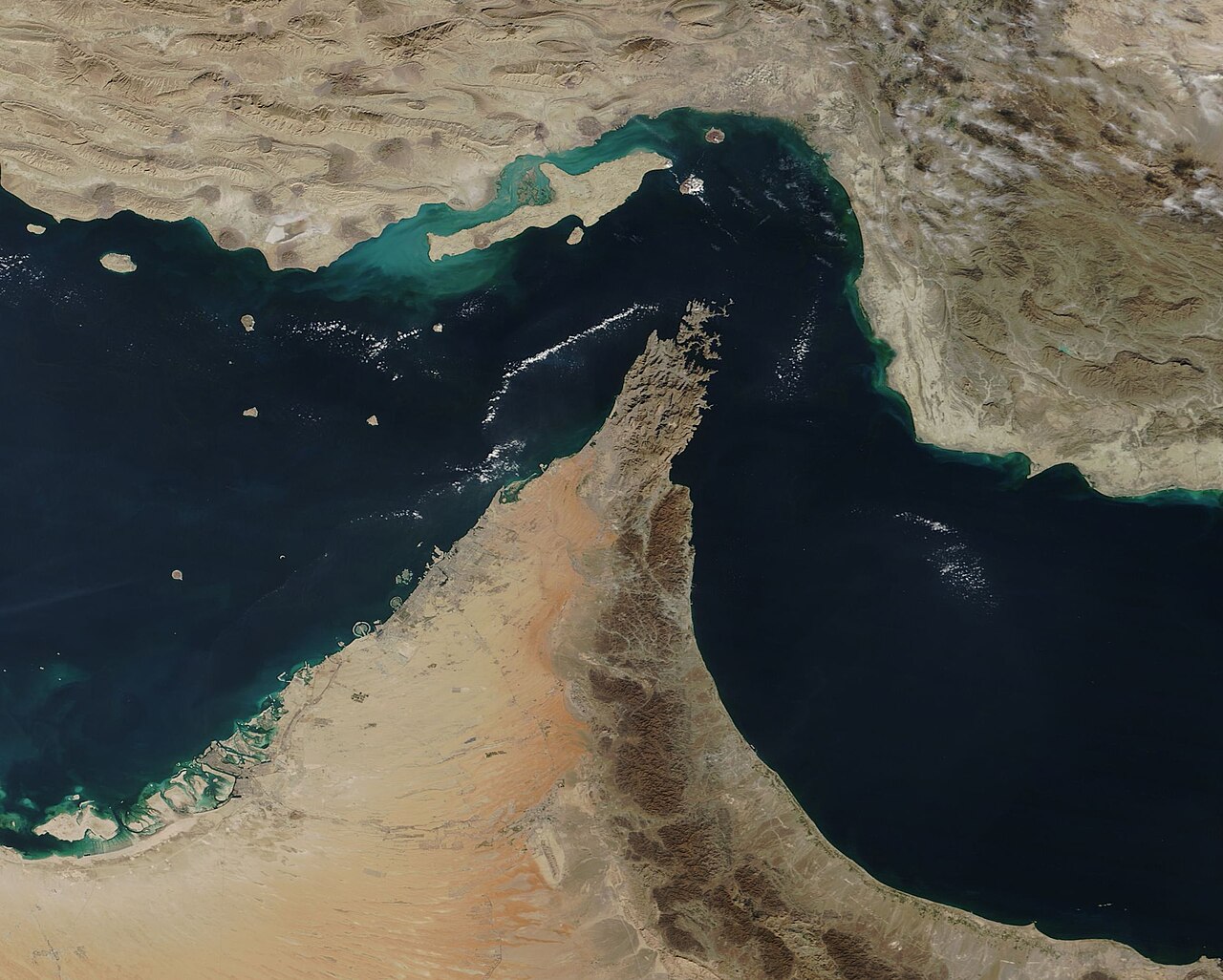
The Strait of Hormuz and the Bab al-Mandeb Strait sit at opposite ends of a single maritime corridor. Their significance lies not merely in the volume of energy and goods that passes through them, but in the way geography itself becomes a political lever at these points. A port can, under certain conditions, be substituted by another. A geographic chokepoint offers far fewer alternatives—and therefore makes the cost of disruption much higher.
By 2026, this logic is no longer merely theoretical. The war involving Iran, the United States, and Israel has transformed the Strait of Hormuz from a potential chokepoint into one of the most consequential sites of power in the global economy. Iran has severely restricted maritime passage through the strait, while the United States has imposed a naval blockade on Iran and sought to control maritime access to and from Iranian ports. By August, commercial traffic through Hormuz had fallen to a small fraction of its normal level; on August 20, only seven commodity vessels were recorded passing through the strait.
This situation illustrates the theoretical significance of chokepoints with unusual clarity. Power here does not arise from territorial conquest. It arises from the capacity to control circulation.
Iran does not need to occupy another country to exert pressure on the global economy. It needs only to restrict passage through one of the world’s most important energy corridors. The United States, likewise, does not need to occupy Iranian ports to exert pressure on Iran’s economy. A naval blockade and control over maritime access can perform part of the same function.
Hormuz has therefore become more than an example of chokepoint power. It is now a site where two different forms of chokepoint power confront one another: Iran’s capacity to restrict passage through a geographically indispensable corridor, and the United States’ capacity to restrict Iran’s maritime access to the global trading system.
The same logic appears differently at Bab al-Mandeb. In July 2026, the Houthis announced a naval blockade against Saudi Arabia and targeted vessels associated with the kingdom. Saudi-linked tankers subsequently turned back from the Red Sea, while attacks and escalating fighting along the coast increased pressure on the maritime corridor.
Yet here too, the distinction between disruption and absolute control matters. Shipping through Bab al-Mandeb has fallen sharply, but it has not ceased entirely. Recent tracking data still recorded vessels passing through the strait.
This is theoretically important because chokepoint power does not require total closure.
An actor may be unable to shut a route completely while still making it sufficiently insecure, costly, or unpredictable to alter the behavior of others. That alone can reroute ships, raise insurance premiums, increase transit times, and disrupt supply chains. Chokepoint power often derives not from the capacity to close a route absolutely, but from the capacity to make continued passage uncertain.
The recent decision by major Chinese state-owned shipping companies to keep oil tankers away from both Hormuz and Bab al-Mandeb illustrates this mechanism particularly well. Even a major commercial power cannot simply ignore a chokepoint once the risks of passage become high enough.
This also changes how the American military presence in the region should be understood. It cannot be explained solely through the traditional language of “defending allies.” Fleets, bases, and naval operations are part of a broader struggle over who has the capacity to interrupt circulation, who can restore it, and who ultimately determines the cost of disruption.
Here the financial dimension of Part One and the infrastructural dimension of Part Two meet directly. Sanctions can exclude a country from financial networks. But if that country can create leverage at a critical point in the physical network through which global trade moves, it retains a degree of bargaining power. Iran’s position at Hormuz is therefore not merely a geographic advantage. Under conditions of sanctions and war, it becomes a geopolitical asset.
The maritime conflicts of the Persian Gulf, the Gulf of Oman, and the Red Sea should consequently not be read simply as a series of disconnected crises. They are manifestations of a broader structural struggle over the arteries through which capital, energy, and goods circulate.
Cables and Data Centers: The Invisible Layer
If ports and straits move the physical economy, submarine cables carry a large part of the information economy: financial transactions, commercial and diplomatic communications, cloud services, and the ordinary circulation of digital life.
Ownership of this layer has shifted noticeably over the past decade. Cable consortia once dominated by national telecommunications carriers have increasingly been joined—and in some cases displaced in new projects—by a small number of technology companies that build, finance, or partially own transoceanic cables, despite having little to do with telecommunications policy as such.
The logic behind their interest in owning the physical layer rather than simply leasing capacity is straightforward: ownership reduces dependence on carriers and regulators that might otherwise determine the terms of access.
But the political significance of cables lies in more than ownership. The digital economy, like the physical economy, has chokepoints. If goods move through ports and straits, data moves through cables, data centers, and communications networks. The same principle therefore applies to information as to oil and goods: wherever flows become concentrated, the possibility of exercising power over those flows increases.
Data centers concentrate the same logic in physical space. Because storing and processing data domestically can often be more expensive and less efficient than relying on large, specialized facilities, a small number of jurisdictions host a disproportionate share of the infrastructure on which other economies depend.
A state seeking genuine sovereignty over its data therefore faces a difficult choice: either absorb the substantial cost of building parallel infrastructure, or continue to depend on infrastructure over which it does not exercise full control.
This is where the technological dimension of Imperial Outreach intersects with chokepoint power. Power no longer necessarily takes the form of a direct command issued by a single government. It can arise from the simple fact that large parts of the world depend on a limited number of companies, networks, and points of connection for access to essential technical infrastructure.
Payment Rails: SWIFT, CIPS, and the Search for an Exit
Part One explained how sanctions restrict Iran’s access to the dollar-based financial system. But the infrastructure that makes such exclusion operational deserves attention in its own right.
SWIFT, the messaging network through which banks transmit instructions for cross-border payments, is legally a Belgian cooperative governed by its member banks. Yet its exposure to pressure from US and European sanctions regimes has meant that, on several occasions, it has effectively become part of the machinery of financial exclusion—most notably in the disconnection of Iranian banks and, later, some Russian banks.
The issue here is not simply a particular company or technical network. Once a network becomes dominant infrastructure, dependence upon it can become a point of political leverage. Under normal conditions, dependence on a common network creates efficiency and economic advantage. Under geopolitical crisis, the same dependence can become a vulnerability.
China’s CIPS system was developed partly in response to this vulnerability, providing an alternative channel for payment messaging and settlement that is less exposed to Western sanctions authority. Its growth has been real, but it has not yet produced a fully autonomous financial infrastructure. Significant portions of international transactions involving CIPS remain connected to existing global financial networks.
CIPS should therefore be understood less as a complete exit than as an attempt to reduce vulnerability to a dominant point of control.
Iran and Russia have likewise pursued expanded non-dollar trade and alternative settlement mechanisms. Their significance lies less in the extent to which they have displaced the dollar system than in what their development reveals: when states experience dependence on a particular infrastructure as a strategic vulnerability, they attempt to construct alternative points of connection.
Competition over payment infrastructure is therefore part of a broader competition over the architecture of global flows. The question is not simply who possesses the most capital. It is who determines the channels through which money moves, who is permitted to transfer it, and who possesses the capacity to exclude another actor from the network.
Chokepoint Power and Its Limits
None of this means that every instance of infrastructure ownership constitutes domination, or that every chokepoint can be transformed indefinitely into an instrument of power.
The same caution that was necessary in Part One regarding financial and institutional power applies here. China’s expansion into ports, cables, and payment systems does not place it outside global capitalism. It is part of a competition for position within that system. Host states are rarely passive recipients of infrastructure imposed from outside. Dubai and Singapore, for example, have built substantial parts of their development strategies around becoming indispensable nodes within these networks, and their ruling elites derive both revenue and political leverage from that position.
Nor does infrastructural leverage necessarily produce the political outcome intended by the actor exercising it. The Houthis have increased the cost and risk of Red Sea shipping through attacks and threats, but that does not amount to absolute control over Bab al-Mandeb. Passage has declined, yet it continues.
Hormuz is equally complex. Iran has severely disrupted normal maritime traffic, while the United States has sought through its blockade to restrict movement to and from Iranian ports. Yet neither side possesses absolute control over the entire regional maritime system. Limited transit, alternative routes, ship-to-ship transfers, and rerouting remain possible. Chinese shipping companies have responded not by abandoning trade altogether but by shifting vessels and cargoes toward alternative routes and methods.
This has a broader theoretical significance.
Chokepoint power is relational power, not absolute power.
The value of a chokepoint depends on the degree to which others depend upon it. But the actor controlling the chokepoint is usually embedded in the same network it seeks to manipulate. Iran depends on oil revenues and maritime trade. Saudi Arabia depends on energy exports and access to global markets. China depends heavily on energy imports. The United States itself depends on the stability of the global network it seeks to police.
Chokepoints are therefore simultaneously sources of power and sources of vulnerability.
That contradiction is essential to any analysis of contemporary imperialism. Structural power is neither held by a completely autonomous center nor imposed upon a completely passive periphery. Every actor is embedded in networks of dependence, but the capacity to exploit those dependencies is profoundly unequal.
This is also why infrastructure should not be confused with imperialism itself. Infrastructure creates capacities. It does not determine how those capacities are used, nor does every asymmetrical relationship generated by infrastructure amount to an imperial relationship. The question is whether control over a node or network becomes part of a broader and reproducible asymmetry in the conditions under which another society produces, circulates, and reproduces itself.
That distinction will become decisive in Part Three.
Why Wars Today Take This Form
If the recent maritime conflicts in the Persian Gulf, the Gulf of Oman, and the Red Sea are read from this perspective, their meaning changes.
These are not merely confrontations over territory or ideology. They are struggles over the physical and digital arteries through which capital, energy, goods, and information circulate: the ports where cargo is loaded and unloaded, the straits that turn maritime routes into chokepoints, the cables that carry financial and communications data, and the payment systems that enable money to move.
The sanctions and hegemonic institutions examined in Part One explain how influence is exercised through the financial and institutional architecture of global capitalism. Part Two shows what that power requires in order to operate: infrastructure, routes, chokepoints, and points of connection.
If Part One was about power over the terms of entry into the system, Part Two is about power over the terms of movement within it—the distinction stated at the beginning of this article: not power over production, but power over circulation.
Yet this is still not the whole story.
Control over infrastructure is not, by itself, imperialism. Infrastructure is a condition of power, not its complete explanation. The question of what transforms infrastructural capacity into a durable relationship of imperial domination is therefore left open here—and it is the question Part Three will address.
If Part Two asks who controls the gates of circulation, Part Three asks who sets the rules governing passage through those gates, and who ultimately extracts value from them.
From this perspective, ports, chokepoints, cables, and payment rails are not merely infrastructure of global capitalism. They are sites at which relations of power become visible.
Empire Without Flags governs less through territory than through flows—and its power becomes most visible where those flows can no longer move freely.
Empires no longer necessarily need governors and garrisons. They need terminal operators, shipping companies, cable consortia, data centers, and messaging networks; and when these prove insufficient, they need a fleet close enough to remind everyone of what ultimately stands behind these networks.
ZNetwork is funded solely through the generosity of its readers.
Donate




