

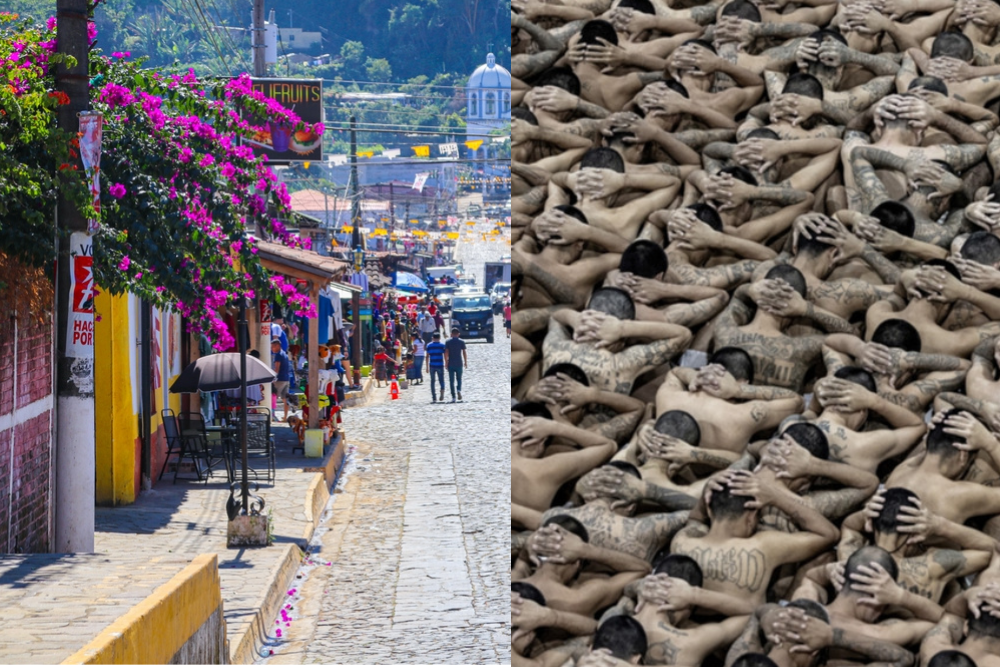
While El Salvador’s government promotes its countries’ beaches, volcanoes, and safe streets in gentrified neighborhoods, thousands of Salvadoran families are denouncing arbitrary detentions and seeking justice for relatives imprisoned under President Nayib Bukele’s extended state of emergency.
The contrast is stark: the country welcomes tourists with open arms while ruthlessly imprisoning its own people, drawing widespread international criticism for human rights abuses.
May 18 marked one year since the arbitrary arrest of attorney Ruth López, head of the anti-corruption unit at the organization Cristosal, in a clear attempt to silence voices critical of the regime. She remains in prison despite the government’s earlier statement that her “provisional arrest” would last six months.
Hundreds of organizations around the world have demanded Ruth’s unconditional release, given the total lack of evidence against her. “Authoritarians love corruption and fear accountability,” said Rep. Jamie Raskin, a U.S. Democratic congressman and staunch critic of Donald Trump. “The arrest of long-time human rights defender Ruth López is another chilling attack on democracy by Bukele’s regime. Free Ruth NOW.”
Margaret Satterthwaite, the United Nations Special Rapporteur on the Independence of Judges and Lawyers, stated that Ruth López does not have full access to legal representation and that her arrest suggests a pattern of repression against civil society — and in particular against those who advocate for government accountability.
Indeed, Cristosal reports that in El Salvador, tens of thousands of people have been arbitrarily detained under the state of emergency and that “civic space has been drastically reduced, and many journalists, human rights defenders, and civil society organizations can no longer operate safely in the country.” In July 2025, Cristosal was forced to relocate its operations outside of El Salvador following an increase in repression.
Ruth López’s arrest took place in the context of the passage of the Foreign Agents Law — approved without debate in the Legislative Assembly — just two days after her arrest.The law imposes a 30 percent tax on foreign economic aid and creates numerous obstacles to the official registration of civil society organizations.
Lopez is far from the only human rights defender who’s been targeted.
The Committee for Solidarity with El Salvador in Mexico notes that “it has been two years since the arrest of nine civil war veterans — from both the army and the guerrillas, who joined forces in 2020 to form the National Alliance for Peace in El Salvador — as well as Luis Menjívar, a college student and communications volunteer for the group.” For years, they helped organize peaceful protests to denounce the Bukele administration’s attacks on democracy and human rights, as well as its trampling of the Peace Accords signed in Mexico in 1992.
The government has also reversed the country’s historic ban on toxic gold mining, won after a long struggle, and targeted opponents of mining for persecution.
El Salvador led the world in 2017 when its legislature voted unanimously to pass a law that prohibits metal mining in the country. Public opinion polls conducted in 2007, 2015, and 2024 showed that more than 60 percent of the Salvadoran population opposes mining in order to preserve the water in their rivers. Despite this public opposition, the legislature — controlled by President Bukele — passed a new mining law in December 2024 that opens the country to mining without environmental protections.
International Allies against Mining in El Salvador support the majority view of the Salvadoran people that mining in El Salvador would exacerbate conditions in a country already grappling with high population density, water scarcity, deforestation, and pollution. They call on U.S. corporations and other foreign companies not to invest in a country whose government is accused of torture in its prisons and denies its citizens — such as Ruth López — the right to due process.
However, the Bukele administration continues to ignore human rights concerns and presses on with its promotional campaign: “El Salvador continues to break records in tourism, thanks to the policies and initiatives that have been promoted in recent years, marked by enormous progress in the area of security… which is attracting the attention of the entire world, ” the government claims.
Mexico is one of El Salvador’s top five trading partners and sources of investment. The application of the Estrada Doctrine of non-intervention is understandable. But in this case, it is not a matter of intervening; rather, the Mexican government should exert all possible diplomatic pressure to defend human rights in a sister nation and to ensure compliance with the Peace Accords signed at Chapultepec Castle in 1992.
An earlier, Spanish-language version of this piece was published by La Jornada.
ZNetwork is funded solely through the generosity of its readers.
Donate
