

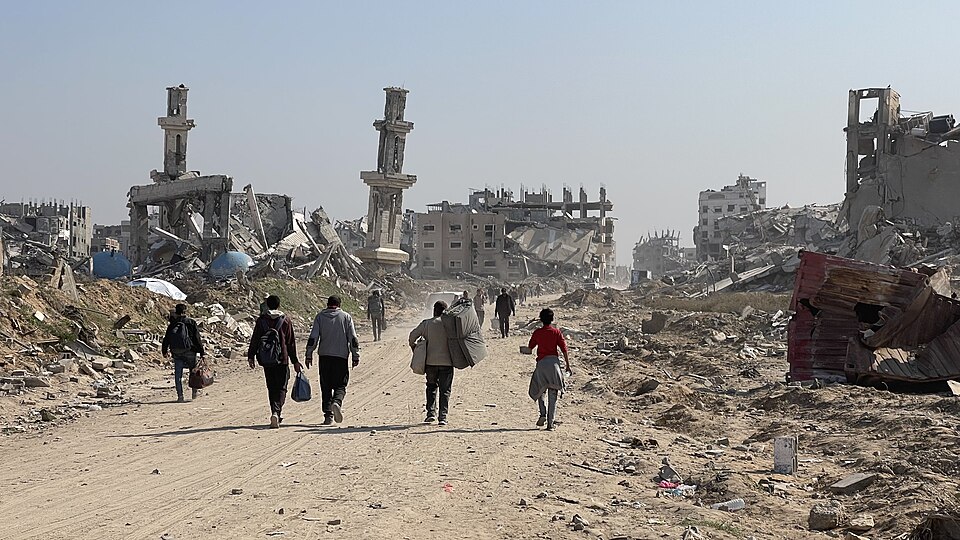
Let’s be done with the pretence of decency and soggy references to just resolution in the face of extreme circumstances. Be done with the hilarious stage acts of referring to legal doctrines that either do not exist or cannot exist in the bloodied context they are being forced to refer to. The State of Israel is intent, with every arm, administrative faculty and office bearer of consequence, to achieve ethnic effacing and utopic bliss with the removal of Palestinians from Gaza and the West Bank, with the former going first.
Speaking on September 2 at a conference organised by the Israeli newspaper Yedioth Ahronoth, the Israeli Defence Minister Israel Katz returned to a theme so rapidly hardening it is likely to ossify at any given moment: that a Gaza filled with Palestinians is not a tenable proposition from the perspective of his country’s interests. Whatever dubious tag is attached – immigration, migration, or depopulation – the current populace could simply not remain. “In the end, there is no real solution for Gaza without this migration.” The emigration of Palestinians would take place “by any means” (“by sea, by air, by every way possible”), the process having only been put on ice by US President Donald Trump.
It had been one of those moments of mental arrest, but Trump engendered a sharp frisson in the ranks of the Netanyahu government with his February 2025 proposal to relocate the residents of Gaza. Once done, developers and builders could come in and turn the strip into a tourist destination replete with the vulgar fripperies typical of such resorts. By October 2025, Trump’s peace plan envisaged something else; the relocation-development scheme seemed to have not so much stalled as died in its sleep, with the promise that the residents could stay and engage in the process of rebuilding the devastated territory. Point 12 of the plan is explicit on this: “No one will be forced to leave Gaza, and those who wish to leave will be free to do so and free to return. We will encourage people to stay and offer them the opportunity to build a better Gaza.” Not so, according to Katz. “The [depopulation] plan hasn’t been cancelled; it is being discussed all the time, even now, and I think there is no other solution for everyone’s good.”
When asked when this odious object might be facilitated, Katz airily suggested that the conduct of Hamas could be the catalyst, notably “when it becomes clear that [it] is not fulfilling its commitment[s]” under US peace plans. “Then we will get a green light to advance militarily, territorially, and in other areas as well.”
During a visit to an IDF post close to the Yellow Line demarcating Israel’s area of control from the rest of the Strip, Prime Minister Benjamin Netanyahu declared his firm intentions. “We are not withdrawing,” he stated in a video message distributed by his office. “We are staying on this line. We control 60% of the Strip. And there is still more to come, because we are eliminating the terrorists who threaten us – we do this day in and day out.”
Gallingly, Katz had the temerity to suggest that the Gazans wished to leave – some 80% – making passing reference to vague, unsubstantiated surveys that had been conducted by Israeli authorities. (It’s always curious how the rabidly patriotic always assume that no other group can cling, so desperately and tenaciously, to a strip of land, whatever the cost.) If only other countries were willing to accept those apparently willing residents of Gaza, the problems would vanish. “Hamas isn’t allowing them [to leave], and there are no countries in the world taking them in. President Trump put the issue on the agenda. Now every country needs to take people in – and that’s the big issue.”
This deplorable language, condemned by US Democratic Senator for Maryland Chris Van Hollen, received a boost of patriotic umami from Israel’s National Security Minister Itamar Ben-Gvir. The minister tends to make a habit of going to prisons to gloat about their ruinous conditions, all the time threatening Palestinian inmates with impending death, ensuring the deprivation of basic human rights (they, the reasoning goes, do not deserve them) while encouraging the inexorable de facto annexation of the West Bank. On September 3, he also advanced his oxymoronic version of a “voluntary emigration” plan dubbed “Disengagement 710”, a nod to Israel’s exit from Gaza in 2005 and the Hamas attacks of October 7, 2023.
The plan entails the removal of 250,000 Gazans in the first year, 1.11 million within three years and 1.86 million within seven. A sinister “Emigration Ministry” will oversee the process. “Instead of [Gazans] digging tunnels, it’s time to pack suitcases,” reasoned Ben-Gvir. To sweeten the abuse, emigrants would receive an “absorption package” comprising “assistance with travel, initial housing, vocational training, employment and support for up to 24 months”. Payments would also be made to recipient States.
In his remarks, Ben-Gvir also had room to draw inspiration from Trump. Ignoring the Gaza Peace Plan, the minister preferred to focus on the President’s initial proposal to “encourage emigration [as] a solution to the Gaza issue.” From being “treated as a delusional extremist”, he mused about his own standing, plans of removing Palestinians had “become legitimate. Suddenly, everyone became Ben-Gvir.”
The second part of the Palestinian eradication program involves the full assertion of sovereign control over the West Bank, though the process there is necessarily staggered, a form of slow-motion extermination of a culture and people that is taking place before an international law system petrified and mostly silent. So far, things are coming along nicely – from the settlers’ perspective. They are the spear carrying proxies for an ethnic cleansing regime. The Israeli authorities have their backs and, when they do intervene to curb any zeal, a mild slap on the wrist is the best to expect. The consistently promoted narrative is that the more violent perpetrators are errant buffoons with a death wish yet sporting a good heart, buffoons in good standing with the broader annexation drive that has been approved by the Knesset in a non-binding motion.
A word, to finish off, on the very euphemistic term “ethnic cleansing”. To say cleansing is a ghastly concession to the supposed wickedness of impurity. Something needs rinsing, the stains need removal. This application of ideological detergent assumes that there is something deficient or suspect in a race, an ethnicity or a religious group, a people, in short. It follows that what is happening to the Palestinians is ethnic in nature and not so much cleansing as eradicative.
ZNetwork is funded solely through the generosity of its readers.
Donate




