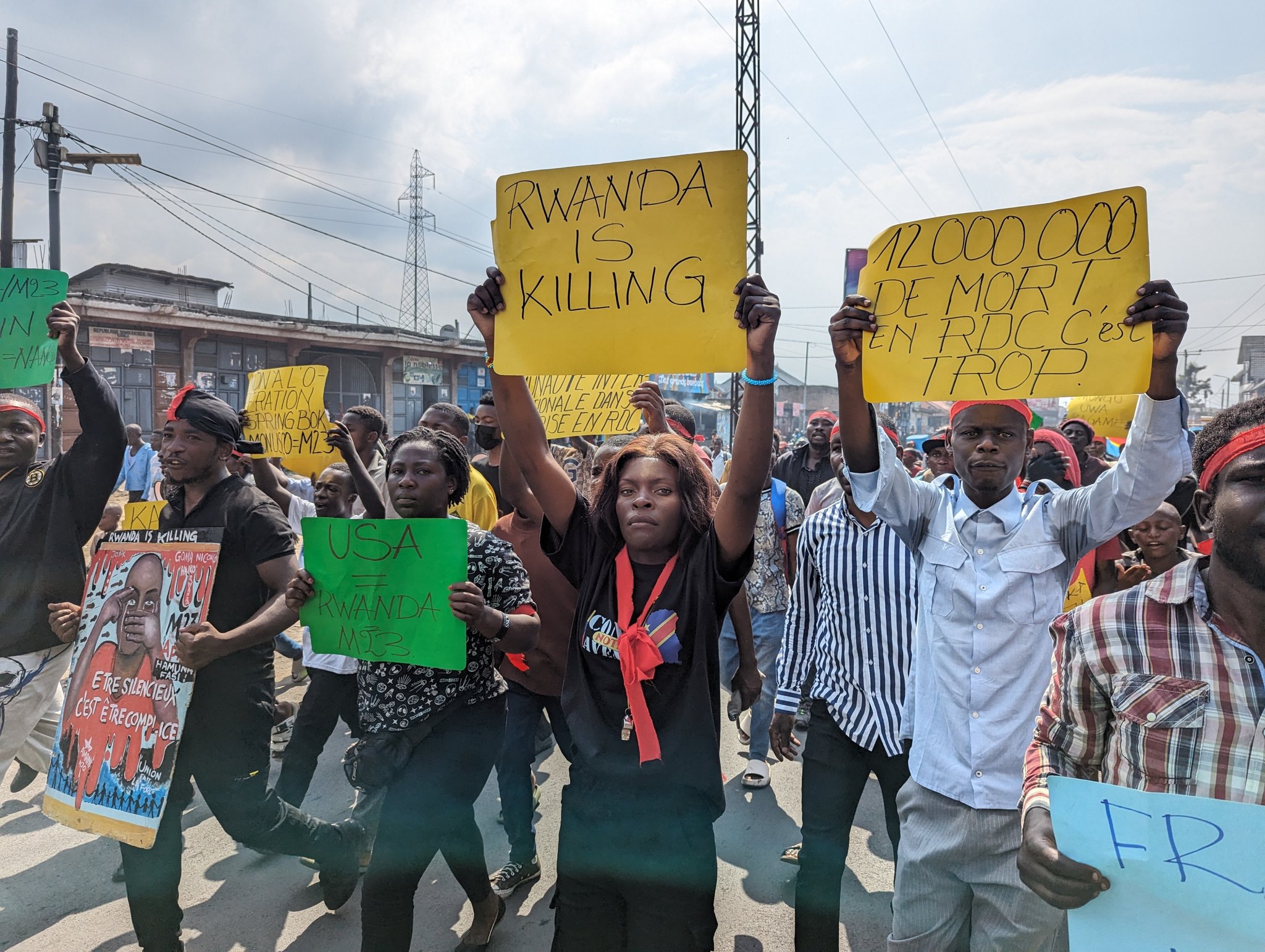
Source: African Arguments

I write on behalf of all the women of the Democratic Republic of Congo (DRC). We women who are bearing the brunt of a war we did not start; a war we do not want; a war in which our children’s futures are being stolen.

Eight million people displaced. 23 million hungry and at risk of famine. We are witnessing the destruction and dehumanisation of an entire people. The sheer scale of the horror defies logic.

This brutal war is couched as a battle for ‘sovereignty’ between ‘nation states’, ‘armed groups’, ‘militias’ – but these terms ignore the real lives of the innocents – women, children and the elderly – who are paying the heaviest price.

As Southern African Development Community (SADC) leaders meet this weekend at the 44th Ordinary Summit of heads of state in Harare, I want to remind them that protecting our people is SADC’s raison d’etre.

The regional bloc’s commitment to ‘human security’ means SADC must be driven by the need to alleviate human suffering.

Protecting its people is SADC’s raison d’etre. Peace is the foundation for future development. The devastation in the DRC has the potential to reverberate not only across the African continent but across the globe.

We know that the war is fuelled in part by a competition for access to the vast mineral wealth of the region. The plundering of minerals by armed groups is fuelled by global demand for the resources found in north-eastern Congo, where the conflict is most concentrated. These minerals are essential to the manufacture of the microprocessors used in our laptops, telephones, aeroplanes, weapons and electric batteries – products the consumer world cannot live without, and which are vital to the global economy.

No country has the right to impose suffering on another to continue with impunity to steal resources. This theft and plunder fuels hatred. Hate speech sows the seeds of genocide, far from the spectre of media attention.

This hate speech fuels the dangerous myth that Congolese Tutsi and Hutu people are at odds, when in reality these are brothers and sisters who have lived alongside each other peacefully for generations.

Putting an end to this war could lead the countries of the region towards civilised cooperation, a future of sustainable development and harmonious cohesion among the region’s peoples.

SADC can – and must – take the lead in elevating the conversation from the rhetoric of ethnic nationalism to one of future togetherness.

Curbing this xenophobic and divisive language is the first responsibility of leaders who must show a firm intolerance for hate speech – most especially given the tragic history of this region. We know all too well how devastating unchecked hate can be.

And now in DRC it is the millions of faceless, nameless innocents who suffer. Rape is almost a normalised weapon of war. Not only do women suffer the extreme indignity of rape, sexual violence and exploitation (with no psychological or other support, the bare minimum of medical attention and no access to justice) they have the compounded burden of having to endure the suffering of their children and families.

Close to 9 million people need essential and critical access to healthcare. Women are more likely to give birth on the grounds of a hospital than in a hospital.

Communities are destroyed as people flee, land is left untilled, crops to feed the hungry not grown. Women and girls turn to prostitution to stave off hunger.  Even so, famine looms.

Children have no chance of attending school, their dreams are being stolen, along with the very future of the nation.

The more this aggression progresses, the more the number of victims increases; sexual violence increases every day, and children do not study. With that the Congolese people move further away from any hopes of economic development. In turn, other countries will suffer the pressure of displaced people and the risk of destabilising their own economies.

SADC’s arrival brought hope to the Congolese, but they must be careful not to stand by and watch this slaughter and suffering. SADC cannot allow that to happen. It is the very essence of the mission – the raison d’être – that is being undermined.


This article was originally published by African Arguments; please consider supporting the original publication, and read the original version at the link above.

Julienne Lusenge is a Congolese human-rights defender, and social activist. She is the co-founded SOFEPADI, which works to prevent sexual and gender-based violence, to support and empower survivors, and to help them rebuild their lives. She is also on the board of the U.N. Voluntary Fund for Victims of Torture. In 2023, the U.N. recognized Julienne’s far-reaching impact with the United Nations Prize in the Field of Human Rights. She is on the Times 100 most influential people of 2024. Other awards include - Lauréate avec mention Honneur du prix Félix Houphouët Boigny-UNESCO – 2023 ; Lauréate du prix Aurora*2021* ; *Lauréate du prix PremiICIP*2021* ; *Lauréate du prix Femmes de Courage*2021* ; *Lauréate du prix international des Droits des Femmes Geneva Summit*2018* ; *Lauréate Prix Ginetta Sagan*2016* ; *Chevalier de la Légion d'honneur/France*2013*


ZNetwork is funded solely through the generosity of its readers.

Donate
Donate
Leave A Reply

Subscribe

All the latest from Z, directly to your inbox.

Institute for Social and Cultural Communications, Inc. is a 501(c)3 non-profit.

Our EIN# is #22-2959506. Your donation is tax-deductible to the extent allowable by law.

We do not accept funding from advertising or corporate sponsors.  We rely on donors like you to do our work.

ZNetwork: Left News, Analysis, Vision & Strategy

THE WIND CRIES FREEDOM

The Wind Cries Freedom, the new book from Z co-founder Michael Albert, is a sweeping oral history of a future American revolution.

Through thirty interconnected chapters, it draws out the strategies, failures, turning points, and hard-won wisdom of a movement that called itself the Revolutionary Participatory Society. These are not the polished memoirs of politicians: they are the unfiltered accounts of people who organized in neighborhoods, hospitals, universities, stadiums, courthouses, and places of worship, and kept a shared vision alive through cynicism and exhaustion.

The result is speculative political fiction that reads like history: messy, human, and quietly hopeful in the way that only real experience and long thought can produce.

Get your copy and peruse more features on the book’s website below.

“Read it, argue with it, but don’t look away. The future it recalls is one we must still fight to deserve.”

Yanis Varoufakis

“The most unusual and intriguing combination of prophecy, manifesto, and movement building manual that I have ever encountered.”

Bill Fletcher Junior

“This work fills a huge gap in our social movement literature.”

Cynthia Peters

Subscribe

All the latest from Z, directly to your inbox.

This is your article this month.

We’re glad you keep coming back. If Z’s work has informed, challenged, or inspired you, that’s no accident: there are no paywalls, no ads, and no billionaire owners here, and there never will be. Independent media survives because readers choose to support it.

Billionaires fund their own media. We fund ours. Help us reach 1,000 sustaining donors:

Number of donors693
Our goal1,000

Sustainers at $9/month or more receive the digital Z Magazine.

Already a sustainer? Click here and we won’t ask again. Thank you!

Your reading count is stored only in your browser and is never sent to us.

Sound is muted by default.  Tap 🔊 for the full experience

CRITICAL ACTION

Critical Action is a longtime friend of Z and a music and storytelling project grounded in liberation, solidarity, and resistance to authoritarian power. Through music, narrative, and multimedia, the project engages the same political realities and movement traditions that guide and motivate Z’s work.

If this project resonates with you, you can learn more about it and find ways to support the work using the link below.

Independent media is not disappearing because the ideas are weak.

It is disappearing because platforms reward speed, outrage, and algorithmic visibility over thoughtful analysis.

More than 100,000 people read Z every month, free of paywalls, ads, and billionaire owners. It takes fewer than 1 in 100 of them to fund all of it: 1,000 donors who keep Z independent, for everyone, and build what comes next.

Number of donors693
Our goal1,000

Sustainers at $9/month or more receive the digital Z Magazine.

Subscribe

Join the Z Community – receive event invites, announcements, a Weekly Digest, and opportunities to engage.

OUT NOW: "The Wind Cries Freedom" by Michael Albert

Exit mobile version

