

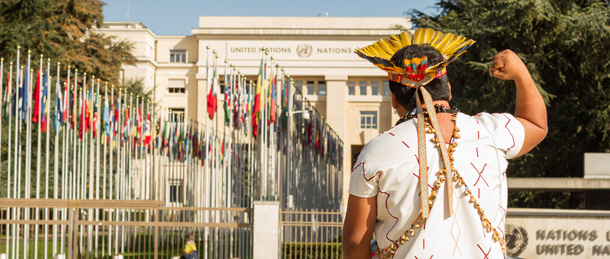
England’s legendary Dr. Samuel Johnson once observed that nothing concentrates the mind so much as the prospect of an imminent hanging. On the international level, we can say that nothing concentrates the minds of nations so much as the prospect of war or of war itself.
Such was the case with World War I. The conflict left between 10-20 million dead. Understandably, the survivors sought to reform the international system in order to prevent another catastrophic war.
The result? The League of Nations, the world’s first genuine collective-security organization. Unfortunately, it failed to prevent the next world war, a product of fascist aggression. The ensuing conflict left more than 50 million dead. No wonder that many statesmen resolved to create an improved League.
The USA had not joined the League in 1920 and the USSR had been expelled during the interwar years. Without these great powers, the League’s collective-security promise had been fatally crippled.
Anticipating the defeat of the Axis powers in 1945, the US and its allies, including the USSR, created a new and improved collective-security organization—the United Nations. It differed from the old League in two important ways. First, the US and the USSR, the two new superpowers, would be members. Secondly, the UN would recognize a reality that had escaped the League’s architects: namely, that great powers must have more influence than smaller states. The UN would have a General Assembly with universal membership, and a smaller Security Council with an absolute veto given to the five Great Powers (the US. USSR, UK, France, and China) on all matters of war and peace.
Make no mistake. Without the veto, the USSR and USA would not have joined the UN. The Americans initially opposed giving the Soviets a veto, but quickly recognized that it would also serve Washington’s interests. The British, French, and Chinese happily joined the veto club.
However, the law of unforeseen consequences sabotaged their hopes for an effective UN. As the Cold War emerged from the rubble of World War II, the Soviets and the US would use the veto in ways that rendered the UN largely impotent. Instead of preventing what the UN Charter called “the scourge of war,” the veto—indeed, even the threat of a veto—left the UN as an ineffective tabby cat. Consequently, the organization never lived up to its promise. It stood on the sidelines during virtually all conflicts that had Cold War overtones including Vietnam and Afghanistan. One of our best early Cold War history books, a volume of over 500 pages, barely mentions the UN.
Moreover, the “problem” of the veto is related to another important development. The 50 nations that comprised the organization in 1945 ballooned to 193 today. Colonies became independent states, many demanding not just a voice in UN affairs, but a seat on the Security Council. And a few demanded the right to veto resolutions. Although the General Assembly after 1945 had expanded by a factor of four, the size of the Security Council increased only slightly and the number of states possessing the veto not at all.
Can the UN be reformed in a way to increase its effectiveness?
This would require two things:
1) limiting the use of the veto. The Soviets used the veto about 120 times during the organization’s first quarter century, the US about 80 times since then.
2) a more representative Security Council. There have been many proposals along these lines, all involving expansion of its membership. However, the five permanent members (the P5) possessing the veto can use their veto to block expansion if it threatens to reduce their own influence. Will any one of the five agree to expand the Council in the interests of fairness to other major powers, say, Japan, Germany, Brazil, or India? To date, the answer is no.
All this is further complicated by how new Council seats, if created, will be delegated. Asians want those new seats. Africans want them. So do Latin Americans. Likewise Arab nations demanding at least one permanent seat for their own. Moreover, many former colonial countries want to reduce the number of European seats on the Council by, say, eliminating British and French Council membership in favor of a single vote for the European Union. However, the Charter authorizes Council membership only for states so that organizations like the EU, African Union, or the G-20 are left out in the cold.
Reform therefore won’t come easy. Russia, with its eyes on Ukraine (a UN member) will surely protect its own right to veto. Likewise, China which claims that its relationship with Taiwan (not a UN member) is a domestic issue and therefore must remain free of UN consideration. Nor has the US shown an inkling of interest in weakening its veto as it ignored and therefore undermined UN authority when conducting war against Serbia (2000) and Iraq (2003).
And yet reform is not out of the question. Wars have a way of altering not only the physical landscape, but the political landscape. The concept of collective security hardly existed in 1914. American participation in a universal political organization seemed a pipe dream in 1941. The next war, perhaps growing out of the so-far limited Russia-Ukraine conflict, may open possibilities that today are yet inconceivable. If instability–much less chaos and catastrophe–threaten the veto powers, they may reject the status quo and understand that a world organization with the ability to prevent war makes more sense than a narrow and nationalistic commitment to traditional sovereignty. In that case, the UN may begin to live up to its original promise.
~~~~~~~~~`
This article is syndicated by PeaceVoice.
Gary B. Ostrower, Ph.D., is an Alfred University historian and author of several books about the UN and the League of Nations.
ZNetwork is funded solely through the generosity of its readers.
Donate




